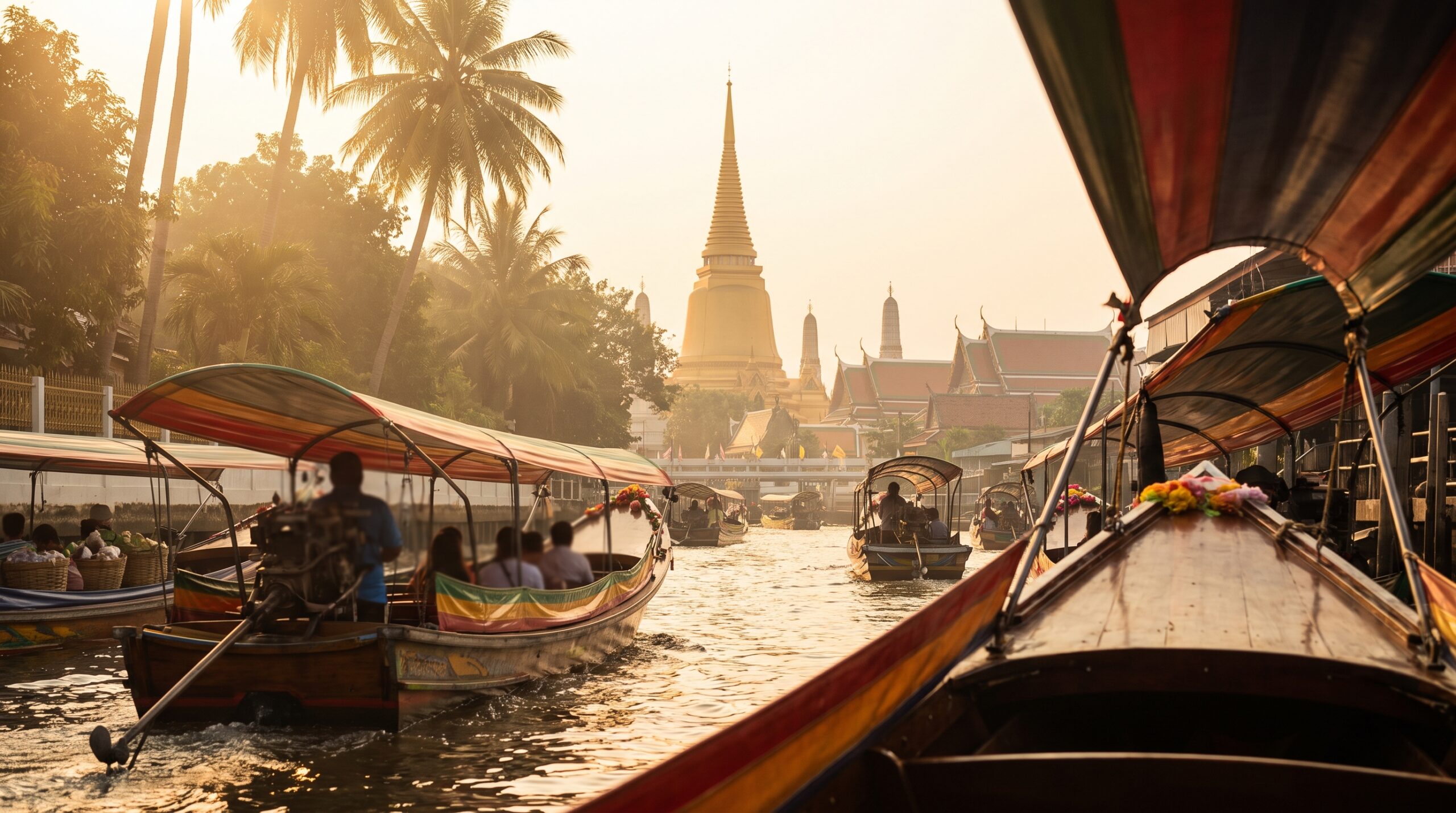
Bangkok is the better base if you have one week or less, want urban energy, or plan to fly onward within Southeast Asia. Chiang Mai is the better base if you want walkable scale, lower costs, and access to mountains and craft culture — but you will sacrifice big-city variety and direct international connections.
Thailand poses a base-city question that fewer travelers ask than they should. Most first-timers default to Bangkok, spend three days, then flee to an island. But for anyone building a Thailand itinerary around more than beaches — food, temples, craft markets, day trips, regional access — the Bangkok-or-Chiang-Mai decision shapes the entire trip. They are not two versions of the same thing. They are different trips.
What Separates Bangkok and Chiang Mai in Practice
The gap is not just size. It is pace, purpose, and what “a good day” looks like.
Bangkok operates at metropolitan scale. It has more temples, more markets, more hotel categories, more Michelin-starred rooms, more flight connections, and more traffic than any other city in Southeast Asia. A day in Bangkok means negotiating distance: a temple visit, a rooftop drink, and a dinner booking can span three neighborhoods and two hours of transit. Bangkok rewards energy and planning.
Chiang Mai operates at provincial scale. The Old City is a one-square-mile moated grid you can walk across in twenty minutes. The food scene is more street-level than fine-dining. The mountains start where the city ends. A day in Chiang Mai typically holds two activities, not six, and that is the point. It rewards slowing down.
The Framework: Which City Fits Which Trip
Use this as a decision grid, not a ranking. One city is not better. One city is better for your specific trip.
Go to Bangkok if:
- Your trip is 5-7 days total and you want maximum density of food, culture, and markets without a second flight
- You are connecting onward within Southeast Asia — Bangkok is the regional hub, and repositioning through Chiang Mai costs a half-day each way
- You want luxury hotel variety: Bangkok has more five-star properties across more categories (see our Four Seasons vs. Mandarin Oriental Bangkok for more) (river palaces, skyline towers, garden resorts) than any city in the region
- You care about fine dining — Bangkok has more Michelin-starred restaurants than Chiang Mai has restaurants with tablecloths
- Nightlife matters: rooftop bars, jazz clubs, late-night street food — Bangkok has the infrastructure for evenings that end at 4 a.m.
Go to Chiang Mai if:
- Your trip is 10+ days and you want a slower base with day-trip depth into mountains, elephant sanctuaries, and craft villages
- You prioritize walkability and human-scale streets — Chiang Mai’s Old City is one of the most navigable historic cores in Asia
- Cost matters: Chiang Mai hotels, food, and transport run 30-50% below Bangkok equivalents at the same quality tier
- You want craft and maker culture: ceramics, textiles, silverwork, woodcarving — Chiang Mai is Thailand’s artisan capital, and the workshops are not performances for tourists
- You are a digital nomad or slow traveler and need a city where a month costs less than a week in Bangkok’s riverside hotels
Do both if:
- You have 12+ days and can budget a half-day transit between them — the domestic flight is 70 minutes, and the contrast makes both cities sharper. Start in Bangkok for energy and logistics, end in Chiang Mai for decompression.
Weather and Seasonality: The Variable That Overrides Everything
Both cities share Thailand’s three-season pattern, but the experience diverges sharply.
November through February (cool/dry): The prime window for both. Bangkok is merely warm instead of oppressive. Chiang Mai mornings can drop to 14°C — jacket weather by Thai standards. This is peak season for both, but Chiang Mai’s smaller hotel stock means its best properties book out earlier. Book 6-8 weeks ahead for Chiang Mai, 3-4 for Bangkok.
March through May (hot): This is where they separate. Bangkok becomes punishing — 36-40°C with humidity that makes walking between temples actively unpleasant. Chiang Mai’s heat is drier, and its altitude (310m) buys 2-3°C of relief. But March-April is also burning season in the north: agricultural burning across northern Thailand, Myanmar, and Laos sends Chiang Mai’s air quality into hazardous territory. If you visit Chiang Mai in March or April without checking AQI data, you may spend your trip indoors. Bangkok has poor air too, but it is less seasonal and less severe.
June through October (rainy): Bangkok floods — literally. Streets turn into canals during heavy downpours, and the humidity is relentless. Chiang Mai gets rain but drains faster due to the terrain. However, mountain day trips become muddier and some trails close. The green season is underrated for Chiang Mai: prices drop, crowds vanish, and the landscape is at its most lush.
Day Trips: What You Can Reach From Each Base
From Bangkok: Ayutthaya (ancient capital, 90 minutes by train), Kanchanaburi (River Kwai, Erawan waterfalls, 2.5 hours), Damnoen Saduak or Amphawa floating markets (90 minutes), and the Gulf islands (Koh Samet in 3 hours door-to-door). Bangkok’s day-trip radius is deep but requires transport logistics.
From Chiang Mai: Doi Suthep temple (30 minutes), Doi Inthanon National Park (Thailand’s highest peak, 2 hours), Mae Rim Valley (elephant sanctuaries, botanical gardens, 45 minutes), sticky waterfalls at Bua Thong (90 minutes), and the Chiang Dao caves (90 minutes). Chiang Mai’s day-trip radius is tighter, greener, and more about nature than history.
Checklist: Bangkok vs. Chiang Mai Decision
- Trip length: under 7 days — Bangkok. Over 10 days — Chiang Mai or both.
- Regional connections: need to fly onward? Bangkok is the hub.
- Budget sensitivity: Chiang Mai runs 30-50% less at comparable quality.
- Season: March-April — avoid Chiang Mai unless AQI data says otherwise. July-October — Chiang Mai’s green season is a quieter, greener value.
- Walkability priority: Chiang Mai’s Old City is walkable. Bangkok demands taxis, tuk-tuks, or the BTS/MRT.
- Food priority: fine dining — Bangkok. Street food and regional Lanna cuisine — Chiang Mai.
- Luxury hotels: Bangkok has more range, more riverfront palaces, more brand flags.
- Craft and maker culture: Chiang Mai is Thailand’s artisan capital; Bangkok has weekend markets but not the same workshop density.
What This Can’t Tell You
This framework assumes a standard leisure trip with cultural and food interests. It does not account for beach destinations, which require a third flight (see our Bali in 2026 for more) from either city. It does not cover visa run logistics or long-stay retirement planning. And it cannot forecast burning-season AQI — check the data two weeks before booking.
Verdict
Bangkok and Chiang Mai are not competitors. They are complements. If you can only visit one, pick based on trip length and season: short trip or regional hub needs — Bangkok. Longer trip, lower budget, or mountain access — Chiang Mai. If you have twelve days, do both in sequence: Bangkok first for intensity, Chiang Mai second to decompress. The contrast is the point.
FAQ
Q: Is Chiang Mai safe for solo travelers?
A: Yes. Chiang Mai has lower crime rates than Bangkok, a more navigable layout, and a large expat and digital-nomad community that normalizes solo travel. Standard precautions around late-night alleys and unlicensed transport apply in both cities.
Q: How many days do I need in each city?
A: Bangkok: 3-4 days for the core temples, markets, and food neighborhoods. Chiang Mai: 4-5 days for Old City exploration plus two day trips. If doing both, budget 8-10 days across the two cities plus a half-day for the connecting flight.
Q: Is the food in Chiang Mai as good as Bangkok?
A: Different, not worse. Bangkok has more range — street food, fine dining, every regional Thai cuisine under one roof. Chiang Mai specializes in Lanna (northern Thai) cuisine: khao soi, sai ua sausage, nam prik noom. Chiang Mai also has an underrated cafe and specialty-coffee scene that rivals any city in the region.
Q: Do I need to speak Thai in either city?
A: No. Both cities have enough English in tourist-facing businesses. Chiang Mai’s expat density means more English-speaking service staff than you might expect. Learning “hello” and “thank you” is appreciated but not required for navigation.
Q: Is the burning season really that bad in Chiang Mai?
A: Yes, in March and April. AQI readings routinely exceed 150-200 during burning season, which is hazardous for prolonged outdoor exposure. If you have respiratory issues, avoid northern Thailand entirely from late February through mid-April. The rest of the year, Chiang Mai’s air is fine.