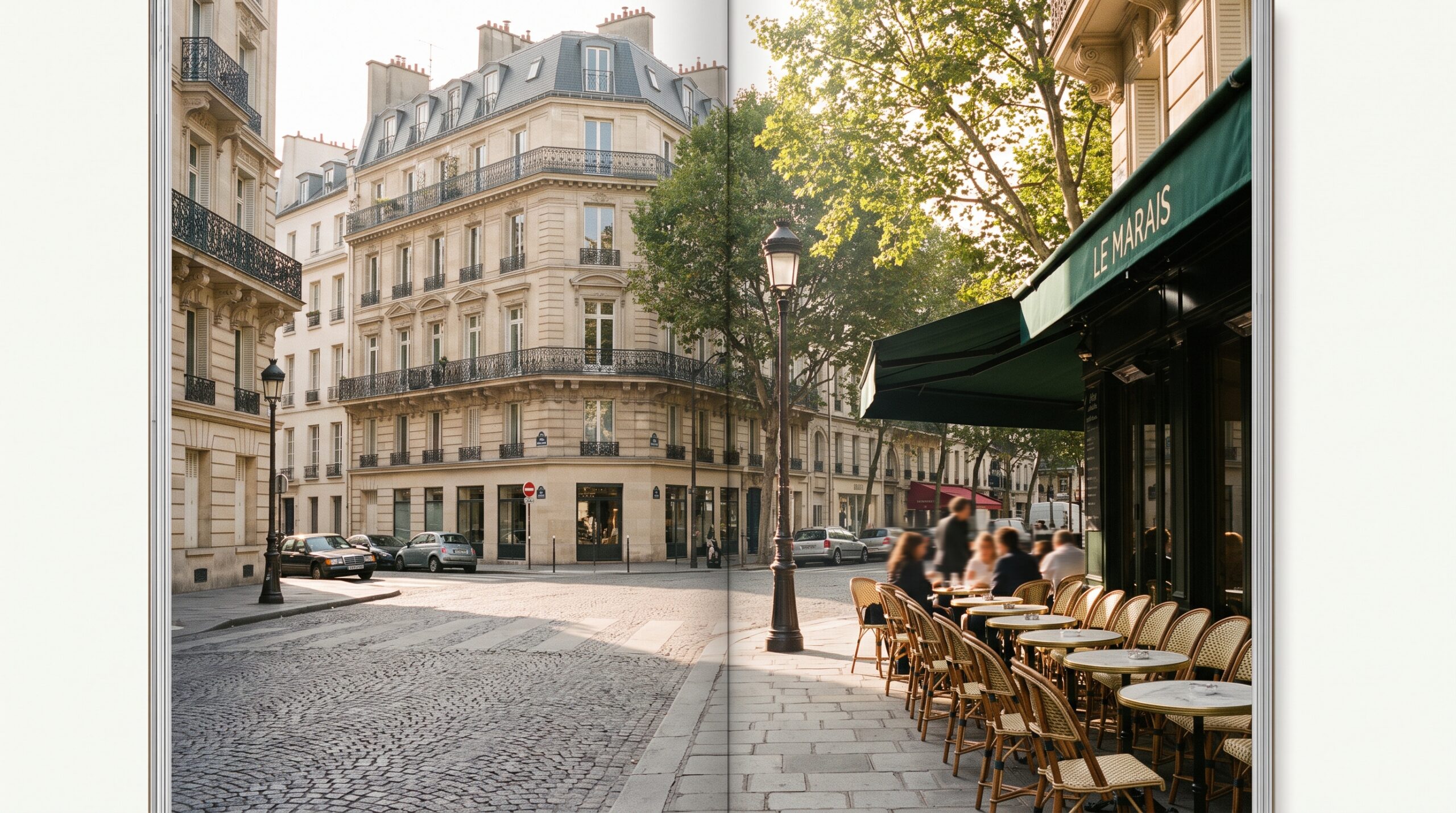
Paris delivers if you skip peak summer, book tickets in advance, stay in the right arrondissement, and treat walking neighborhoods as the main event — not standing in queues for monuments. Disappointment comes from visiting in August, staying too far out, and expecting the city to arrange itself around you.
Paris is the most-visited city in the world and, without preparation, one of the most likely to underwhelm. The gap between the postcard version and the lived experience is real: crowds, pricing, and the city’s indifference to tourists who have not done their homework. This is not a warning to avoid Paris. It is an instruction manual for when it works and when it does not.
The Expectation Gap: What Paris Promises vs. What It Actually Delivers
Paris does not set out to charm you. Unlike cities that perform hospitality — Tokyo, Lisbon, Bangkok — Paris performs itself. The beauty is genuine. The architecture, the food, the Seine at dusk, the way light moves through Haussmann’s boulevards: none of this is exaggerated. But the experience is mediated by crowds, queues, tourist-targeted pricing, and a city rhythm that rewards insiders and punishes the unprepared.
The gap is about 60% earned and 40% unfair. The earned part: inflated cafe bills near Notre-Dame, bracelet scammers at Sacre-Coeur, RER pickpockets, tourist-trap restaurants serving defrosted coq au vin. The unfair part is that Paris is objectively magnificent once you know where to be and when, and the people are not hostile — they are reserved in a way that reads as cold to cultures that default to warmth with strangers.
When to Go: The Variable That Determines Everything
Best overall: April through June and September through October. Mild weather (15-22°C), blooming parks in spring, cultural season in fall, hotel rates 20-35% below July-August peaks. Late April to mid-May and mid-September to mid-October are the consensus sweet spots across multiple guidebooks and traveler data [1][2].
Best single month: September. Similar weather to August, roughly 25% lower hotel prices, fewer tourists, the rentree culturelle brings new exhibitions and performances.
Best for budget: Mid-January through late February, or mid-November. Hotels 40-60% below summer rates, flights roughly 30% off. Cool (4-10°C) and shorter daylight, but museums stay open with negligible queues. You will see Paris, not a crowd.
Avoid: July and August. Hotel prices peak at roughly 42% above February rates, roughly 30% of central shops close between mid-July and mid-August, metro platforms can hit 38°C, and only lines M1 and M14 are air-conditioned. December holiday weeks are also expensive and heavily booked.
Where to Stay: The Arrondissement Decision
Paris is twenty villages stitched together. Where you sleep determines your trip.
1st Arrondissement (Louvre/Tuileries): Ultra-central, walkable to most first-timer landmarks, excellent metro access. Best for short trips where proximity matters. Expensive and touristy — you will hear more English than French on the street.
4th Arrondissement (Le Marais): The consensus top pick for first-timers. Historic, boutique charm, dense with cafes and small museums, immediate “Paris” feel. The Marais balances central access with neighborhood character better than any other arrondissement [3].
5th Arrondissement (Latin Quarter): Student energy, more affordable food, lively without being overwhelming. Good for budget travelers who still want Left Bank location.
6th Arrondissement (Saint-Germain-des-Pres): Classic Parisian elegance, sidewalk cafes, iconic streetscape. Best for travelers who want the postcard version and can pay for it. Good for families.
18th Arrondissement (Montmartre): Village feel, more affordable, but further from central sights. If you stay here, stay in the upper part near Sacre-Coeur — the lower slopes near Pigalle are a different experience entirely.
What You Need to Know About Scams and Practical Traps
Paris is Europe’s most-scammed city for tourists. Knowing the playbook eliminates most of the friction [4].
Friendship bracelet scam (Sacre-Coeur stairs): Someone grabs your wrist, starts weaving a string bracelet, then demands EUR 20-30. Keep hands in pockets and walk past without engagement.
Gold ring trick (Seine bridges, Trocadero): Someone “finds” a ring near you and asks if it is yours. When you say no, they offer it to you and demand payment. Walk away.
Petition/clipboard scam: Usually young women with a “deaf-mute” petition. While you read it, a partner picks your pocket. Do not engage.
Fake taxis: An organized fraud ring overcharged tourists an estimated EUR 680,000 before being broken up. Use only licensed taxis with a displayed license number and meter, or use Uber, Bolt, or G7. Never accept an unlicensed driver at an airport or train station.
Restaurant markup near landmarks: Cafes and brasseries within 200 meters of Notre-Dame and the Eiffel Tower regularly inflate prices. Walk five minutes inland and check the menu before sitting.
Checklist: Paris Without the Disappointment
- Visit April-June or September-October. If forced into summer, book everything in advance and budget for heat.
- Stay in the 3rd, 4th, 5th, or 6th arrondissement for first-timer walkability.
- Book Louvre and Eiffel Tower tickets online before arriving. The Louvre caps daily visitors.
- Notre-Dame is free but requires a timed reservation (book online).
- Walk the neighborhoods. The Seine banks, the Marais, the Latin Quarter — this is the real Paris, and it costs nothing.
- Eat at bouillons (traditional affordable Parisian restaurants) for solid meals at EUR 15-25.
- Skip going up the Eiffel Tower. The view from the Trocadero esplanade and the Champ de Mars is better than the view from the tower itself.
- Do not engage with anyone offering you a bracelet, a petition, or a found ring. Walk past.
- Use the Metro — it is excellent, cheap, and everywhere. Buy a Navigo Easy card.
- Do not try to see everything. Pick four things and leave room for wandering. Paris is a city you experience, not a checklist you complete.
What This Can’t Tell You
This framework covers practical trip quality, not whether Paris will move you emotionally. That depends on your expectations, your tolerance for urban density, and whether you arrive in the right season. It also does not cover day trips (Versailles, Giverny, Champagne), which add logistics and require their own planning. And it cannot predict 2026-specific events — the Olympics hangover pricing may persist longer than historical data suggests.
Verdict
Paris is worth visiting once, on the right terms: off-peak, centrally based, ticket-prepared, and scam-aware. Do not visit in summer unless you have no choice. Do not try to complete a monument checklist — prioritize walking and eating. Paris rewards the traveler who treats it as a neighborhood city, not an attraction city. If you approach it as a collection of queues to be suffered through, it will confirm every worst thing you have heard.
FAQ
Q: Is Paris safe?
A: Yes, in terms of violent crime. Petty theft and scams are the real risks, concentrated around major landmarks and transit hubs. Standard urban precautions — bag awareness on the Metro, no wallets in back pockets — eliminate most exposure.
Q: Do I need to speak French?
A: No, but starting interactions with “Bonjour” and learning “merci,” “s’il vous plait,” and “l’addition” meaningfully changes the quality of service. Parisians are not hostile to English. They are hostile to being addressed in English without acknowledgment that you are in France.
Q: How many days do I need?
A: Four full days for a first visit that covers the major landmarks plus neighborhood wandering. Five to six days if you want a day trip to Versailles or Giverny.
Q: Is Paris really that expensive?
A: Accommodation near the center is expensive. Food can be reasonable — EUR 16 for a lunch formule at a neighborhood bistro, EUR 2 for a croissant, EUR 25-35 for a solid dinner outside the landmark zones. The city is cheaper to eat well in than London or Zurich.
Q: Can I visit Paris and London in the same trip?
A: Yes, and the Eurostar makes it a 2-hour 15-minute connection between city centers. But each city deserves at least four days. Trying to do both in a week means shortchanging both.