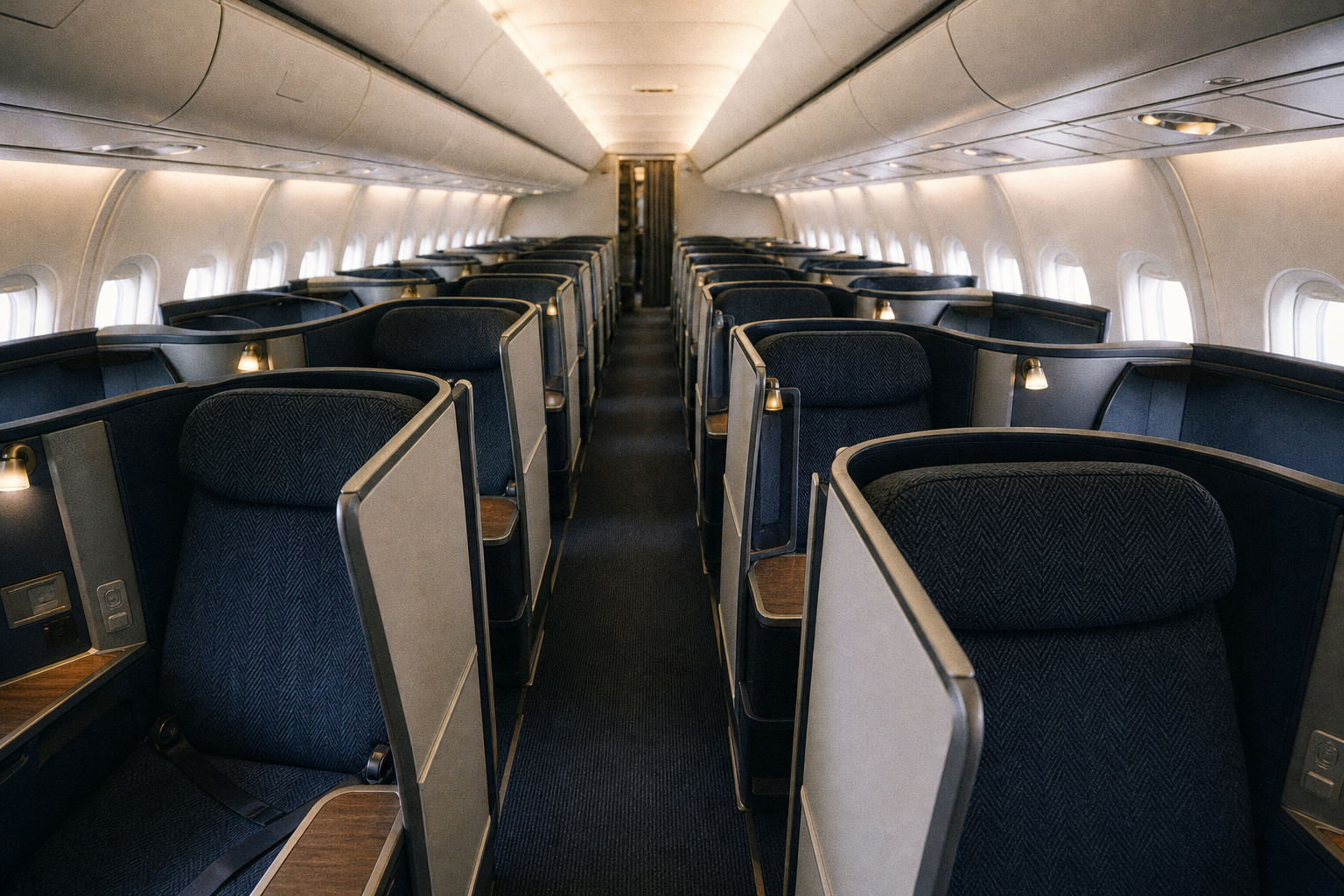
The case for Turkish Airlines business class is built on geography, not the seat. Istanbul Airport (IST) connects more international destinations than any other hub on earth, making Turkish the default routing solution for markets that have no direct premium option. The seat, on aircraft that carry it, is genuinely competitive. The variance between aircraft types is not.
The question a discerning traveler faces is whether the route network advantage outweighs the product inconsistency, and whether IST’s CIP Lounge delivers enough to make a connection through it worthwhile.
The Product: Crystal Business on the 787-9
Turkish Airlines deploys its Crystal Business Class cabin on Boeing 787-9 Dreamliner aircraft across long-haul routes from IST. The configuration is 1-2-1, fully flat, with 30 seats in a herringbone layout. Every seat has direct aisle access. The bed length reaches 198 cm (6’5″) with a 76 cm width, measurements that hold up against Gulf carrier benchmarks.
The seat shell provides reasonable privacy on window seats. Middle pairs convert to a double for couples traveling together, a genuine differentiator versus cabins that cannot offer that option. The IFE screen measures 16 inches. Power (110V AC and USB-A) sits within reach of the reclined position.
The Dreamliner cabin pressure and humidity work in Turkish’s favor: the same physiological advantages that Singapore Airlines markets on its A350 apply here.
What the product does not do: The Crystal Business seat does not have a closing door. In a market where Qatar QSuites and other Gulf carriers have set expectations around full enclosure, Turkish business class is a premium open cabin. That distinction matters if privacy is a priority.
The Network: Where Istanbul Actually Wins
Turkish Airlines flies to more countries than any other carrier, over 120 as of 2026. The practical implication for travelers from markets with limited direct premium service is significant.
Routes where IST routing is the only viable business class connection include most of sub-Saharan Africa, Central Asia, the Balkans, and secondary European cities. A traveler flying from Nairobi to Lagos in business class, or from Baku to São Paulo, will frequently find Turkish the only carrier offering a premium-cabin option at a competitive price.
The IST hub has reduced the friction problem that plagued the old Ataturk Airport. Transit times under two hours are manageable for most connections. The CIP Lounge in the new airport is large, well-staffed, and includes a restaurant service that competes with regional carrier lounges.
Where IST routing creates a real cost: geography. A traveler flying from London to Singapore via Istanbul is adding 1,400 km to the routing. The premium for business class may not offset the additional travel time if a direct option exists at a reasonable price difference.
The Inconsistency Problem
Turkish operates multiple business class products simultaneously. Narrow-body routes within Europe and to regional destinations use recliner seats, not flat beds. Older wide-body aircraft on some routes carry a different cabin configuration. The Crystal Business product on the 787-9 is not what every Turkish business class passenger receives.
Verifying the aircraft type before booking is not optional. It is the primary research task. Turkish’s seat map tool and seat-map aggregators confirm the configuration for a specific flight. The 787-9 routes most likely to carry Crystal Business include transcontinental routes to North America, South America, and East Asia. European and Middle Eastern routes are more likely to carry recliners.
This inconsistency is not unique to Turkish. Lufthansa and Air France have the same problem on intra-European routes. But for a carrier where the network is the selling proposition, it is worth flagging that the product you are buying depends on the routing you select. For a full comparison of how to assess a business class product before booking, see How to Evaluate a Business Class Product Without Flying It.
When to Book Turkish Business Class
Three scenarios where Turkish business class is the right answer:
When the routing problem solves itself. If Istanbul is genuinely on the great-circle route, or close to it, the product is competitive at a price that frequently undercuts Gulf carriers on the same city pairs.
When no direct premium option exists. For routes where Turkish is the only carrier offering a flat-bed cabin, the choice is not between Turkish and a door-equipped suite. It is between Turkish business class and a connecting itinerary in economy.
When award availability opens up. Turkish Miles&Smiles has historically offered competitive award pricing to its partners, including United MileagePlus and other Star Alliance programs. An award redemption through IST can deliver the 787-9 product at a points cost below what partner programs charge for equivalent Gulf carrier seats. For a full analysis of when award miles beat cash for long-haul business class, that framework applies here.
The Bottom Line
Turkish Airlines business class is a network play, not a product play. The Crystal Business seat on the 787-9 is a credible, fully flat product: a lie-flat bed, direct aisle access, adequate power, and a lounge at IST that meets the standard. It does not compete with the best of Emirates or Singapore Airlines on pure product merit.
Book it when the routing logic justifies it, when you have confirmed a 787-9, and when the price gap versus direct competitors is significant enough to outweigh what the closed-door carriers provide. Avoid it on narrow-body routes, where “business class” means a blocked middle seat or a recliner. For the broader question of when upgrading to a premium cabin is worth the cost, the answer here depends entirely on which Turkish product you are actually buying.