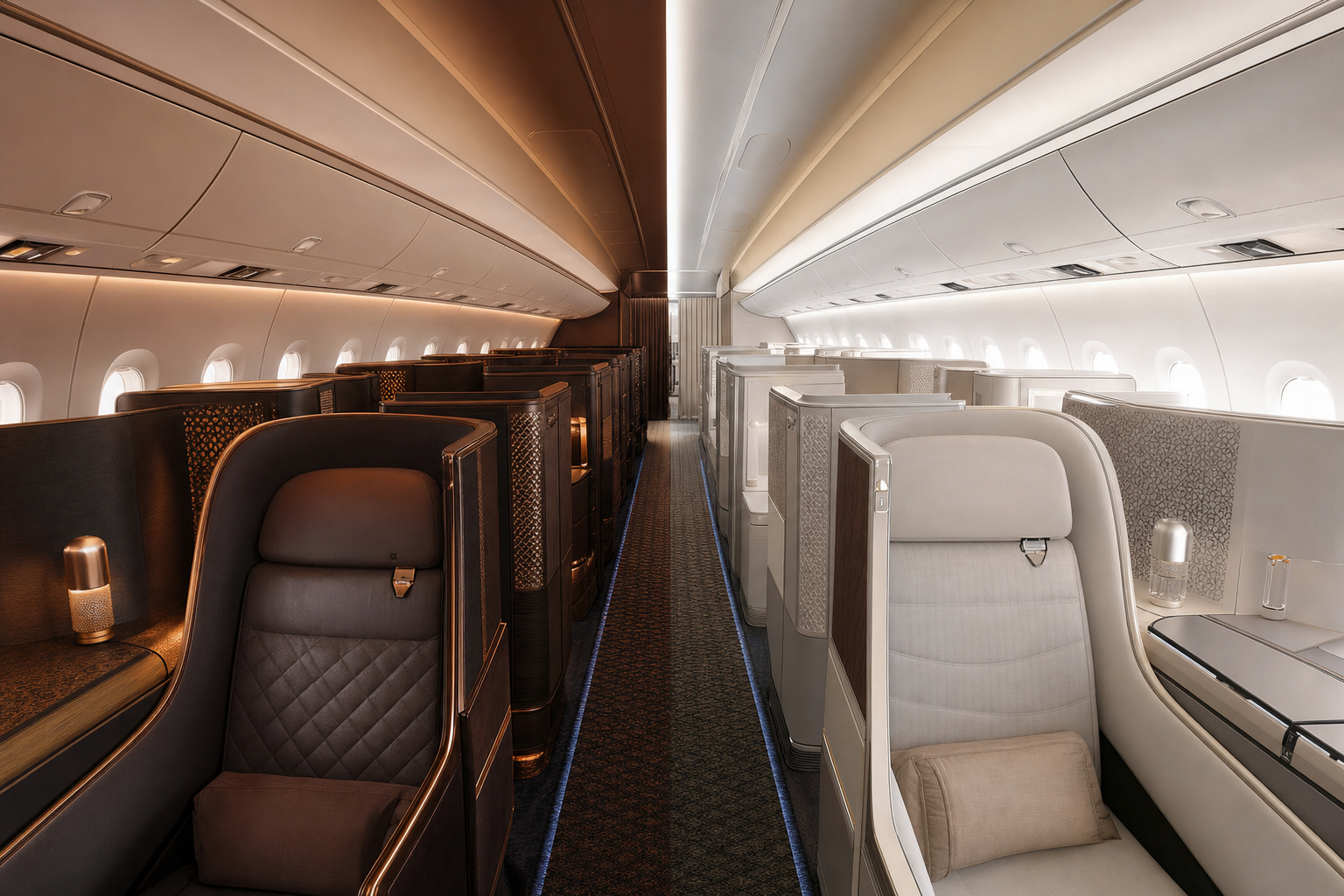
The comparison between Emirates and Singapore Airlines business class is one of the most reliably inconclusive arguments in long-haul travel. Both carry consistent top-tier rankings. Both offer lie-flat seats, but direct aisle access depends on the aircraft and cabin layout. Both spend heavily on catering and amenity design. The reason the debate never resolves is that these are not competing versions of the same product — they are different products optimized for different priorities, and the right answer depends almost entirely on variables the traveler controls.
This piece does not declare a winner. It defines the conditions under which each airline is the correct choice.
At a Glance: Emirates vs. Singapore Airlines Business Class
| Category | Emirates | Singapore Airlines |
|---|---|---|
| Primary long-haul aircraft | A380, 777-300ER | Singapore Airlines A350 review-900, 777-300ER |
| Seat width (long-haul) | 18.5 inches (A380) | 28 inches (A350/777) |
| Bed length | 78 inches | 78-79 inches (up to 81 on select config) |
| Screen size | 17 inches (A380) | 15.4-18 inches (varies by aircraft) |
| Onboard bar | Yes (A380 upper deck only) | No |
| Mattress topper | No (standard padding) | Yes (fleet-wide as of early 2026) |
| Pre-order meal program | No | Yes — Book the Cook (60+ options) |
| Service consistency | Variable (larger fleet, wider crew pool) | High (smaller fleet, tighter training) |
| Cabin atmosphere | Social, livelier (especially A380 upper deck) | Quiet, contained |
| Ultra-long-haul nonstop US routes | No | Yes (A350-900ULR: SIN-JFK, SIN-LAX, SIN-SFO) |
| Typical cash fare vs. comparable route | Lower by 5-15% | Higher (commands the premium) |
| Best for | Daytime/entertainment-focused flights, A380 bar experience | Sleep-critical sectors 13+ hours, consistency |
What Each Product Actually Is
Emirates Business Class is a performance-oriented cabin. The product is designed to be noticed — the onboard bar on A380 upper deck flights, the ICE entertainment system with a 17-inch screen and one of the broadest content libraries in commercial aviation, the Moet and Chandon on departure, the herringbone seat in a 1-2-1 configuration. The experience is deliberately social in ways that Singapore Airlines is not. Emirates business class rewards travelers who intend to be awake, engaged, and moving around the cabin.
The seat itself is a competent lie-flat product. At 18.5 inches wide on the A380 — narrower than several competitors in the category — it extends to 78 inches fully flat. The shell provides standard privacy. The padding is reported as adequate across most independent reviews. It is not the most ergonomically refined seat in the category, but it is functional for most body types on medium-haul sectors.
Singapore Airlines Business Class is an execution-oriented cabin. The product is designed to perform consistently and quietly. The flagship seat on long-haul A350 and 777 aircraft offers 28 inches of width — substantially wider than Emirates and among the widest business class seats in commercial aviation — a fully flat 78-inch bed with a dedicated mattress topper (fleet-wide as of early 2026), and a 1-2-1 layout that gives every passenger direct aisle access. The A350-900ULR variant used on ultra-long-haul routes (Singapore to New York, Los Angeles, San Francisco) carries an updated lumbar support system and a separate ottoman.
Where Singapore Airlines consistently separates itself from the field is service reliability. Crew ratios, pre-departure drink service, meal timing, and response to requests are more consistent flight-to-flight than Emirates. The Book the Cook pre-order program — available on most routes with more than 60 dish options — reduces the variability in catering quality that affects all airlines on high-load departures.
The Specific Tradeoffs
Entertainment and Onboard Experience
Emirates wins this category without qualification. The ICE system on A380 business class operates on a 17-inch screen — comparable to or larger than Singapore Airlines’ 15.4 to 18-inch range depending on aircraft, but the decisive advantage is content breadth, not screen size. Emirates’ ICE library is consistently reported as broader across movies, television, music, and games than Singapore Airlines’ KrisWorld system.
The onboard bar on A380 upper deck routes is a genuine differentiator. It is a staffed bar with seating for six to eight passengers, open throughout the cruise phase of flight. There is no equivalent product on Singapore Airlines. For travelers who want a social mid-flight option — a drink, a change of position, a conversation — the Emirates A380 upper deck delivers something Singapore Airlines does not offer.
Seat Ergonomics and Sleep Quality
Singapore Airlines wins this category for most body types on most routes. The 28-inch seat width on long-haul A350 and 777 aircraft translates to meaningfully more shoulder room in the lie-flat position compared to Emirates’ 18.5 inches. That is a difference of nearly 10 inches — enough to affect comfort during sleep for most adults. The mattress topper, now standard fleet-wide, closes a gap that used to separate Singapore Airlines from Emirates only on specific aircraft. The lumbar support on the A350-900ULR is specifically engineered for 17-plus-hour sectors.
Emirates’ seat is not uncomfortable. For travelers under six feet, it performs adequately on medium-haul sectors. But on routes exceeding ten hours — where the quality of sleep is the primary variable affecting how you arrive — Singapore Airlines’ seat dimensions and bedding quality produce a more consistent result.
Service Consistency
Singapore Airlines wins this category by a measurable margin. The variance in service quality between Emirates flights is higher than between Singapore Airlines flights. Emirates operates a larger fleet across a wider range of hub connections, and crew quality on secondary or overnight departures from Dubai can vary. Singapore Airlines’ crew training and deployment standards produce more uniform outcomes.
This is not a statement about individual crew excellence — Emirates has exceptional crew members. It is a statement about reliability. If your schedule puts you on a red-eye to Europe or a connecting flight through Dubai at an off-peak hour, the probability of a fully consistent premium service experience is higher on Singapore Airlines.
Cabin Atmosphere
Singapore Airlines operates a quieter, more contained cabin environment. Emirates A380 business class — particularly on the upper deck where the bar is open — is a livelier environment. That is not a deficiency; it is a design choice. The question is whether you want ambient social energy on a long overnight flight or a cabin that defaults to quiet.
On daytime routes where passengers are less likely to be sleeping, the Emirates atmosphere is not a disadvantage. On overnight transcons or long-haul red-eyes where sleep is the objective, the quieter Singapore Airlines cabin is the more functional environment.
Which Airline Wins on Daytime Long-Haul Routes?
On daytime sectors — Singapore to Tokyo, Dubai to London in the morning, any route where you are not planning to sleep for more than a few hours — Emirates is the stronger product. The entertainment system keeps pace with a full waking day in the air. The bar provides a mid-flight option that Singapore Airlines cannot match. The showmanship of the Emirates experience is appropriate to a cabin where passengers are alert and engaged.
Singapore Airlines is the better daytime product only for travelers who prioritize service precision and catering quality over entertainment breadth. Book the Cook produces a more reliably excellent meal than Emirates’ catering on equivalent-length daytime routes.
Does Emirates Business Class Justify the Premium Over Singapore Airlines?
On most routes, Emirates business class does not carry a premium over Singapore Airlines — it carries a discount. Emirates cash fares typically run 5 to 15 percent below Singapore Airlines on comparable intercontinental sectors. Singapore Airlines commands the premium, not Emirates.
The question therefore inverts: does Singapore Airlines business class justify its premium over Emirates?
On ultra-long-haul sectors of 14 hours or more — Singapore to New York, Singapore to Los Angeles, any sector where sleep quality determines how you function on arrival — Singapore Airlines’ seat ergonomics, bedding, and service consistency justify the price difference for most travelers. The A350-900ULR product on these routes is consistently rated by independent reviewers — including AirlineRatings, The Points Guy, and Business Traveller — as one of the strongest ultra-long-haul business class offerings currently in service.
On medium-haul sectors of eight to eleven hours — Dubai to London, Singapore to Sydney, routes where entertainment consumption and awake time are significant factors — the Emirates product is competitive enough that the price premium for Singapore Airlines is harder to justify unless service consistency is a high priority.
On routes of under eight hours where both carriers operate the product, the case for paying Singapore Airlines’ premium weakens further. Neither seat’s ergonomic advantages matter as much on a six-hour sector, and Emirates’ entertainment system becomes a more decisive advantage.
Route and Network Considerations
Emirates routes business class through Dubai (DXB), which creates a connection-heavy structure for passengers originating in North America or Europe. The connection quality through Dubai is high — the Emirates Terminal 3 business class lounge is a genuinely strong facility — but a two-segment itinerary introduces variables that a nonstop does not.
Singapore Airlines operates nonstop service from the US East Coast (New York JFK and Newark) and West Coast (Los Angeles, San Francisco) to Singapore, and connects onward to Southeast Asia, Australia, and South Asia without requiring a layover. For North American travelers routing to Asia, Singapore Airlines’ ultra-long-haul nonstop option eliminates a connection and delivers its best-performing aircraft on those sectors.
For Europe-based travelers, Emirates’ network breadth through Dubai gives it a routing advantage to South Asia, East Africa, and secondary Asian cities that Singapore Airlines cannot match with nonstop or one-stop options.
Who This Is For
Book Emirates when:
- You are flying on an A380 and want the upper deck bar experience
- Entertainment is a primary priority on a daytime or evening sector
- The route is 8 to 12 hours and the price differential favors Emirates
- You are connecting through Dubai and using the Emirates lounge product as part of the journey
- Your route to Asia or Africa runs through Dubai with fewer connections than an SIA itinerary
Book Singapore Airlines when:
- The sector is 13 hours or longer and sleep quality is the dominant variable
- You are flying one of the ultra-long-haul US-to-Singapore nonstop routes
- Service consistency is a priority — you need the execution to hold across a full-service overnight
- You are traveling with a companion who values the double-bed configuration available on A380 bulkhead rows
- The price premium over Emirates is under $400 on a long-haul sector (justified by ergonomic and service differences at that margin)
Do not book Emirates when:
- You are on a 14-plus-hour sector and sleep quality will determine how you perform on arrival
- Cabin quiet is a priority and the flight is overnight
- You are on a non-A380 Emirates aircraft where the bar is not available and the seat is not differentiated from a competitive product
Do not book Singapore Airlines when:
- The price premium over Emirates exceeds $600 to $800 on a sub-10-hour sector
- You are on a route where the SIA aircraft assignment is a regional configuration rather than a long-haul product — verify the equipment before booking
- Entertainment is your primary concern and you are flying a route where Emirates deploys the A380
Frequently Asked Questions
Which is better for an overnight flight to Europe?
Singapore Airlines. On overnight transatlantic or Europe-bound sectors where sleep is the objective, the wider seat (28 inches vs. 18.5), mattress topper, and quieter cabin environment consistently outperform the Emirates product. The bar advantage is largely irrelevant when the cabin goes dark for eight hours.
Does Emirates have better in-flight entertainment than Singapore Airlines?
Yes. The Emirates ICE system carries a broader content library than Singapore Airlines’ KrisWorld across movies, television, music, and games — and on A380 operations the 17-inch business class screen is competitive with Singapore Airlines’ 15.4 to 18-inch range. The screen size gap is marginal; the content depth advantage is consistent.
Which airline is cheaper in business class?
Emirates, typically. On comparable intercontinental routes, Emirates cash fares run 5 to 15 percent below Singapore Airlines. The price gap narrows on ultra-long-haul sectors and widens on medium-haul routes where Emirates is more aggressively priced.
Is the Emirates A380 bar worth booking around?
For the right traveler, yes. The upper deck bar is a mid-flight option that no other carrier in this comparison offers. It is worth specifically selecting an A380 route and upper deck seat if the social cabin experience matters to you. It is not worth a price premium over Singapore Airlines if sleep quality is your primary concern.
Which has better business class seats for tall travelers?
Singapore Airlines on long-haul aircraft. The A350 and 777 long-haul seat at 28 inches of width, combined with a bed length of up to 79 inches (81 on select configurations), accommodates taller passengers more comfortably than Emirates’ 18.5-inch A380 seat. Confirm the specific aircraft assignment before booking either carrier.
Can you get a flat bed on all Singapore Airlines flights?
As of October 2025, yes. Singapore Airlines completed the transition to fully flat-bed business class across its entire fleet, including the final 737-800 retirements. All routes, regardless of length, now operate flat-bed business class seats.
Which airline wins for the Singapore to New York route specifically?
Singapore Airlines, without qualification. The A350-900ULR product deployed on this sector — updated lumbar support, mattress topper, the Book the Cook pre-order program, and consistent crew service on an 18-plus-hour flight — is one of the strongest arguments for the carrier’s premium. Emirates does not operate a nonstop equivalent.
Verdict
Neither Emirates nor Singapore Airlines is unconditionally the better product. The decision depends on four variables: route length, flight time of day, whether the Emirates A380 with the bar is the actual aircraft operating your flight, and how much the price differential is on your specific itinerary.
The working rule: book Singapore Airlines for any sector over 13 hours where sleep quality is your primary concern, for ultra-long-haul US nonstop routes, and when the price premium is under $500. Book Emirates when the route is under 12 hours, the A380 upper deck is operating, you want the entertainment and bar experience, and — especially — when Emirates is the cheaper option by a meaningful margin.
The comparison resolves clearly at the extremes. An 18-hour Singapore-to-New York sector on the A350-900ULR is Singapore Airlines without serious debate. A Dubai-to-London daytime flight on Emirates A380 upper deck, priced $400 below Singapore Airlines’ equivalent, is Emirates without serious debate. The middle ground — 10 to 13 hours, similar pricing, non-A380 Emirates equipment — is genuinely competitive, and on those sectors the decision comes down to a single question: do you need to sleep well, or do you need to stay entertained? Answer that, and the choice makes itself.
If another airline is on your shortlist, compare Qatar Airways versus Emirates or Etihad versus Qatar Airways business class before choosing a Gulf connection. For a Japan itinerary, use the ANA versus JAL comparison. If you are deciding whether to move beyond business class, our Emirates versus Etihad first-class comparison addresses that different purchase.
This comparison is based on published product specifications from Emirates and Singapore Airlines, independent cabin reviews from Business Traveller, AirlineRatings, and The Points Guy, and fare comparisons on major booking channels, reviewed in August 2026. Aircraft configurations and product details change with fleet updates — verify the specific equipment on your route before booking.