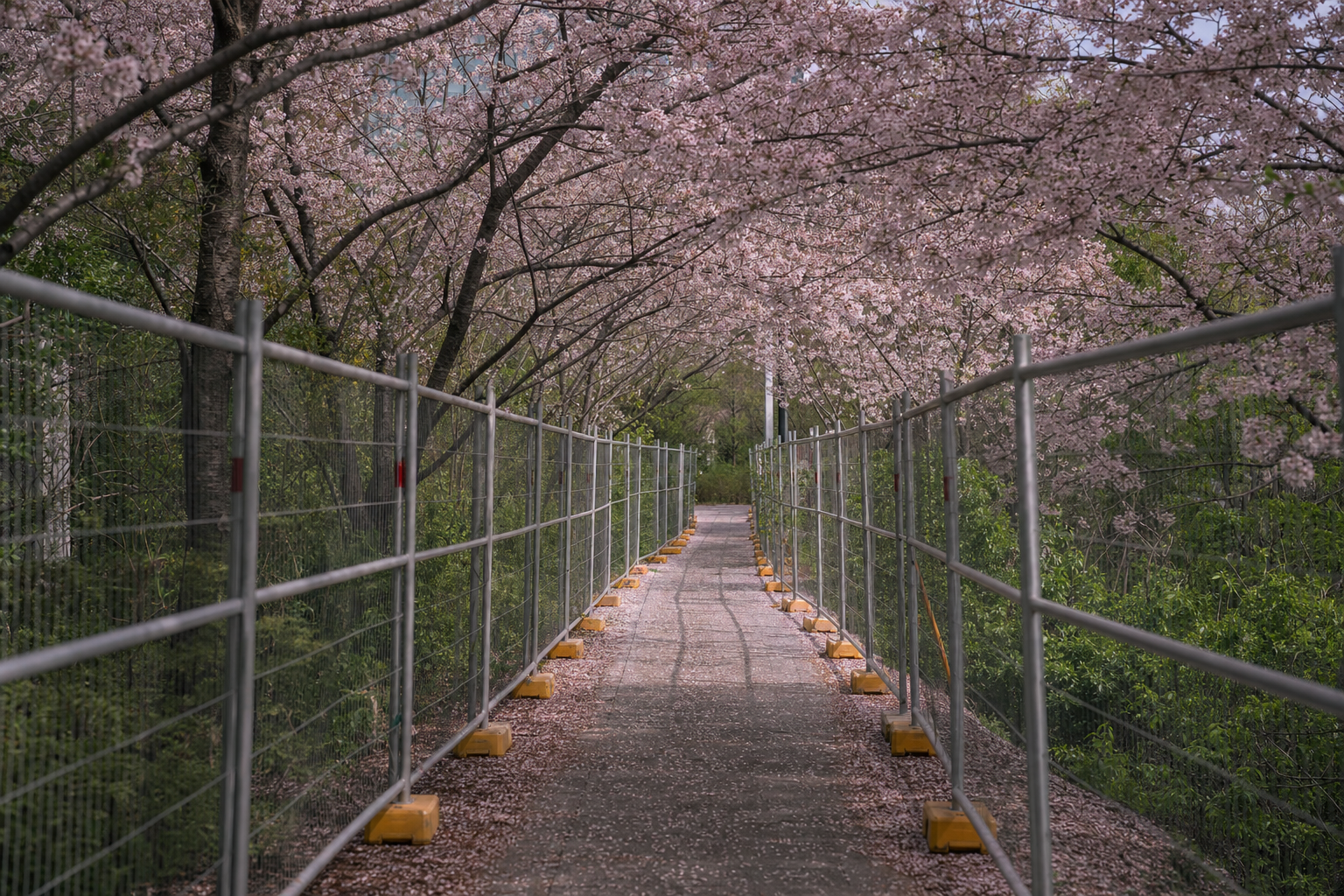
Cherry blossom season in Tokyo is not a secret. What has changed is the scale of the consensus around it — and what that consensus now costs you in time, money, and the quality of the thing you came to see.
Japan received 42.7 million international visitors in 2025, a record exceeding the prior year by 15.8 percent (Japan National Tourism Organization, 2026). A meaningful share concentrates into a ten-day window in late March and early April. The Meguro River alone draws approximately 2.3 million visitors during the cherry blossom period. Nakameguro installed view-blocking screens on its main bridge in 2026 to manage sidewalk congestion. That is the condition of the market you are entering.
What Cherry Blossom Season Actually Is
The sakura bloom in Tokyo is brief. Peak bloom falls in a five-to-seven day window, historically between March 25 and April 5. The Japan Meteorological Corporation forecast March 28 as the 2026 peak for Ueno Park and Shinjuku Gyoen. Trees reach full bloom, hold for several days, then petal drop begins. Rain or warm temperatures accelerate the decline. Arrive three days late and the trees may be finished.
The main viewing parks — Ueno, Shinjuku Gyoen, Yoyogi, Chidorigafuchi, Meguro River — are not interchangeable. Ueno is the oldest and most festival-oriented, with 50-plus food stalls running during the formal hanami period. Shinjuku Gyoen charges 500 yen admission and prohibits alcohol, which filters the crowd meaningfully. Chidorigafuchi has the canal-side moat path and rental rowboats.
What all of them share in 2026: operating at or above comfortable visitor capacity during peak bloom days.
What Works
The aesthetic event is real. A city that plants the same species at the same density across hundreds of parks, rivers, and streets produces something citywide during full bloom. No single park captures it. The experience is cumulative and spatial — photographs compress it into something easier to dismiss than it deserves.
Can you still see the bloom without the crowds?
Yes — if you are willing to be at a park entrance before 7:30am. Ueno and Chidorigafuchi are uncrowded by cherry blossom standards at that hour: better light, no food stalls, no midday crush. The experience is materially different from midday. Build the itinerary around this or do not count on it.
Shinjuku Gyoen’s alcohol prohibition is a real filter. The no-alcohol rule keeps the densest segment of party-oriented hanami crowds out. The park is still busy, but the crowd type differs from Ueno or Meguro River. For travelers who want to see trees without festival atmosphere, this is the correct park.
First-time Japan visitors have the clearest case. If this is a first visit and the blossom is the primary purpose of the trip, the crowd friction is a tolerable tax on a genuine experience. The event delivers what it promises — once.
What Doesn’t Work
The accommodation premium is steep. Published hotel rates during peak cherry blossom season run 50 to 70 percent above baseline for the same properties, with luxury tiers reaching 200 to 300 percent above off-season rates (MyLighthouse hotel demand data, 2025; Four Seasons Marunouchi published rates, cherry blossom season 2025). A hotel at $300 per night in February runs $450 to $480 in late March. Over seven nights, that differential is $1,050 to $1,260 before any other cost increases.
Transport congestion is structural, not incidental. The Meguro and Chuo lines serving the most popular viewing corridors operate at crush capacity on peak bloom weekends. Waits at Shinjuku Gyoen’s main gate have exceeded one hour. Tokyo’s train system is among the most efficient in the world — except during this window, when it is handling volume it was not built for.
The blossom does not improve other Tokyo experiences — it degrades them. Restaurant reservations are harder to obtain. Transit is slower. Sensoji, Tsukiji Outer Market, and Shibuya Crossing are all running their own simultaneous seasonal peak. Every experience outside the parks gets worse. None gets better.
What is the best alternative time to visit Tokyo if you want to avoid the cherry blossom crowds?
Two weeks earlier or two weeks later are both materially different cities. Early-to-mid March: full hotel availability, standard rates, an uncrowded city, no blossom. Mid-to-late April (before Golden Week): rates step down, crowds recede, the trees are green. Tokyo is navigable again. The only thing missing is the bloom. — shoulder seasons also make choosing between Narita and Haneda less consequential given lighter flight schedules.
Who This Is For
First-time Japan visitors whose primary purpose is the hanami event. Not as a stop on a broader Tokyo trip — as the reason for the trip. If the blossom is why you are going, the premium and the crowds are a known cost. Book accommodation three to four months in advance for anything above Y30,000 per night. Monitor the Japan Meteorological Corporation bloom forecast from January. Plan park visits before 8am. Done correctly, it is worth it — once.
Also defensible: travelers with flexible booking timelines who can shift their dates plus or minus four days based on forecast updates. The bloom window is predictable enough to hit accurately if you are willing to move.
Who This Is Not For
Repeat visitors who have already seen the bloom. The trees are the same. The crowd and cost conditions are worse than they were. There is no new return.
Food-focused travelers, anyone who values low-friction urban movement, and travelers whose primary interest is cultural depth. Cherry blossom season is actively hostile to all three. A quiet kaiseki dinner, efficient neighborhood access, and the experience of Tokyo moving at its own pace are not available during this window.
Anyone who wants to go because the season is famous. Incidental cherry blossom visits — where the bloom is a backdrop rather than a purpose — represent the worst possible value proposition for the premium being paid. The cost is the same. The return is a fraction.
The Tradeoffs
Is cherry blossom season in Tokyo worth the premium if the bloom is not the primary reason for your trip?
No. The exchange is a 50 to 70 percent accommodation premium, degraded transport, harder restaurant access, and crowds at every major park — in return for a citywide aesthetic event that is only transformative if you are there specifically for it. If the blossom is incidental to your itinerary, you are paying the full cost for a fraction of the return. Go two weeks earlier or two weeks later. The city is better in every other respect.
Verdict
First-time Japan visitors for whom the sakura event is the explicit purpose: go. Build the itinerary around the bloom, book early, monitor the forecast, and get to the parks before 8am. The experience is worth the friction — once.
Everyone else: go in early March or mid-to-late April. The city is better, cheaper, and navigable. The calculus is not close.
Sources Consulted
- Japan National Tourism Organization (JNTO). International Visitor Arrivals Data, 2024-2025. jnto.go.jp
- Japan Meteorological Corporation. Sakura Bloom Forecast, 2026. n-kishou.com
- Japan-Guide.com. Tokyo Cherry Blossom Reports, 2025-2026. japan-guide.com/sakura
- MyLighthouse. Hotel Demand and Pricing: Japan Cherry Blossom Season 2025. mylighthouse.com
- Four Seasons Marunouchi Tokyo. Published rates, cherry blossom season 2025. fourseasons.com
- Soranews24. “Famous Tokyo Cherry Blossom Spot Installs View-Blocking Screens.” March 2026. soranews24.com
- Japan Times. “Cherry Blossoms Economic Impacts.” March 2025. japantimes.co.jp
- Tokyo Metropolitan Government. Tourism Statistics 2024. metro.tokyo.lg.jp
- Veltra Travel Guide. “How Crowded Is Japan During Cherry Blossom Season.” veltra.com