Japan attracted 42.7 million international visitors in 2025 — a figure the country’s own tourism authority described as a record, and that its cities are still reckoning with. The conversation around Japanese overtourism has been loud for two years. Much of it is accurate. Some of it is exaggerated. The useful question is not whether Japan is crowded — it is — but whether the specific things that make Japan worth prioritizing have been degraded enough to change your calculus, and whether the new friction costs (financial, logistical, experiential) are proportionate to what you get in return.
The answer is conditional, and it depends heavily on where you go and how you travel.
What Has Actually Changed
Visitor numbers and the yen story
Japan’s post-pandemic reopening in late 2022 triggered a tourism surge that has not plateaued. The 42.7 million visitors recorded in 2025 represent a roughly 20 percent increase over 2023’s already-elevated figures. Inbound tourist spending reached approximately ¥9.5 trillion (JNTO preliminary 2025 figures) — a number the government celebrates, and that local residents in Kyoto, Nara, and the Fuji Five Lakes region increasingly resent.
The yen’s weakness is the primary driver. The USD/JPY rate has hovered between 152 and 161 through early 2026, meaning Japan remains materially cheaper for dollar and euro holders than it was in 2019, when the rate sat closer to 107–110. A mid-range hotel that cost $180 per night in 2019 costs the equivalent of roughly $130–$140 at current rates — even after factoring in Japanese hotel inflation. For travelers from high-income countries, Japan still represents genuine value relative to comparable European destinations. The “cheap Japan” narrative of 2023 — when the yen briefly touched 151 — has moderated, but the structural advantage persists.
The more accurate framing: Japan is not as inexpensive as it was two years ago, but it is not expensive by the standard of London, Paris, or Sydney. The pricing story has been somewhat overcorrected in travel media.
New fees and taxes
Several concrete financial changes took effect in 2025 and early 2026:
- Kyoto accommodation tax: Revised effective March 1, 2026. The new tiered structure applies per person, per night. Rates increase steeply at higher room price points — guests staying in higher-end properties face meaningfully larger surcharges than under the previous structure. The tax is collected by the property and appears as a line item on the bill.
- Fuji climbing fee: The Yoshida Trail now charges ¥4,000 per person per climb (up from ¥2,000 in 2024). A daily cap of 4,000 climbers is enforced, with a gate that closes overnight to prevent the “bullet climbing” practice of ascending through the night without rest.
- Departure tax increase: Japan’s ruling coalition specified a raise in the departure tax to ¥3,000 per person (from ¥1,000) in the FY2026 tax reform outline. The increase is intended to fund tourism infrastructure improvements.
- Dual pricing at national museums: Under active policy consideration as of early 2026. Japan’s Agency for Cultural Affairs is drafting guidelines that would allow the country’s 12 national museums (per the Agency for Cultural Affairs) to charge higher entry fees to non-residents. No specific rates have been announced; implementation is expected later in 2026 or into 2027. This is a significant policy shift — worth monitoring, not yet a trip-planning factor.
The cumulative effect for a week-long trip to Kyoto and Tokyo: an additional $40–70 in taxes and fees per person beyond what the same trip cost in 2024. Real, but not prohibitive.
Where the Pressure Is Genuine
Kyoto
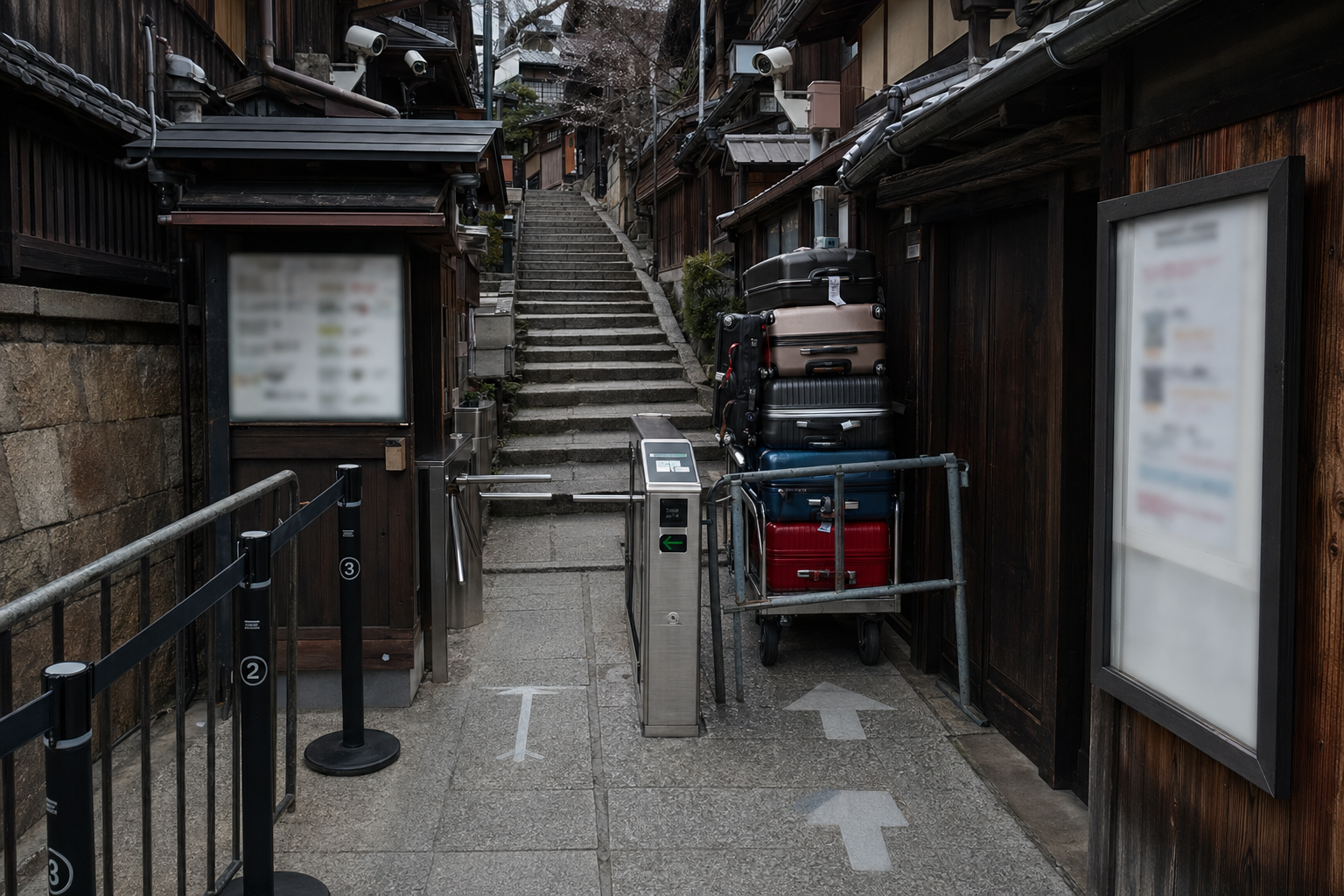
Kyoto has the most acute overtourism problem of any Japanese city, and it is structural rather than seasonal. The geisha district of Gion has required barriers and signage to manage tourist behavior around private alleys. The Fushimi Inari torii gates — free to enter, open 24 hours — remain manageable at dawn and overwhelming by 9am. Arashiyama’s bamboo grove is photographable only in the margins of the day. The city’s narrow pre-modern street layout was not designed for 10-figure annual visitor counts, and its bus network regularly fails to absorb demand during peak periods.
The city’s response has been fee-based containment rather than physical access limits. This manages revenue but does not meaningfully reduce crowd density at specific nodes.
Kyoto is still worth visiting. It is not worth visiting in April (cherry blossom peak), early November (autumn foliage), or Golden Week (late April to early May) unless you plan obsessively around timing. Outside those windows, specifically January through mid-March and late June through July, the city operates at a level of density that allows genuine engagement with its architecture and culture.
Mount Fuji and the Fuji Five Lakes Region
The Fuji situation has been more successfully managed than Kyoto’s. The ¥4,000 fee and 4,000-climber daily cap on the Yoshida Trail have materially reduced the chaotic conditions that characterized 2023 and 2024 climbing seasons. The overnight gate closure has eliminated the most dangerous and crowded ascent pattern. If climbing Fuji is the goal, the 2026 system is functional — book a permitted slot early, pay the fee, expect a genuine mountain experience with fewer competitors for the same trail.
The Fuji Five Lakes area (Kawaguchiko, Fujikawaguchiko) remains heavily visited during cherry blossom season and autumn, with the Lawson convenience store viewpoint having become a symbol of overtourism management-by-barrier. The region is worth a night or two outside peak periods; it is not worth fighting for in late March or early November.
Osaka
Osaka’s overtourism pressure is concentrated in Dotonbori and the Shinsekai area. Both are genuinely unpleasant in the evenings during peak travel months — dense, noisy, and oriented entirely toward tourists. The city’s food culture remains the reason to visit, and that culture is accessible outside the tourist corridors. Osaka does not have Kyoto’s structural problem because it is a functioning commercial city rather than a museum city. The crowds are annoying; they do not fundamentally compromise the visit.
Where the Pressure Is Overstated
The overtourism narrative in travel media has a tendency to flatten Japan into Kyoto plus Fuji. This is inaccurate, and it is distorting trip-planning decisions.
Tokyo is large enough that even its most visited neighborhoods — Shibuya, Shinjuku, Asakusa — absorb visitor density without degrading the experience for most travelers. Asakusa’s Nakamise shopping street is crowded; the neighborhood’s temple and surrounding streets are not. Tokyo in 2026 is busy but navigable, and its size means genuine discovery remains possible.
The secondary cities are not suffering from overtourism at all. Kanazawa, Hiroshima, Matsumoto, Takayama, and the Tohoku and Kyushu regions operate at visitor densities that allow unhurried engagement. These are not consolation prizes for travelers who missed out on Kyoto — they are destinations with comparable historical density, strong regional food cultures, and a fraction of the visitor pressure.
Regional Comparison
| Region | Crowd Pressure | Cost Level | New Restrictions | Recommended Timing |
|---|---|---|---|---|
| Kyoto | High (structural) | Mid–High | Lodging tax increase (Mar 2026) | Jan–mid-Mar; late Jun–Jul |
| Tokyo | Moderate (absorbable) | Mid–High | None significant | Year-round workable |
| Osaka | Moderate (localized) | Mid | None significant | Avoid Golden Week |
| Mount Fuji / Yoshida | Managed (fee + cap) | Low–Mid | ¥4,000 fee; 4,000/day cap | July–early Sep (climbing season) |
| Kanazawa / Takayama | Low | Low–Mid | None | Mar–May; Oct–Nov |
| Tohoku / Kyushu | Low | Low | None | Year-round |
What to Ignore
- “Japan is getting expensive” — relative to its own 2019 prices, yes; relative to comparable high-cost Western European capitals, no. The yen is weak enough that the value proposition for Western travelers remains intact.
- Blanket deterrence — advice to skip Japan entirely due to overtourism ignores that the problem is geographically concentrated. Avoiding the three or four specific pressure points (Arashiyama at noon, Dotonbori on a Saturday night, Fuji in October) is not complicated.
- Dual pricing as a current factor — it is under consideration, not implemented. Don’t price it into trip planning yet.
Who Japan Is Right For in 2026
Travelers who plan with specificity — who pick timing deliberately, book accommodations early, and design itineraries that include at least one secondary city — will find Japan in 2026 rewarding at a level that few other destinations match. The food, transit infrastructure, safety, service standards, and density of genuinely distinct cultural experiences remain difficult to match at this price point in any other single country. The yen, while less extreme than in 2023, still benefits dollar and euro holders.
Japan is particularly strong for travelers who are flexible enough to avoid the four or five peak weeks that account for the majority of the overtourism problem: late March to early May, mid-July (Gion Matsuri in Kyoto), and the first two weeks of November.
Who Should Defer
Travelers unwilling or unable to plan around timing — specifically those locked into school holiday windows (late March to early April, Golden Week) — will experience Kyoto and Fuji at their most congested. The experience is not ruined, but it is significantly diminished relative to what the destination is capable of delivering. If the only available window is cherry blossom peak, the honest recommendation is to focus on Tokyo (which handles the crowds better) and skip Kyoto until a better window opens.
Travelers expecting the yen-driven “value” story of 2023 will be mildly disappointed. Japan is not cheap in the way it briefly was. It remains competitive.
Verdict
Go, but plan with precision. Japan in 2026 is not the uncrowded, inexpensive revelation that 2023 media coverage implied it would always be. It is also not a destination in managed decline. The overtourism problem is real and geographically concentrated; the pricing shift is real and moderate; the new fees and taxes are real and manageable. None of these changes justify deferring a well-planned Japan trip.
The travelers most at risk of disappointment are those chasing the Kyoto-and-Fuji itinerary during peak weeks without advance planning — that trip is overpriced and overrun. The travelers best positioned to find Japan exceptional are those willing to extend beyond the canonical circuit: a week in Kyoto in late January or late June, Tokyo on its own terms, one secondary city (Kanazawa and Hiroshima both repay visits), and Fuji approached via a booked permit rather than an impulse.
Japan has not peaked as a destination. It has raised the floor on what competent trip planning requires.
Frequently Asked Questions
Is Japan actually overcrowded in 2026, or is it overhyped?
Both, depending on where and when you go. Kyoto’s Arashiyama, Gion, and Fushimi Inari are genuinely overcrowded during peak periods. Fuji has been meaningfully improved by the 2025–2026 fee and cap system. Tokyo and secondary cities (Kanazawa, Hiroshima, Takayama) are not suffering from overtourism. The problem is real but geographically concentrated; the blanket “skip Japan” narrative does not reflect conditions on the ground outside three or four specific pressure points.
How much have costs increased in Japan since 2019?
Japan’s local prices have risen modestly due to inflation — roughly 10–15 percent in yen terms over five years. For Western travelers, the weak yen (USD/JPY ~155–160 in early 2026, versus ~107–110 in 2019) substantially offsets this. A mid-range hotel, meals, and transport in Tokyo costs the equivalent of significantly less in USD terms than in 2019. Japan is not “cheap” in the way 2023 coverage suggested, but it remains competitive with comparable European destinations.
What are the new tourist taxes in Japan in 2026?
The main changes: Kyoto’s accommodation tax was revised upward effective March 1, 2026, with steeper rates at higher room price points. Japan’s departure tax is proposed to increase to ¥3,000 per person (from ¥1,000). Mount Fuji’s Yoshida Trail charges ¥4,000 per climber with a daily cap of 4,000. Dual pricing at national museums is under consideration but not yet implemented. Total additional cost per person for a typical one-week trip: roughly $40–70 above 2024 levels.
What is the best time to visit Japan in 2026 to avoid crowds?
January through mid-March and late June through early July are the clearest windows for Kyoto and the main tourist circuit. October and November are the most congested months outside cherry blossom season — autumn foliage draws as many visitors as sakura. Golden Week (late April to early May) should be avoided for any itinerary that includes Kyoto, Nara, or Fuji. Tokyo is manageable year-round.
Should I include Kyoto in my Japan itinerary in 2026?
Yes, if your timing is right. Kyoto outside peak windows — specifically late January to mid-March and late June to early July — operates at a density that allows real engagement with its temples, neighborhoods, and cuisine. During cherry blossom and autumn foliage peaks, the experience is heavily compromised. If your travel dates fall in those windows, reduce time in Kyoto and increase time in Tokyo, which handles peak periods considerably better.
Are Japanese secondary cities worth prioritizing over Kyoto?
For some travelers, yes. Kanazawa offers comparable historical architecture and a strong craft and food culture at a fraction of Kyoto’s visitor density. Hiroshima combines historical significance with a genuinely livable modern city. Takayama and the Shirakawa-go villages reward visitors who prioritize craft, mountain landscapes, and local food over temple circuits. These are not backup options — they are legitimate first-choice destinations that the overtourism conversation has made easier to access.
Is Fuji worth climbing in 2026 given the new restrictions?
The 2026 Fuji Yoshida Trail system — ¥4,000 fee, 4,000-climber daily cap, overnight gate closure — has improved conditions relative to the chaotic 2022–2024 seasons. If climbing Fuji is the goal, book a slot early in the season (July, preferably), pay the fee, and expect a managed but genuine mountain experience. Fuji as a viewed object (from Kawaguchiko, from the Shinkansen, from Hakone) remains as rewarding as ever and requires no fee or permit.
Checklist: Planning a Japan Trip in 2026
- Confirm your travel window against peak periods (cherry blossom: late March–mid April; Golden Week: late April–early May; autumn foliage: late October–mid November)
- Book Kyoto accommodation at least 3 months in advance; 6 months for spring and autumn
- Reserve Fuji Yoshida Trail climbing permit if summit is planned (4,000/day cap means early booking is essential in July and August)
- Build at least one secondary city into the itinerary — Kanazawa, Hiroshima, Takayama, or a Kyushu city
- Budget an additional $40–70 per person for new taxes and fees relative to 2024
- Plan major Kyoto site visits (Fushimi Inari, Arashiyama bamboo grove) for pre-7am or post-5pm windows
- Verify Japan Rail Pass cost-effectiveness for your specific route — for short stays or Tokyo-only trips, point-to-point tickets may cost less
- Check accommodation tax rates for your specific Kyoto property — the March 2026 tiered structure varies by room rate