Kyoto is the better base for a first-time Japan visitor who wants one city as home for a week to 10 days. Tokyo is the better base if you plan to spend at least two weeks, want to mix city energy with day trips, or if your trip is built around food and contemporary culture rather than temples and gardens. If you have only a week, pick Kyoto and fly into Kansai International Airport (KIX). If you have longer, split your time between both and land at whichever airport minimizes your total transit cost.
This is not a “both cities are wonderful in their own way” article. Both cities are wonderful, but the choice between them as a first-trip base has real consequences for your itinerary, your hotel budget, your daily logistics, and how much of Japan you actually see. The wrong pick for your trip length and travel style will cost you hours in transit and leave you wishing you had done it differently.
What the Decision Actually Turns On
Most travelers frame this as a personality question: “Am I a Kyoto person or a Tokyo person?” That is the wrong frame. The right question is logistical: how many days do you have, what do you want to do with them, and how far are you willing to travel each day to do it.
Four variables determine which city works better as your base:
Trip length. Under nine days, commit to one base. Nine to 14 days, consider a two-city split but accept that you lose a half day to transit each time you move. Over 14 days, splitting is almost always the correct call.
Day-trip ambition. Kyoto is a launchpad for Nara, Osaka, Himeji, and the Kii Peninsula. Tokyo is a launchpad for Kamakura, Nikko, Hakone, and the Fuji Five Lakes region. Both offer excellent day-trip networks, but the character is different: Kyoto’s network is temples, smaller cities, and cultural sites; Tokyo’s is mountains, hot springs, and coastal towns.
Pacing preference. Kyoto rewards slower mornings and long walks. Its sites close early, often by 5:00 p.m., and nightlife is modest outside the Gion and Pontocho districts. Tokyo never closes. If your travel style requires evening stimulation, restaurants open past 10:00 p.m., and neighborhoods that feel alive at midnight, Tokyo wins by a wide margin.
Season. Both cities are crowded in cherry blossom season and autumn foliage, but the nature of the crowding differs. Tokyo’s tourist load is more diffuse across the city; Kyoto’s concentrates at about 15 sites, and the experience of visiting Kinkaku-ji or Fushimi Inari in high season can be genuinely unpleasant. We addressed the case against cherry-blossom Tokyo in a separate piece, but the short version is that both cities suffer in peak periods; Kyoto just suffers more visibly.
Kyoto as a Base: What You Get
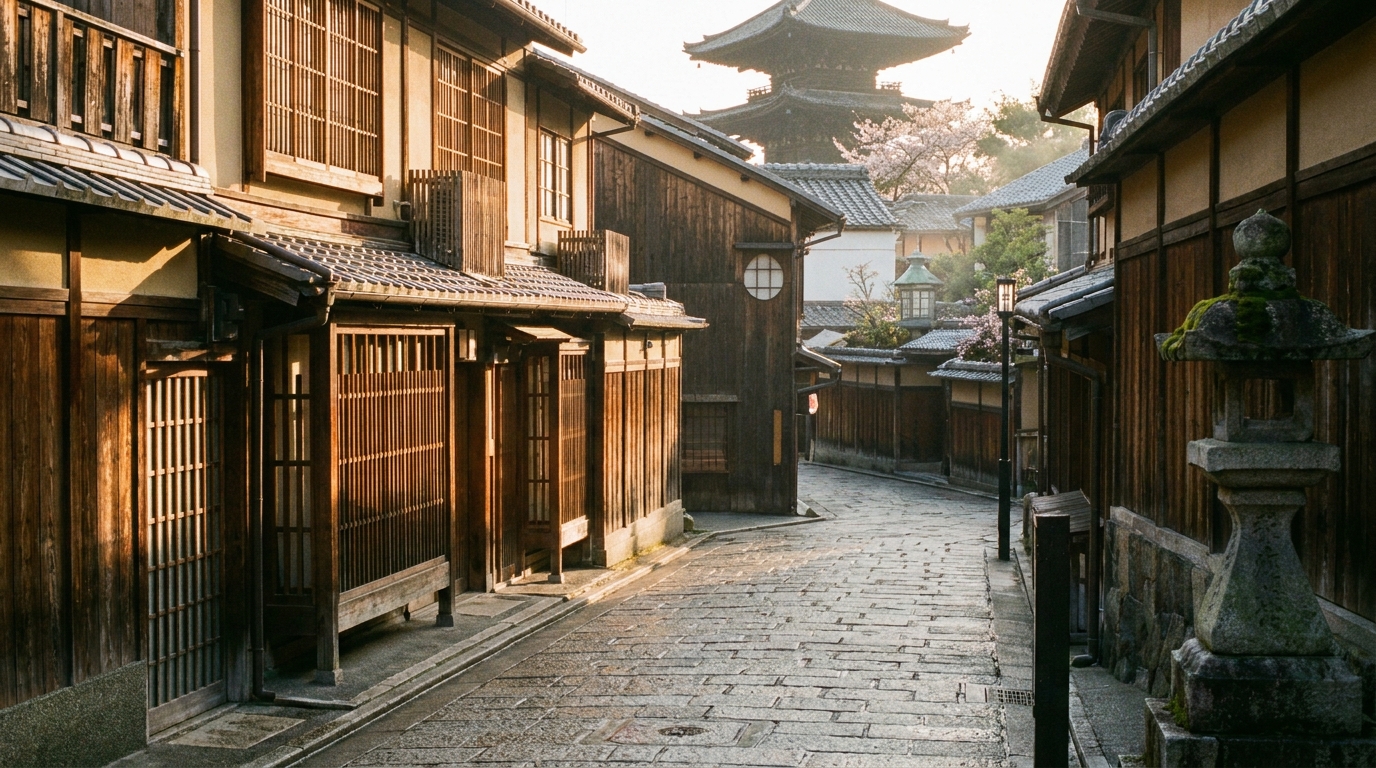
Kyoto compresses Japan’s pre-modern cultural density into a walkable, navigable city. You can visit two or three temples in a morning, eat well, and still have the afternoon free. The city operates on a manageable scale: the bus and subway network is adequate, cycling is a legitimate transport mode in the flatter central wards, and the Higashiyama walking corridor links several major sites on foot.
The hotel market has shifted meaningfully in the last five years. Where Kyoto once offered primarily ryokan and modest business hotels, it now has Park Hyatt, Four Seasons, Aman, Six Senses, and a cluster of high-design boutique properties in the Higashiyama and Nakagyo areas. The entry price for a well-located Western-standard hotel remains lower than Tokyo’s comparable tier, roughly 20 to 30 percent less for a similar room category.
Kyoto’s weakness as a base is its limited reach into contemporary Japan. If your interest extends beyond temples, gardens, and the preserved streets of Higashiyama, Kyoto exhausts its primary offerings in roughly four days. Day trips extend the utility: Nara is 45 minutes by train, Osaka is 30 minutes, Himeji Castle is just over an hour on the Shinkansen. But those are all variations on the same cultural-historical theme. If you want design districts, vintage shopping, electronic music, or contemporary architecture, Kyoto cannot supply them at Tokyo’s scale.
Tokyo as a Base: What You Get
Tokyo rewards the visitor who treats it as a collection of distinct neighborhoods rather than a single city. Shinjuku, Shibuya, Ginza, Asakusa, Shimokitazawa, Daikanyama, and Kichijoji each function as independent centers with their own food, retail, and nightlife logic. The city’s scale means you never exhaust it; after two weeks you will still have unexplored wards.
Hotel choice in Tokyo is more varied than anywhere in Japan. You can stay in a $400-per-night tower hotel in Shinjuku, a $250 boutique in Meguro, or a $120 efficiently designed business hotel near Tokyo Station that outperforms most American hotels at double the price. The diversity of price points and neighborhood character means Tokyo adapts to a wider range of budgets than Kyoto, where the floor for a well-located Western room is higher relative to what you get.
The Tokyo weakness is transit exhaustion. Getting from your hotel in Shinjuku to Asakusa takes 35 minutes on a good day. Day trips to Kamakura or Nikko consume 90 minutes each way. You will spend more time on trains in Tokyo than you would in Kyoto, and first-time visitors consistently underestimate how much transit the city demands. For a deeper assessment of Tokyo’s current visitor reality, including pricing and overtourism pressure, see our 2026 Japan assessment.
The Airport Factor
Your base decision also determines which airport you use, and that choice has real cost and convenience implications. We covered the Narita versus Haneda routing decision in a dedicated piece; the relevant point here is that Tokyo gives you two international airports with different profiles, while Kyoto directs you to Kansai International (KIX), roughly 75 minutes from Kyoto Station by express train.
If your itinerary is Kyoto-only, fly into KIX and out of KIX, or into KIX and out of Tokyo if you end the trip there. If your itinerary is Tokyo-only, Haneda wins for convenience and transfer time. Avoid the trap of flying into Narita for a Kyoto-focused trip; the Narita-to-Kyoto transfer will consume most of a day.
Verdict
You have 5 to 8 days. Pick one base. If your priority is cultural density, temples, gardens, and a slower pace, choose Kyoto. If your priority is food diversity, nightlife, shopping, and contemporary energy, choose Tokyo. Do not try to split; the half-day lost to transit is too expensive on a short timeline.
You have 9 to 14 days. Split your time, but lead with the city that matches your arrival airport. Give Kyoto four to five nights and Tokyo five to seven; Tokyo needs more time because its sites are farther apart. Use the Shinkansen for the transfer; the Nozomi makes the trip in roughly two hours and 15 minutes.
You have more than 14 days. Split, and consider adding a third stop. Osaka, Hiroshima, or Kanazawa all work as logical extensions from a Kyoto base. From Tokyo, consider Hakone or the Japanese Alps.
You are traveling with young children. Tokyo has more infrastructure for families: wider sidewalks, better stroller access, more food options for picky eaters, and attractions like teamLab and Ueno Zoo that work across age groups. Kyoto’s temples require quiet, involve steep stone steps, and offer limited engagement for children under eight.
You have a disability or limited mobility. Tokyo is the more navigable city by a significant margin. Its stations have elevators and escalators more consistently, its sidewalks are wider and flatter, and its hotel stock includes more accessible room categories. Kyoto’s historic districts, particularly Higashiyama and Arashiyama, involve uneven stone paths, stairs, and slopes.
FAQ
Q: Can I do both Kyoto and Tokyo in a week?
A: You can, but you should not. You will spend roughly 10 percent of your waking trip hours on the Shinkansen and station transfers, and you will leave both cities feeling like you saw the trailer instead of the movie. Pick one and do it properly.
Q: Which is cheaper, Kyoto or Tokyo?
A: Kyoto hotels are cheaper at the midrange and luxury tiers for a comparable room. Tokyo food is cheaper at the bottom end: a decent bowl of ramen or a set lunch costs less in Tokyo because competition drives prices down. Overall, a Kyoto-based trip tends to cost 10 to 15 percent less for an equivalent comfort level, mostly on accommodation.
Q: Is Kyoto too crowded to enjoy anymore?
A: In peak cherry blossom and autumn foliage weeks, yes, the major sites are oppressively crowded. Outside those windows, and if you visit the major temples early in the morning, Kyoto is manageable. The crowding is real but concentrated in time and location; it does not ruin the city if you plan around it.
Q: Do I need to speak Japanese?
A: No, but Tokyo is more English-friendly than Kyoto for navigation, restaurant menus, and hotel staff fluency. In Kyoto, having a translation app and a few polite phrases makes a material difference at smaller restaurants and ryokan.