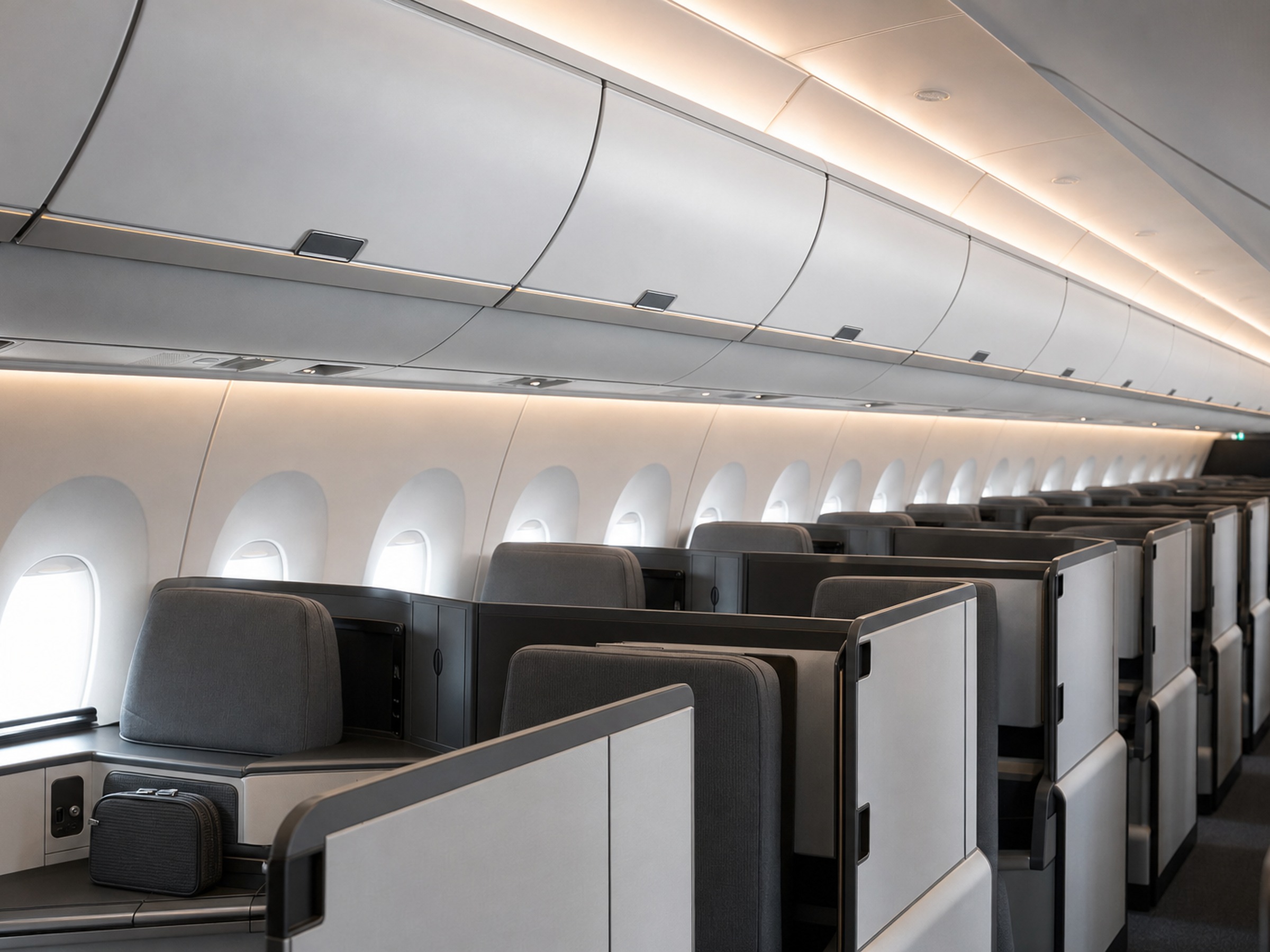
On a premium long-haul ticket, carry-on wins by default. It removes the wait at the belt and the risk of a bag that does not follow you. Checked baggage wins only in defined cases: when the trip runs beyond roughly a week, or when items that are allowed in the hold but not permitted in the cabin, such as liquids in larger containers, equipment, or large items, make the cabin limits unworkable.
The premium cabins change the arithmetic that applies in economy. On most long-haul business and first fares the checked allowance is included rather than sold, so the usual price argument disappears and the decision narrows to time, risk, and what the security rules will let through the cabin door. This framework is built from the carriers’ current published baggage allowances and priority-delivery policies, together with the liquid rules now in force at major airports, and it should be rechecked against your specific fare before you pack.
What the Two Options Actually Cost You
Start with what is already included, because the answer differs sharply by cabin. On British Airways long-haul, a Club World business passenger may bring a cabin bag of 56 by 45 by 25 cm plus a handbag or laptop bag, and on most long-haul routes two checked bags of up to 32 kg each. Premium economy also carries a two-bag allowance, though at a lower per-bag weight than Club World, which is more than many travelers assume. In economy the picture tightens, and fees start to apply on discounted fares. On long-haul low-cost carriers the model is built around charging for both the cabin bag and the hold.
Carry-on is not free in the way it appears. The real cost is a set of caps: dimensions, weight, and the liquid restrictions that vary by airport. Checked baggage carries its own costs, which are time and exposure. At the belt you add a wait that ranges from a few minutes to considerably longer at large hubs, and you accept a small but genuine chance that the bag is delayed. Priority delivery shortens the wait for eligible passengers, but it does not remove the risk, and eligibility is defined by each airline. On American Airlines, for example, priority bag delivery covers First and Business passengers, AAdvantage Platinum, Platinum Pro, and Executive Platinum members, and oneworld Emerald and Sapphire members, on bags checked directly with American, and a premium-cabin upgrade has to clear before check-in for it to qualify.
The Variables That Should Drive the Decision
Four variables settle most cases. Trip length determines volume: a week or more of clothing rarely fits a single cabin bag without laundry access. Routing determines risk: every connection is another chance for a checked bag to miss the transfer. Cabin determines price: on premium fares the bag is included, which neutralizes the fee argument entirely. And the liquids rule determines feasibility, because cabin limits vary by airport and a full-size bottle will not pass where the older limit still applies. The allowance itself is set by fare class rather than by cabin alone, so the same seat can carry different bag rules on different tickets.
The liquid picture is now uneven, which is where many travelers get caught. Heathrow permits containers of up to two litres at all of its terminals, and some other airports have adopted the same standard, but a number of European airports still cap each container at 100 ml even where the new scanners are installed. The rule that applies is the one at the airport you are actually passing through, not the one at your origin.
Decision Table
| Variable | Carry-on only | Checked bag |
|---|---|---|
| Cost on premium fares | Included; business often allows two cabin items | Usually included at no extra charge |
| Cost on discounted economy | May be charged where previously free | Priced per bag, per direction |
| Time on arrival | Walk out; no belt wait | Add a belt wait, longer at hub airports |
| Risk | Bag stays with you | Small chance of delay or loss, compounded by connections |
| Volume | Capped by dimensions, commonly around 55 by 40 by 23 cm, and by weight | Capped by piece count, dimensions, and weight, and by restricted-item rules |
| Liquids | Subject to the cabin limit at each airport, which varies | No cabin liquid limit applies |
| Priority handling | Not applicable | Available to eligible cabin and status passengers on some carriers |
| Best when | A short trip with predictable weather and easy laundry access | A long trip, multiple climates, or equipment and liquids the cabin will not take |
Pre-Departure Checklist
- Confirm the cabin allowance for your specific fare, including piece count, dimensions, and weight, because discounted fares differ from the headline cabin allowance.
- Measure your bag against the airline’s stated dimensions, not the retailer’s label, since manufacturer sizing is often generous.
- Check the liquid rule for every airport on the routing, not only your departure point, because limits now differ by scanner and by country.
- Decide the checked-bag question when you book rather than at check-in, because fees are typically lower online in advance.
- If you check a bag, keep medication, travel documents, chargers, and one change of clothing in the cabin.
- Photograph the bag and its contents before check-in, so a claim has a record if the bag is delayed.
- Confirm whether your cabin or status includes priority delivery, and whether the airline requires any upgrade to have cleared before check-in for it to apply.
- Link the bag decision to your seat choice, because overhead space is not distributed evenly across a cabin.
- On a tight connection, assume a checked bag may not follow you, and pack the first day from the cabin.
- For trips beyond a week with laundry access, treat carry-on as viable rather than heroic, and pack to the weight limit rather than to the volume.
When Checked Still Wins
Checked baggage remains the correct choice in three situations. The first is volume: a trip beyond about a week, or one that spans climates, rarely fits a cabin bag once shoes and layers are counted. The second is content: items that are allowed in the hold but not permitted in the cabin, such as liquids in larger containers, sporting equipment, or tools, have to travel checked. Note the reverse rule too: some dangerous goods are permitted only in the cabin and must not be placed in a checked bag, and hold bags carry their own dimension, weight, and restricted-item limits, so check the airline’s list before you decide what goes where. The third is a trip whose contents genuinely exceed a cabin bag. An included allowance removes the cost of checking, but by itself that does not make checking better: the handling risk and the belt wait do not disappear because the bag was included in the fare.
There is also a risk consideration that cuts the other way. If your fare includes a checked bag but your itinerary involves two or more connections, the bag is exposed to the same delays as the aircraft, and a short transfer is exactly where a checked bag is most likely to separate from its owner. The sensible default for a multi-connection premium trip is to carry on and keep the bag with you, and to check a bag only when volume or contents force it.
Verdict
For most premium long-haul trips of a week or less, travel carry-on only. The allowance is already paid, the bag stays with you, and the time saved at the destination is real. Check a bag when the trip exceeds roughly a week, when the contents cannot legally travel in the cabin, or when the itinerary is simple enough that the connection risk is low. The traveler this framework suits is one on a business or first fare who wants to arrive and leave without a detour to the carousel, and who is willing to pack to a weight limit to get it.
What to ignore: the assumption that a checked bag is the safe choice on a premium fare. It removes the packing constraint but adds a handling risk, and a delayed bag costs more of a short premium trip than a tight cabin does. Decide on trip length, routing, and contents, not on which option sounds more comfortable.
Frequently Asked Questions
Q: Is carry-on always cheaper than checking a bag?
A: No. On premium long-haul fares the checked allowance is usually included, so the fee argument disappears and the tradeoff becomes time and risk rather than price. On discounted economy fares the reverse is often true, and a cabin bag can carry a charge.
Q: How large can a carry-on bag be?
A: It depends on the airline. British Airways allows a cabin bag of 56 by 45 by 25 cm, and other carriers publish their own dimensions and weights. Check the airline’s stated figures rather than a bag’s marketing description.
Q: Can I take full-size liquids in a carry-on now?
A: At many airports, yes, though the rule is set per airport. Heathrow permits containers of up to two litres at all of its terminals (2, 3, 4, and 5), while a number of other European airports still cap each container at 100 ml even where newer scanners are installed. The limit at each airport on your routing governs, so check the rule for every airport you pass through.
Q: Does priority baggage delivery guarantee my bag comes out first?
A: It improves the odds and shortens the wait for eligible passengers, but it is not a guarantee, and eligibility is set by each airline. On American Airlines, for example, First and Business passengers, AAdvantage Platinum and above, and oneworld Emerald and Sapphire members qualify, on bags checked directly with the airline, provided any premium-cabin upgrade has cleared before check-in.
Q: What should I keep in the cabin if I check a bag?
A: Medication, travel documents, chargers, valuables, and at least one change of clothing. On a multi-connection trip, pack the first day from the cabin in case the bag arrives later than you do.
Q: How much time should I allow at the belt for a checked bag?
A: Allow a realistic margin rather than an optimistic one, particularly at large hub airports where the walk and the wait are both longer. If you have a time-critical arrival, budget for a delay rather than the best case.
Q: Does a premium fare always include a checked bag?
A: On most long-haul business and first fares it does, and premium economy frequently includes it as well. The exact allowance depends on the route and the fare, so confirm it for your booking rather than assuming it from the cabin name.