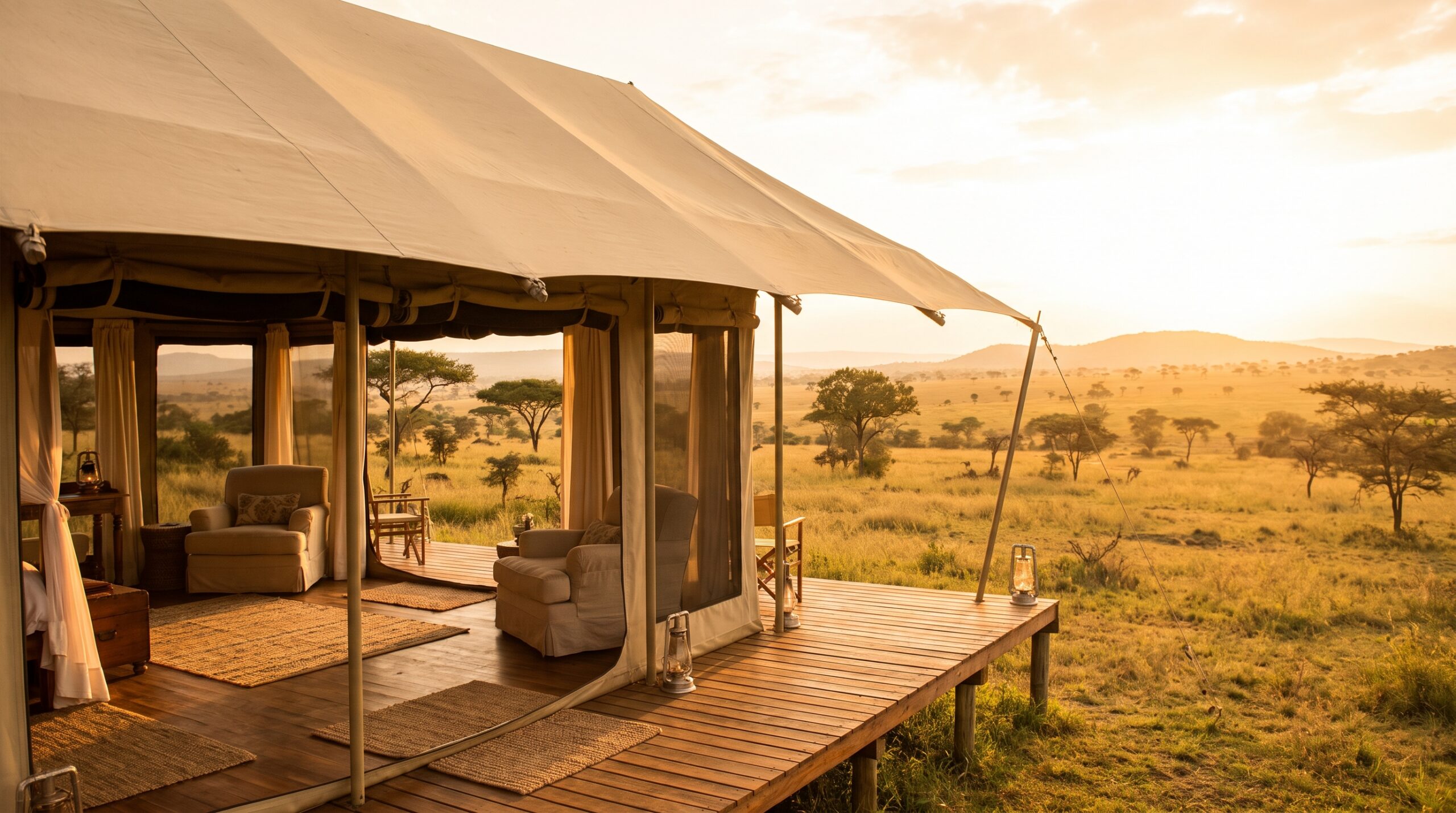
Safari lodges look expensive at the headline — EUR 600-2,500 per person per night is common — but the per-night rate typically includes game drives, meals, drinks, laundry, and transfers that would cost hundreds of euro per day if purchased separately. The all-inclusive safari math works differently from all-inclusive resort math, and in most cases, the bundled lodge rate is better value than an a la carte alternative.
A safari lodge rate can induce sticker shock. A mid-tier camp in the Serengeti at EUR 700 per person per night reads as exorbitant compared to a EUR 400 five-star city hotel. But the hotel rate includes a room and breakfast. The safari rate includes game drives with a guide and vehicle, three meals, drinks, park fees, laundry, and transfers from the nearest airstrip — items that, if itemized, often exceed the bundled rate. This article explains what the per-night rate actually covers, where the value lies, and when an a la carte safari makes more sense.
What the All-Inclusive Safari Rate Typically Includes
Safari pricing is not standardized, but the following is typical for mid-tier to luxury lodges and camps across Kenya, Tanzania, South Africa, and Botswana:
Accommodation: The tent, room, or suite. At the luxury tier, this can mean a 100-square-meter canvas suite with a plunge pool. At the mid-tier, a comfortable tented room with an en-suite bathroom.
Game drives (2 per day): Morning and afternoon drives in an open-sided vehicle with a professional guide and sometimes a tracker. This is the core product. A private guide and vehicle costs extra at most lodges.
Meals (3 per day): Full breakfast, lunch, and dinner. At luxury lodges, the food is destination-restaurant quality. At mid-tier camps, it is solid and plentiful but not gourmet.
Drinks: House wine, beer, spirits, soft drinks, and water are typically included at the all-inclusive tier. Premium wines and champagne cost extra. Some lodges exclude imported spirits.
Park and conservation fees: These are significant. A 24-hour Serengeti National Park fee is roughly USD 70-80 per adult. Maasai Mara fees are roughly USD 80 per adult per day. Over a 4-night stay, park fees alone can total USD 300-400 per person — and the lodge rate typically absorbs them.
Laundry: Included at most all-inclusive camps. This is not a luxury line item. It means you can pack lighter and fly on bush planes with strict weight limits (typically 15 kg in soft-sided bags).
Airstrip transfers: The road transfer from the nearest bush airstrip to the lodge, which can be 30-90 minutes. Not the flight to the airstrip itself — that is booked separately.
What It Does Not Include
International and domestic flights: The flight to Nairobi, Kilimanjaro, or Johannesburg, plus the bush plane from the international gateway to the lodge airstrip. Bush flights are priced separately and range from roughly USD 200-500 per leg depending on distance.
Premium drinks: Champagne, premium spirits, and reserve-list wines.
Private vehicle and guide: At most lodges, game drives are shared with other guests (typically 4-6 per vehicle). A private vehicle costs extra — USD 300-500 per day is typical.
Gratuities: Tipping guides (USD 15-25 per guest per day), camp staff (USD 10-15 per guest per day), and transfer drivers.
Travel insurance: Required by most high-end operators and camps. Evacuation coverage is non-negotiable — a medical evacuation from a remote camp by air can cost USD 20,000-50,000.
Additional activities: Walking safaris, night drives (where legal), hot-air balloon safaris, cultural village visits. These are typically extra and can range from USD 50-500.
The Real Cost Structure: All-Inclusive vs. A La Carte
A mid-tier all-inclusive camp in the Serengeti at USD 700 per person per night breaks down roughly as follows when you reverse-engineer the components:
| Component | Estimated a la carte cost (per person/day) |
|---|---|
| Accommodation | USD 250-300 |
| Two game drives (shared vehicle, guide) | USD 200-250 |
| Three meals | USD 80-100 |
| Drinks (house wine, beer, water) | USD 30-50 |
| Park fees | USD 70-80 |
| Laundry, transfers, WiFi | USD 20-30 |
| Total (estimated a la carte) | USD 650-810 |
The bundled rate of USD 700 sits in the middle of the a la carte range. You are not saving dramatically over itemized pricing. You are paying for convenience and not being nickel-and-dimed in a remote location where you have no alternatives.
At the luxury tier (USD 1,500-2,500+ per person per night), the calculus shifts. The accommodation component is the largest variable — luxury lodges compete on suite quality, plunge pools, view, and exclusivity. The game-drive product is similar to what a mid-tier camp offers, but with better guide-to-guest ratios and more experienced trackers. The value at this tier is in the hard product and the location (private concessions with fewer vehicles per sighting), not in the bundled cost savings over a la carte.
When an A La Carte Safari Makes More Sense
Self-drive in Kruger or Etosha: South Africa’s Kruger National Park and Namibia’s Etosha have excellent self-drive infrastructure. You rent a vehicle (USD 50-80 per day), book rest-camp accommodation (USD 80-150 per night), pay park fees directly (roughly USD 25 per adult per day), and self-cater or eat at rest-camp restaurants. A self-drive Kruger safari can cost USD 150-250 per person per day — dramatically less than a guided lodge. The tradeoff: you are your own guide, you stay on designated roads, and you miss the tracker’s ability to find animals you would drive past.
East African budget camping safaris: Operator-organized camping safaris in Kenya and Tanzania using public campsites and a shared guide/vehicle can cost USD 200-350 per person per day. You sleep in dome tents, eat camp cooking, and share a vehicle with 6-8 guests. The guide and game-viewing experience are similar to a lodge. The accommodation and food are not.
South Africa lodge stays booked without the full package: Some South African private reserves offer room-only rates at lodges near Kruger’s gates. You book game drives separately (USD 50-80 per drive) and handle meals yourself. This can work if you only want a few drives and prefer flexibility, but the per-drive cost is higher than the bundled rate.
Checklist: Safari Pricing Decisions
- Budget safari (self-drive or budget camping): USD 150-350 per person per day. Good wildlife viewing, basic accommodation. Best in South Africa and Namibia.
- Mid-tier all-inclusive lodge: USD 500-900 per person per day. Comfortable accommodation, shared game drives, full board. Best value tier in East Africa (Kenya, Tanzania).
- Luxury all-inclusive lodge: USD 1,200-2,500+ per person per day. Exceptional suites, private concessions, low vehicle density at sightings. Best in Botswana, private reserves in South Africa, and top Serengeti camps.
- Always confirm what “all-inclusive” means at the specific property. Some lodges use it to mean full board plus select drinks; others mean everything except champagne and private vehicles.
- Factor park fees into any a la carte comparison. They are invisible in the bundled rate and visible (and significant) when itemized.
- Private vehicles add USD 300-500 per day and are the single most impactful upgrade at any tier — you control the pace and duration of sightings.
- Bush flights are a separate, fixed cost. A 4-night Serengeti safari typically adds USD 400-600 per person in domestic flights between Arusha and the lodge airstrip.
What This Can’t Tell You
This framework covers pricing structure, not wildlife-viewing quality, which varies enormously by reserve, season, and luck. The best-value lodge in the wrong reserve at the wrong time of year is a bad deal regardless of the bundled rate. It also does not cover gorilla trekking (Rwanda, Uganda), which operates on a different pricing model (permit-based, typically USD 800-1,500 per trek) and is unrelated to the lodge-cost framework. And it does not address the ethical dimension of safari pricing — some ultra-low-cost operations cut corners on guide wages, vehicle maintenance, and conservation contributions. The cheapest option is not always the best value.
Verdict
The all-inclusive safari lodge rate is not a markup. It is a bundle that, when reverse-engineered, typically costs roughly what the components would cost a la carte — and in remote locations with no alternatives, the convenience of the bundle is worth the absence of savings. If you want maximum value per wildlife-viewing euro, a mid-tier all-inclusive camp in the Serengeti or Maasai Mara at USD 500-700 per person per night is the sweet spot: solid accommodation, professional guiding, and the core safari experience without the luxury-hardware premium. If you want to spend less, self-drive in Kruger or book a budget camping safari. If you want private concessions and exceptional suites, the luxury tier delivers — but the value is in the product, not the bundled-cost savings.
FAQ
Q: Why are safari lodges more expensive than five-star city hotels?
A: Remote logistics. Everything at a safari camp — food, fuel, water, staff, building materials — arrives by bush plane or truck. Staff live on-site for weeks at a time. Park fees and conservation levies are built into the rate. A city hotel does not maintain its own fleet of vehicles, employ guides and trackers, or operate its own water treatment and generator system.
Q: Is it cheaper to book a safari directly with the lodge or through a tour operator?
A: Lodge-direct rates and operator-packaged rates are often the same — operators earn commission from the lodge, not by marking up the lodge rate. A good operator adds value by matching you to the right camp, handling logistics, and troubleshooting problems. A bad operator adds cost without adding value. Compare the operator’s package price to the lodge’s direct rate; if they match, use the operator.
Q: Can I do a safari for under USD 300 per person per day?
A: Yes — self-drive in Kruger (USD 150-250 per person per day) or budget camping safaris in East Africa (USD 200-350). The wildlife viewing can be excellent. The accommodation and food will be basic.
Q: When is the best time of year for a safari — and does it affect pricing?
A: Dry season (June-October in East Africa, May-September in Southern Africa) offers the best wildlife viewing because animals concentrate around water. It is also peak pricing. Green season (November-March in East Africa) offers lower rates (20-40% off), greener landscapes, fewer vehicles, and excellent birding — but animals are more dispersed and harder to find. The shoulder months (late May, early November) often offer the best price-to-viewing ratio.