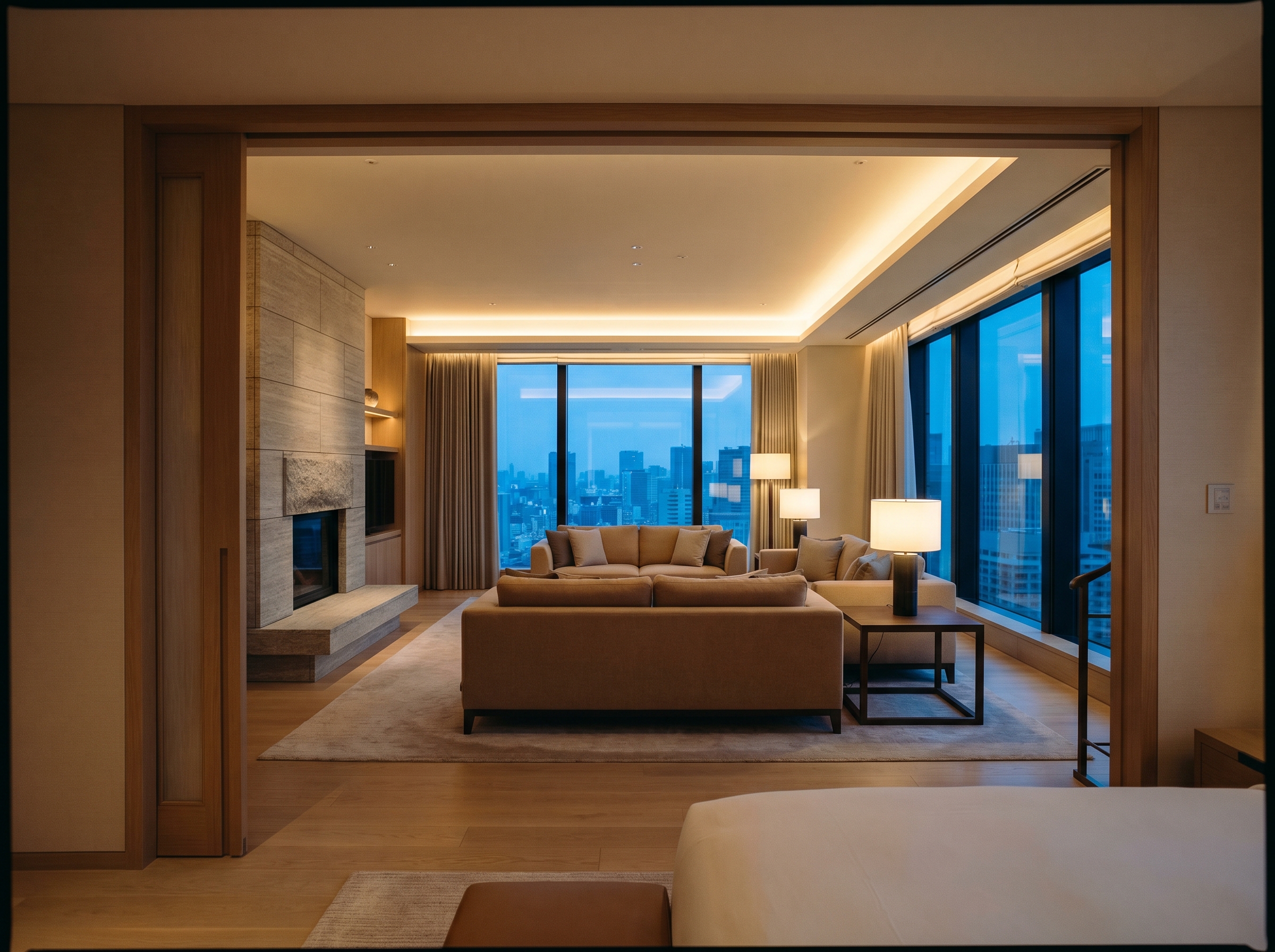
Most travelers overpay for suites on trips where they will barely use the room and skip the upgrade on the one trip where it would actually earn its cost. The decision comes down to one variable: how many waking hours you will spend inside the room. If the answer is fewer than four, a standard room with a view is almost always the better call. If the answer is six or more, and especially if you are traveling with another person who needs workspace or privacy, the upgrade math shifts sharply in the suite’s favor.
The problem is that hotels make the upgrade decision emotional. They show you the soaking tub. They mention the separate living area. They describe the “experience.” What they do not show you is the calculation: how much you are really paying per usable square foot, what included perks are worth in tangible terms, and which trip types genuinely reward the extra space.
This piece walks through that calculation for the five most common travel scenarios, with a clear verdict for each.
The Upgrade Cost Reality
Suite upgrades vary wildly by property type, but the patterns are consistent enough to build a framework around them. At a mid-range city hotel, the step from a standard room to a junior suite typically costs $50 to $80 per night. At a luxury urban property, that number climbs to $150 to $300. At a resort, a proper suite with separate living space can run anywhere from $200 to $500 above the entry-level rate.
Those are the sticker prices. What matters is what you get for them.
A junior suite at a chain hotel usually adds 100 to 150 square feet and a seating area. A one-bedroom suite at a luxury property typically doubles the square footage and adds a door between rooms. A resort suite often includes a plunge pool, a view tier upgrade, or club lounge access that the base room does not.
The simplest filter: divide the upgrade cost by the additional square footage. If you are paying less than $1 per additional square foot per night, the upgrade is reasonably priced by real estate standards. If you are paying more than $2 per square foot, you are paying for branding rather than space, and the math rarely works unless the non-space perks carry real value.
Scenario by Scenario
The short city break (1 to 2 nights). You will be in the room to sleep, shower, and change. Total waking room time: maybe 90 minutes a day. Paying an extra $80 to $150 per night for a room you do not sit in is a waste. A standard or superior room with a comfortable bed and decent water pressure is all you need. If the hotel offers a corner room with more natural light for $30 more, take it. Skip the suite.
Verdict: Skip.
The business trip (2 to 4 nights). You will work from the room for several hours each evening, possibly take calls from it, and may need to host a colleague for a 30-minute conversation. Here the calculus changes. A junior suite with a proper desk, a seating area that is not your bed, and enough space that a room service tray does not crowd your laptop can genuinely improve productivity and comfort. At $60 to $80 per night, the upgrade pays for itself if you bill by the hour. At $200, it does not.
One nuance: if the suite includes club lounge access and you would otherwise buy breakfast and evening drinks, factor those savings in. Lounge access alone can offset $40 to $60 of the upgrade cost at a full-service property.
Verdict: Worth it at $50 to $100 per night, especially with lounge access. Skip above $150.
The romantic getaway (3 to 4 nights). This is where hotels win the emotional sale. The suite feels special. The bathtub is bigger. The view might be better. The problem is that on most romantic trips, the room is still only used for sleeping and the obvious. A $150-per-night suite upgrade over four nights costs $600 before tax. For $600, you can buy a spectacular dinner, a private boat charter, or a spa treatment for two experiences you will remember more vividly than an extra 200 square feet.
The exception: if the hotel is the destination (a remote resort, a property you chose specifically for the room experience), the suite becomes part of the product rather than just the container for it. In that case, the splurge is defensible. But for a city hotel where you will spend days exploring? Take the standard room and spend the difference on the city.
Verdict: Skip unless the hotel is the destination.
The family trip (4 to 7 nights). This is the scenario where suites earn their premium most consistently. Two connecting standard rooms at a decent hotel run $300 to $500 per night combined. A two-bedroom suite or a one-bedroom with a pullout sofa often costs $250 to $400. You get a shared living space, a door you can close between sleeping areas, and often a kitchenette that saves $40 to $60 per day on breakfast alone. Over four to seven nights, the suite is frequently cheaper than two rooms and materially better for family sanity.
The kitchenette is the sleeper value here. A family of four spending $60 on hotel breakfast every morning saves $240 to $420 over four to seven nights. That alone can cover most or all of the upgrade cost, making the extra space effectively free.
Verdict: Worth it. Do the two-rooms-vs-suite comparison before booking.
The extended stay (7+ nights). At seven nights or more, the suite moves from a discretionary upgrade to the financially rational choice. A kitchenette or full kitchen saves $50 to $80 per day on food compared to eating every meal out. A separate living area prevents the claustrophobia that sets in when your bedroom is your office is your dining room. Laundry facilities, if included, cut another $30 to $40 per trip.
Run the numbers on a 10-night stay: a suite costing $100 more per night than the standard room ($1,000 total premium) that includes a kitchen saves roughly $500 to $800 in food costs over 10 days, plus another $40 in laundry. Net premium: roughly $160 to $500 for dramatically better quality of life. That is a bargain.
Verdict: Worth it, often net cheaper.
When Two Rooms Beat One Suite
For families of four or more, a pair of connecting standard rooms frequently outperforms a suite on both price and practicality. Two rooms give you two full bathrooms (versus one or one-and-a-half in most suites), two televisions, and real privacy. At a mid-range hotel where rooms run $150 each, two rooms cost $300. A family suite at the same property might run $350 to $400 and give you less bathroom access.
The tradeoff is the shared living space. If your family actually gathers in the living room to play cards or watch a movie, the suite’s common area has value. If everyone retreats to their own space after dinner, the two rooms win.
Always price both before booking. Hotels rarely surface the comparison themselves.
The Loyalty and Status Factor
Hotel loyalty status changes the upgrade calculus significantly. Mid-tier and top-tier elite members at the major chains receive complimentary suite upgrades at check-in when space is available, subject to the property’s discretion on any given day. This means the question shifts from “should I pay for the suite” to “should I book the suite or gamble on a free upgrade.”
The honest answer: never book a suite expecting a free upgrade to something better. The upgrade path from a paid suite is to a premium suite or specialty suite, and those are scarce. If you want the suite, book it. If you are indifferent, book the standard room and let status do what it can. But if you would be genuinely disappointed to end up in a standard room, pay for the upgrade. The free-upgrade gamble is a bonus, not a strategy.
The Window of Usefulness
A final filter that most upgrade advice misses: how many hours will you actually notice the difference? A separate living room is great, but if you check in at 6 p.m., go to dinner at 7:30, sleep, and leave at 9 a.m., you never occupied that living room. You paid for it, you saw it, you did not use it.
The suite upgrade makes sense when the room is part of your trip, not just the place you store your luggage. That means extended stays, remote resorts, work trips that require room-based productivity, and family travel where the room functions as a living space for multiple people. For everything else, book the best standard room you can afford and spend the difference on the trip itself.
Frequently Asked Questions
Q: How much more does a suite typically cost than a standard room?
A: The premium ranges from roughly $50 to $80 per night at mid-range city hotels, $150 to $300 at luxury urban properties, and $200 to $500 at high-end resorts. The premium is highest at properties where the suite represents a genuine category jump (separate living room, different view tier, exclusive access) and lowest at limited-service hotels where “suite” often just means a slightly larger room with a sofa.
Q: Is a suite ever cheaper than two connecting rooms?
A: Frequently. A two-bedroom suite or one-bedroom with pullout often costs $250 to $400 per night. Two connecting rooms at the same property typically run $300 to $500 combined. Over four to seven nights, the suite can save $200 to $700 total while providing a shared living area and often a kitchenette that further reduces meal costs.
Q: Does hotel loyalty status make suites free?
A: Top-tier elite members at major chains receive complimentary suite upgrades at check-in when availability permits, but the upgrade is never guaranteed. Mid-tier elites may receive upgrades to preferred rooms or higher floors rather than suites. The free-upgrade path is a useful bonus, not a reliable strategy. If you need the suite, book it.
Q: When is the suite upgrade clearly a waste of money?
A: On trips of one to two nights where you will spend fewer than four waking hours per day in the room; at city hotels where you plan to be out from morning until late evening; and at properties where the “suite” designation means only a modestly larger room without meaningful additional features like a separate living area, kitchenette, or lounge access.