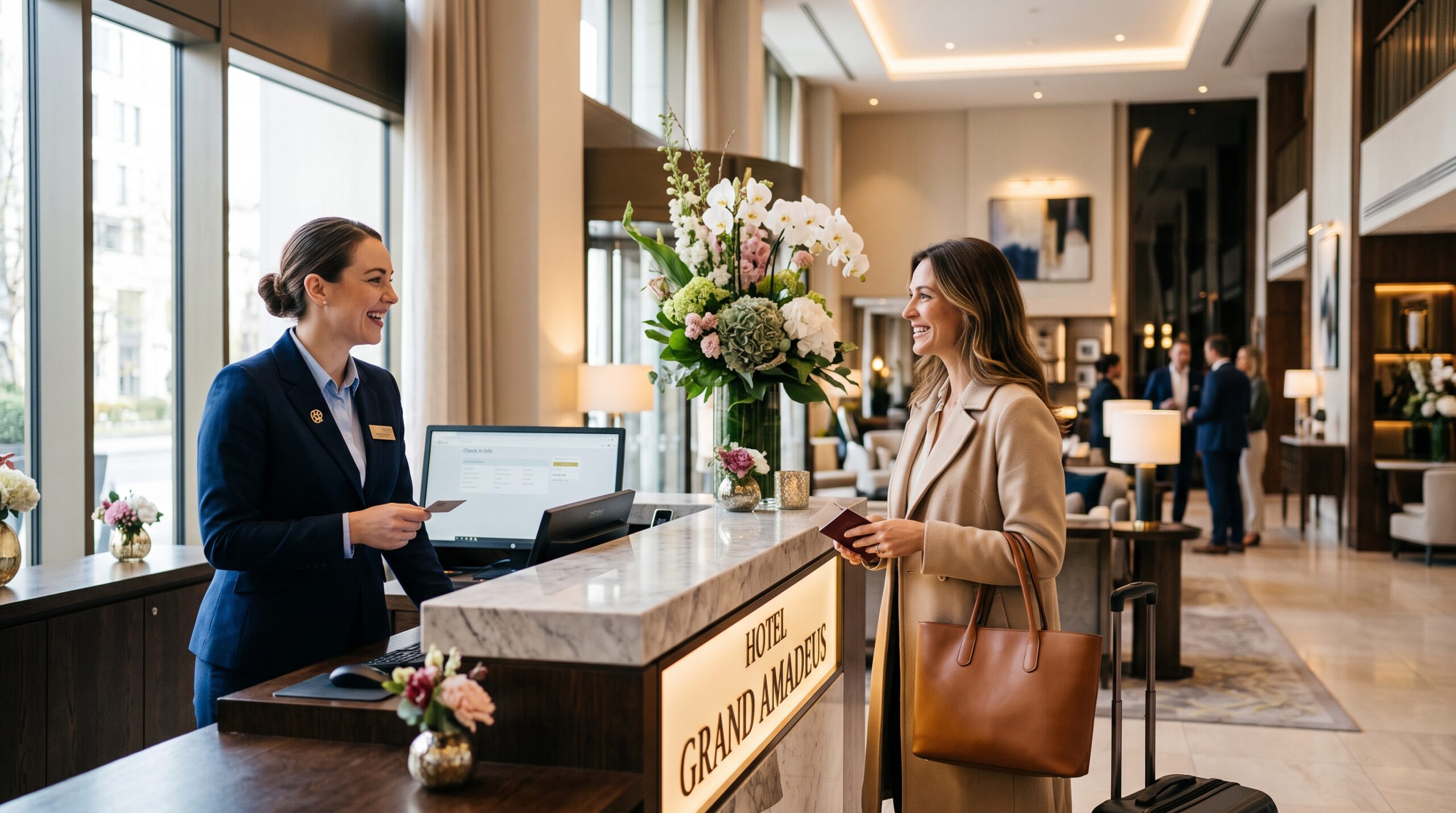
The single most effective upgrade tactic at check-in is asking directly, politely, and with a specific reason — and the single most reliable predictor of success is arriving after 4 p.m. on a weekday at a property running below 70% occupancy. No amount of charm overcomes a sold-out hotel.
Hotel upgrades at check-in are not a secret art. They are a function of three variables: occupancy rate, loyalty status, and how the request is made. The front desk agent has discretionary authority to upgrade rooms within limits set by the revenue manager. That authority is broader at independently operated properties than at chain hotels with automated upgrade queues. Understanding the mechanics — when the inventory exists, how status programs prioritize upgrades, and what phrasing triggers a yes rather than an eye-roll — is the difference between a suite on the 20th floor and a room next to the elevator.
The Occupancy Window
Hotels do not upgrade guests when they are full. They upgrade when they have unsold inventory in higher categories and a guest who might appreciate — and return because of — the gesture. The sweet spot is occupancy below 70%, which is most common on Tuesday and Wednesday nights at business hotels and Sunday through Thursday at urban leisure properties. Weekend nights (Friday/Saturday) at leisure hotels and Monday nights at business hotels are the tightest — upgrades are rare at 90%+ occupancy regardless of status or approach.
Check-in timing matters. Arriving at 2 p.m. — the start of the check-in window — means the hotel has not yet processed all departures and room assignments. The front desk cannot confirm what inventory will be available. Arriving at 5-7 p.m. means the hotel knows exactly which rooms are occupied, which are clean, and which premium rooms remain unsold. Late check-in is the upgrade sweet spot.
Loyalty Status: The Automated Advantage
At chain hotels (Marriott, Hilton, Hyatt, IHG), upgrades are processed automatically by the property management system 24-72 hours before arrival based on elite status tier and availability. Marriott Platinum Elite and above, Hilton Gold and Diamond, and Hyatt Globalist are the tiers at which complimentary upgrades become systematic rather than occasional. Below those thresholds, upgrades are at the front desk’s discretion — the system will not auto-assign them, but the agent can.
The automated system is both an advantage and a ceiling. If you have top-tier status and the hotel has availability, the upgrade happens without you saying a word. But if the system did not upgrade you — because it assessed availability as insufficient or because your status tier does not trigger automatic upgrades — the front desk agent cannot easily override the system at a major chain property. The agent’s terminal will reject a room-category change the revenue-management system has not authorized.
At independent and boutique properties, there is no automated system. The front desk agent’s discretion is the entire upgrade mechanism. This is where asking makes the largest difference.
How to Ask
The phrasing matters more than most travelers realize. Front desk agents hear upgrade requests constantly. The requests that work are specific, low-pressure, and framed as a question the agent can answer positively without risking their job.
What to say: “I noticed the hotel doesn’t look too busy tonight — is there any flexibility on upgrades for a room with a better view?” Or: “I’m celebrating an anniversary and was wondering if you have any rooms with a little more space available.” Or, for status holders: “I know my [Platinum/Gold] status sometimes opens up upgrades — would you mind checking if anything is available?”
What not to say: Do not demand. Do not mention that you are an influencer, a reviewer, or “friends with the GM” (the GM is contactable, and the agent can verify this in 15 seconds). Do not complain about anything unrelated as leverage (“the flight was terrible, so I really need a nice room” — the agent did not operate the flight and does not owe you compensation). Do not name a specific suite type unless you are willing to pay the published upsell rate for it.
The special occasion card: Legitimate celebrations (honeymoon, anniversary, milestone birthday) communicated in advance — ideally via email 1-2 weeks before arrival, not at check-in — have a meaningfully higher upgrade success rate. Hotels train staff to recognize and act on celebration bookings. Mention it at booking, not at the front desk when the agent has 60 seconds to process your check-in.
Paid Upsells: When the Math Works
Many hotels now offer paid upgrade offers at check-in or via pre-arrival email: “Upgrade to a suite for USD 75/night.” These are revenue-management tools, not gestures of goodwill. But they can be worth taking when the differential between the suite’s published rate and your booked rate is large.
If you booked a standard room at USD 250/night and the suite is selling for USD 450/night, a USD 75/night upsell is a 63% discount on the suite. If the suite adds meaningful space (separate living area, better view, balcony), the USD 75 may be better value than booking the suite outright. The counterargument: if the hotel is offering paid upsells, occupancy is low enough that a complimentary upgrade was theoretically possible — and a paid upsell at check-in closes the door on the complimentary path.
If you are willing to pay for the upgrade, ask: “Is there any flexibility on that rate, or would you be able to do a complimentary upgrade for a return guest?” You may get a better price or a waiver. You will not get either if you do not ask.
Checklist: Upgrade Strategy
- Check the hotel’s occupancy before arrival (search for the property on your dates — if multiple room categories show “only 2 left” or “sold out,” upgrades are unlikely).
- Arrive between 5 and 7 p.m. Late check-in means the hotel knows exactly which premium rooms remain unsold.
- Mention celebrations at booking, not at check-in. Email the hotel 1-2 weeks in advance — it costs nothing and raises the upgrade probability measurably.
- At chain hotels, know your status tier’s upgrade eligibility. Marriott Platinum+ and Hyatt Globalist get automatic upgrade processing for suites. Below those tiers, upgrades are front-desk-discretionary.
- At independent hotels, ask directly and politely — the front desk agent’s discretion is the entire upgrade mechanism.
- Paid upsells can be good value at 50%+ off the suite’s published rate. Negotiate the upsell price: a polite “Is there any flexibility?” often produces a lower number.
- Do not book through an OTA (Expedia, Booking.com) and expect an upgrade. OTAs are the lowest upgrade priority. Direct bookings, especially through the hotel’s own website, signal a more valuable guest relationship.
Verdict
Hotel upgrades at check-in are a function of low occupancy, high status, and a well-phrased request — in that order. The tactics that work: arrive late, ask specifically and politely, mention legitimate celebrations in advance, and book direct. The tactics that do not: demanding, name-dropping, complaining, or relying on status tiers that do not trigger automatic upgrade processing. At independent hotels, asking is the upgrade strategy. At chain hotels, status is — and if the system did not upgrade you, the front desk probably cannot either. A paid upsell at 50%+ off the suite’s published rate is sometimes the better move than holding out for a complimentary upgrade that the occupancy numbers do not support.
FAQ
Q: Does tipping at check-in get me an upgrade?
A: The “USD 20 sandwich” — a bill folded between your credit card and ID at check-in — has a mixed track record. At independent and boutique hotels in the US, it can work, especially at lower occupancy. At chain hotels, the front desk’s upgrade capability is constrained by the property management system, and a tip does not change the system’s authorization rules. At international properties (Europe, Asia), tipping at check-in is unusual and can create discomfort rather than goodwill.
Q: Does booking directly with the hotel help?
A: Yes, measurably. Hotels prioritize direct bookings for upgrades because the guest relationship is direct — they have your email, your booking history, and no OTA commission (15-25%) reducing the margin on your stay. OTA bookings are the lowest upgrade priority.
Q: Can I get an upgrade for free with a credit card?
A: The American Express Fine Hotels & Resorts and Chase Luxury Hotel & Resort programs include “room upgrade upon arrival, subject to availability” as a standard benefit on qualifying bookings. These are not guaranteed but are prioritized similarly to mid-tier hotel elite status.
Q: Is it worth emailing the hotel before arrival?
A: Yes, especially for celebrations. A brief, polite email 1-2 weeks before arrival mentioning a specific reason (anniversary, birthday, first visit to the city) raises the probability of an upgrade. The hotel can note it in the reservation without committing inventory — and at check-in, a noted celebration is a legitimate trigger for the agent’s discretionary upgrade authority.
Q: What if they say no?
A: Thank them genuinely and move on. The agent remembers a gracious response to a no. Pushing or complaining after a polite refusal not only does not produce an upgrade — it can result in a note on your reservation that precludes upgrades on future stays. The relationship with hotel staff is a long-term asset. An upgrade is a one-time transaction. Do not trade the former for the latter.