Updated August 2026. Tourism arrival data verified against the Hellenic Statistical Authority (ELSTAT) monthly publications. Weather observations are based on general meteorological patterns for the region.
Greece in September is the right call for most travelers — the sea has had all summer to warm, visitor numbers drop noticeably from the August peak, and hotel evaluation checklist rates decrease as the high-season demand softens. The only travelers who should consider August instead are those who specifically want the full-season energy of Mykonos and Santorini overtourism reality at peak volume, or who cannot travel after the first week of September.
The conventional wisdom is that July and August are the “right” months for Greece. That is the tourist calendar, not the optimal one. Sea temperatures are warmer in September than in June — the Aegean has spent three months absorbing heat. The Acropolis, which requires advance-booking slots in peak summer, becomes more accessible. Santorini’s caldera views become more manageable without peak-summer queues.
What September Actually Delivers
Weather. Daytime temperatures in Athens and the Cyclades are typically in the high 20s Celsius in early September, gradually cooling through the month. Sea temperatures in the Cyclades are generally in the mid-20s Celsius — warm from the accumulated summer heat. Evenings are comfortable. The weather becomes less stable in late September: windy or briefly rainy days are possible, particularly in the northern Aegean and Ionian islands. For beach-focused trips, the first three weeks of September are the sweet spot.
Crowds and prices. The transition from August to September is real but not uniform. According to the Hellenic Statistical Authority (ELSTAT), accommodation arrivals in September 2025 totaled approximately 5.09 million, compared to approximately 7.19 million in August 2025 — a reduction of roughly 29% in total arrivals across hotels and similar establishments. This is total accommodation arrivals (domestic and international), not site-specific visitor counts. The reduction is most pronounced after mid-September, when school calendars in Germany, France, and the UK reduce family travel demand. Hotel rates generally decrease from summer peaks as demand softens, though the exact percentage varies significantly by property type, island, and booking channel — luxury properties on Santorini tend to maintain rates more aggressively than mid-range accommodations on less-visited islands, where rate drops are steeper.
Practical access. The Acropolis, which sells out daily time slots weeks in advance in July and August, has same-week availability through most of September. Delphi, Olympia, and the National Archaeological Museum in Athens are similarly more manageable. Restaurant reservations at sought-after establishments in Santorini and Mykonos become possible 1-2 weeks out rather than months out.
The Island Routing Question
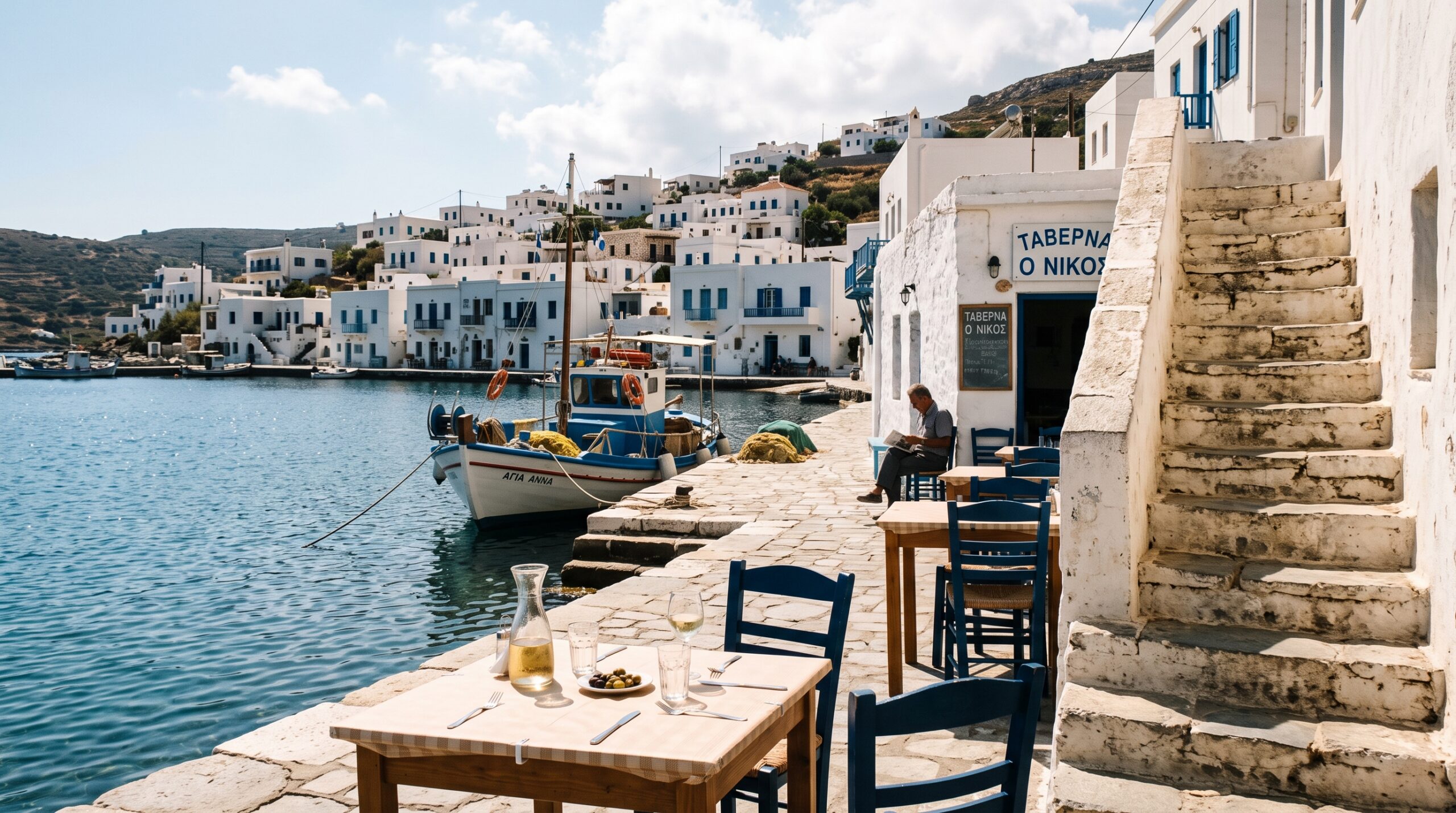
The most important planning decision in Greece is which islands — and the answer changes in September. Santorini and Mykonos remain worth the visit but no longer require the heroic advance booking effort of August. Both are fully operational through late September: restaurants are open, ferries run on full summer schedules, beach bars remain active.
For travelers comfortable with slightly shorter operating seasons, September opens up islands that are overwhelmed in peak summer. Hydra, Folegandros, and Amorgos — car-free islands with strong architectural character — are more pleasant in September when visitor numbers are manageable. Crete, Rhodes, and Corfu are ideal for beach-focused trips in September because of their size and coastline diversity; their western coasts are particularly good in late September when northern winds produce ideal conditions for windsurfing and kitesurfing.
The Peloponnese — Nafplio, Monemvasia, the Mani peninsula — sees almost no reduction in quality in September and benefits from the same crowd reduction as the islands. For travelers combining ancient sites with sea access, the Peloponnese in September is one of the strongest travel propositions in Europe.
What September Does Not Deliver
Late September brings shorter days, cooler evenings, and the first chance of rain. Beach clubs on smaller islands begin closing in the final week. Ferry schedules reduce from full summer frequency to shoulder-season timetables by late September, though they do not stop entirely. The Meltemi wind, which calms in September, can still produce windy spells in the Cyclades. These are not dealbreakers — they are calendar realities that affect trip planning, not reasons to avoid September.
Verdict
Greece in September is the right call for most travelers. The sea is warm, the crowds are reduced, the prices are lower, and the experience is closer to what the marketing images promise than the August reality delivers. The travelers who should stick with August are those seeking peak energy — the packed beach clubs, the full-volume nightlife, the at-capacity islands — or those whose travel dates cannot extend past the first week. For everyone else, September is the month that changes the calculus.