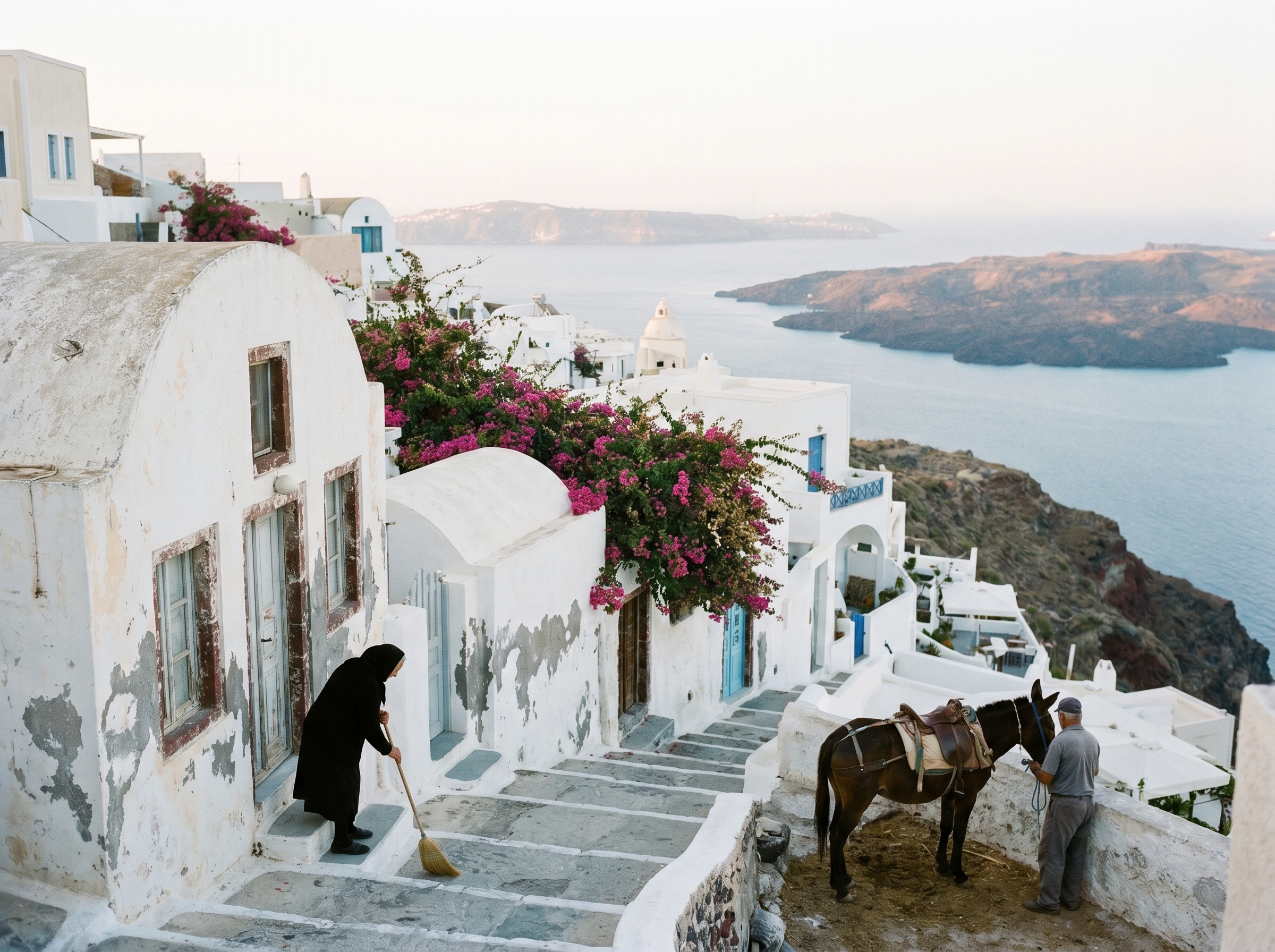
Santorini is not worth visiting during peak months unless you are willing to pay a significant premium for tightly controlled conditions. If you go, book a hotel with a private caldera-view terrace, restrict your outdoor movement to early morning and late evening, and accept that the island’s most photographed locations will be shoulder-to-shoulder crowded from roughly 10 a.m. to 6 p.m. If that tradeoff does not appeal, the Greek islands offer several alternatives that deliver comparable scenery with a fraction of the crowd pressure.
The island’s popularity has outgrown its physical capacity. Before a daily cruise passenger cap of 8,000 took effect in 2025, Santorini regularly recorded days with more than 16,000 cruise arrivals — the island’s permanent population is roughly 15,000 — and the infrastructure strain from those peak-volume days is what the cap was introduced to address. The result is a destination whose infrastructure — from the narrow caldera-edge footpaths to the single road connecting Fira to Oia — does not scale to demand.
This is not a blanket case against visiting. It is an honest assessment of when Santorini works, when it does not, and which Greek islands make better alternatives for specific types of travelers.
The Crowd Reality: What You Will Actually Encounter
The caldera-edge towns of Fira and Oia are the problem. These are the locations that appear in every Santorini photograph, and they are where nearly every visitor congregates. The footpaths are 2 to 3 meters wide in places, lined with shops and restaurants, and on a peak-season afternoon they function as a slow-moving human queue.
The cruise ship schedule is the dominant variable. On days with four or more ships in the caldera, the combined passenger load can exceed 12,000 people, most of whom head directly to Oia for the sunset. The result is a bottleneck at the Oia Castle viewpoint that begins forming 2 to 3 hours before sunset. The photographs you see of an empty Santorini sunset were taken either in the off-season, at dawn, or from a private terrace that cost several hundred euros per night.
The parts of Santorini that escape the worst crowding: The island’s southeast coast (Kamari, Perissa) has beach infrastructure and far fewer day-trippers. The interior villages (Pyrgos, Megalochori, Emporio) see a fraction of the caldera-edge traffic. The wine region in the center of the island remains uncrowded even in August. If you are willing to structure your stay around these areas and treat the caldera-edge towns as a single early-morning or evening visit, the experience is materially different.
The Pricing Problem
Santorini’s hotel pricing has decoupled from value in a way that few other Mediterranean destinations have matched. A caldera-view room in a mid-range hotel in Oia or Imerovigli runs EUR 400 to 800 per night in peak season. A comparable room with a comparable view on Milos or Paros costs EUR 150 to 300. The premium is not for a better room, a better view, or better service. It is for being in Santorini specifically.
Restaurant pricing follows the same pattern. The caldera-edge restaurants in Oia charge EUR 25 to 35 for a main course that would cost EUR 15 to 20 at a restaurant of comparable quality on a less-famous island. The food is not worse. It is simply priced to the location.
The practical implication: a 5-night stay on Santorini for two people, at a caldera-view hotel with mid-range dining, runs EUR 3,000 to 5,000 in peak season. The same trip to Milos or Paros with a sea-view room and comparable dining runs EUR 1,500 to 2,500. The Santorini premium is real, and it pays for access to a specific view, not for a higher-quality hotel experience.
When to Go: The Honest Calendar
Santorini works well in April, May, early June, late September, and October. During these windows, the weather is warm enough for swimming by late May, the cruise ship load is substantially lower, and hotel rates drop 30 to 50 percent from their July-August peaks.
The shoulder months carry caveats. April can be cool, with water temperatures still in the mid-60s Fahrenheit and some restaurants and hotels not yet open. October is warm through mid-month and then cools rapidly. The caldera sunset in October is lower and softer than the summer version, which is a genuine improvement.
July and August are the months to avoid unless you are committed to the strategy of booking a private-terrace hotel and limiting daytime movement. If you do go in peak season: book a hotel with a caldera view and a private plunge pool or terrace, plan to be at the hotel between 10 a.m. and 6 p.m., and visit Oia at sunrise, not sunset. That approach works. But it is expensive, and it requires discipline.
November through March is the off-season. Many hotels and restaurants close. The weather is variable. The ferry schedule reduces. This is not the Santorini of postcards, and for some travelers that is exactly the point. The island is quiet, the prices are reasonable, and the landscape is still the landscape. If you are indifferent to swimming and nightlife, a winter visit to Santorini produces an experience that is unrecognizable from the August version.
For a broader look at destination timing, see The Shoulder Season Calculus: When Cheap Timing Costs More Than It Saves and Maldives Timing: The One Variable That Determines Whether It’s Worth It.
Where to Stay Instead: The Greek Island Alternatives
The question most travelers should be asking is not “should I go to Santorini?” but “which Greek island is right for what I actually want?”
If you want the caldera view and the whitewashed village aesthetic: Milos. The fishing villages of Klima and Mandrakia offer the same Cycladic architecture against dramatic coastal geology, with roughly 10 percent of Santorini’s visitor volume. The beaches on Milos are superior — more numerous, more varied, and far less crowded. The tradeoff: Milos has no equivalent of the Oia-to-Fira caldera path, and the island’s dining scene is smaller and less polished.
If you want a sophisticated Cycladic island with strong food and a social scene: Paros. Naoussa, the island’s main harbor town, delivers a level of restaurant quality that rivals anything on Santorini at roughly 60 percent of the price. The beaches are good. The nightlife is present but not dominant. Paros appeals to a slightly older, more European crowd than the social-media-driven Santorini audience.
If you want Santorini’s views without Santorini’s crowds and are willing to compromise on infrastructure: Folegandros or Anafi. Both are small Cycladic islands with dramatic cliff-edge towns and views that rival Santorini. Both lack the hotel density, restaurant variety, and transport links of a major destination. They are the right choice for travelers who value emptiness over amenities.
If you want a volcanic landscape and hot springs but do not need the caldera view: Nisyros. This is a left-field recommendation, but the volcanic crater, the thermal springs, and the quiet harbor town of Mandraki deliver a geological experience that Santorini cannot match. The island sees a tiny fraction of the visitors.
Who Should Still Go to Santorini
Travelers who can visit in May, late September, or October and who are willing to book a hotel with a caldera-view terrace that allows them to enjoy the view without joining the footpath crowds. Honeymooners and photographers for whom the caldera view specifically is non-negotiable. Travelers who are comfortable paying the price premium and have done the math on what that premium buys.
Who Should Skip Santorini
Travelers visiting in July or August who are not willing to structure their days around crowd avoidance. Budget-conscious travelers for whom the premium over Milos or Paros would meaningfully reduce the quality of the rest of the trip. Travelers who value beaches over views — the beaches on Santorini are volcanic sand and are categorically worse than those on Milos, Paros, Naxos, or Crete.
Verdict
Santorini in peak season is a trade on which the traveler gives up more than the destination returns. In the shoulder months, particularly May and late September, the calculus flips: the crowds thin, the prices drop, and the landscape remains the same. The island is not overrated. It is simply mis-timed by most visitors. If you are set on the caldera view and can travel outside July and August, go. If your dates are locked into peak season, Milos, Paros, and Folegandros deliver more value with less friction.
Frequently Asked Questions
What is the best month to visit Santorini?
Late September. The weather is still warm, the sea is at its warmest, the cruise ship volume drops sharply after the first week of the month, and hotel rates are 30 to 40 percent below August peaks.
Which part of Santorini avoids the worst crowds?
The interior villages (Pyrgos, Megalochori) and the southeast coast (Kamari, Perissa). The caldera-edge towns of Oia and Fira are where the crowding concentrates.
Is Santorini worth visiting for the beaches?
No. The volcanic sand beaches are among the least appealing in the Cyclades. If beaches are the priority, Milos, Paros, and Naxos are better choices.
Does the caldera view justify the price premium?
It does if you book a hotel with a private caldera-view terrace and visit in the shoulder season. The view is genuinely extraordinary. The premium is for the view, not for the hotel quality, the food, or the service. Decide accordingly.
What Greek island is the best alternative to Santorini for a honeymoon?
Milos. Comparable Cycladic architecture, a dramatic coastline, far fewer people, and better beaches. The tradeoff is a smaller dining scene and no caldera-edge footpath.