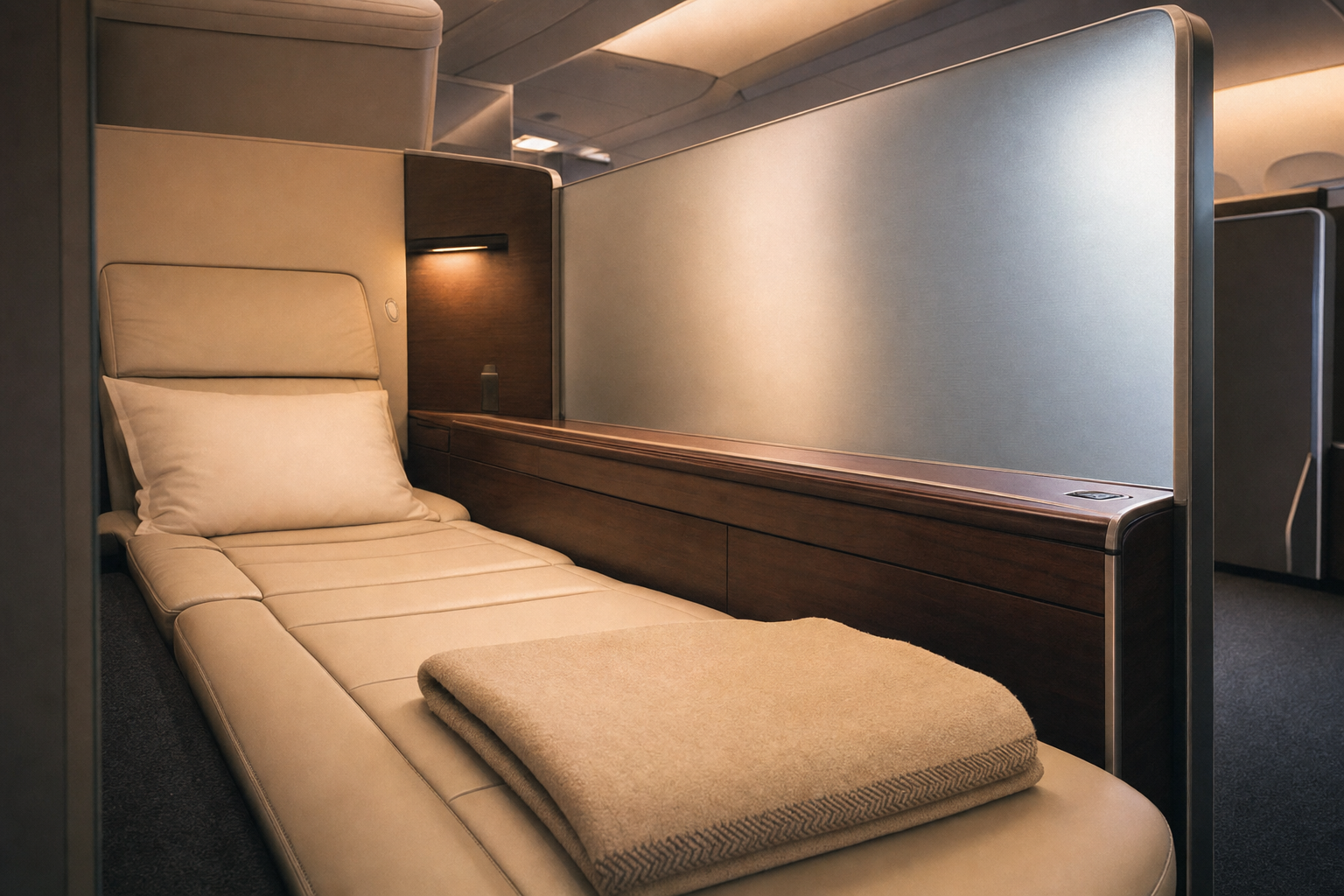
The hard product is among the strongest in commercial aviation. The booking reality is one of the most restrictive. Both things are true, and your decision depends entirely on which side of that equation you are starting from.
What This Product Is and Where It Actually Flies
Cathay Pacific First Class operates exclusively on Boeing 777-300ER aircraft. The cabin holds six seats in a 1-1-1 diagonal configuration across two rows. That is the entirety of the product: six suites per departure, on a subset of the carrier’s long-haul network.
The routes that currently carry a First Class-equipped 777 are centered on Hong Kong as origin or connection point. Based on current schedules and aircraft assignments, confirmed First Class service is available on Hong Kong to London Heathrow, Hong Kong to New York JFK, Hong Kong to Los Angeles, and Hong Kong to Tokyo Haneda. Paris CDG and Beijing Capital appear on a rotating basis subject to aircraft swaps. All new routes added in 2025 and 2026 — including Dallas and Seattle — are operated by Airbus A350 aircraft, which carry no First Class cabin.
This is a critical framing point: Cathay Pacific’s network is expanding, but its First Class footprint is not. The A350 is the future of the fleet. The 777-300ER, and First Class with it, serves a defined and shrinking slice of that network. A new generation cabin, reportedly called Halo Suites, is planned for the incoming 777-9, but deliveries are not expected before 2027 at the earliest.
Hard Product: Seat, Suite, Storage, Bed
The seat is 36 inches wide and converts to an 81-inch fully flat bed. Both figures place it at or near the top of the category. The diagonal 1-1-1 layout means every seat has direct aisle access without stepping over another passenger — a functional advantage that matters on a 15-hour sector.
Privacy is genuine but not sealed. There are no closing suite doors, a design element that newer competitors such as Singapore Airlines Suites and Emirates First have adopted. Cathay’s suites use curtains and physical partition walls to create separation. Seats in the A position (left window) benefit from wall separation on both sides, making 2A the most private seat in the cabin by layout. The center seats (D/E) share proximity with the opposite aisle.
Storage is a structural strength. The absence of overhead bins is compensated by a large personal closet behind the IFE screen — reported to accommodate a standard carry-on — plus under-ottoman storage and a side console. For a long-haul cabin, the storage architecture is practical and well-organized.
The bed is 36 inches wide and 81 inches long with a dedicated mattress pad and 600-thread-count cotton sheets. That thread count is among the highest cited for a commercial cabin. The sleep surface is flat without a perceptible hump or angle — guest reporting on this point is consistent across sources reviewed.
The IFE screen runs 17 to 18.5 inches depending on the specific aircraft configuration. That is noticeably smaller than screens on newer first class products. The Bose QC15 headphones are competent but not current-generation noise cancellation. These are the clearest indicators that the hard product, while strong by absolute measure, reflects a design that has been in service for over a decade.
What works: Width, bed quality, storage volume, aisle access for every seat, bedding specification.
What does not: No suite doors, smaller IFE screen versus newer competitors, cabin design that reads as mature rather than contemporary.
Soft Product: Catering, Service, Amenity Kit
Catering is structured around a “Choose My Meal” approach — order when ready rather than on a fixed schedule — with an option to pre-select up to 24 hours before departure. The menu rotates and includes a Chinese Classics series spotlighting regional Chinese cuisines on a monthly cycle (Sichuan, Fujian, Jiangsu, Ningbo and others). Caviar service with oscietra is standard on long-haul routes. Champagne is Krug; the 2004 vintage has been documented on recent departures.
Tableware is Noritake china with Robert Welch cutlery and Riedel glassware. Dining can be configured face-to-face using the ottoman as a second seat — a practical option for couples, and one that differentiates from single-seat dining formats.
The amenity kit is a Bamford partnership. The case is marbled leather. Contents include Bamford Grooming Department skincare products, a pillow mist in frankincense, lavender, and marjoram, and a bamboo toothbrush. A PYE-designed sleep suit in 100% organic cotton is provided separately on long-haul sectors. The Aesop partnership that previously stocked lavatories has been replaced by Bamford across the cabin.
Service on Cathay First is consistently cited in guest reporting as attentive and non-intrusive. The cabin ratio of six passengers to a dedicated crew is a structural advantage. Pre-boarding reception, a hot towel, and sparkling JING jasmine silver needle tea are standard on current routes. Lounge access at Hong Kong includes The Pier First and The Wing First — both large, well-resourced facilities with shower suites and dining rooms.
What works: Catering flexibility, food quality, Bamford partnership, Krug champagne, lounge access in Hong Kong.
What does not: Soft product consistency varies on shorter-haul First Class routes (Tokyo, Beijing). Some routes do not receive the full sleep suit and turndown service protocol.
Is Cathay Pacific First Class Worth the Cash Fare?
The short answer is rarely, and the math is not close.
Cash fares for Cathay Pacific First Class on long-haul sectors run from approximately $8,700 to over $14,000 USD one-way for New York or London to Hong Kong, based on current published fares as of April 2026. Outliers in peak periods can reach $32,000. These are fares for a six-seat cabin on an aging interior. The competition on these routes — Singapore Airlines, Lufthansa, Air France, Qatar — is running newer product in some cases and often at comparable or lower cash prices.
At $8,700 one-way, the Cathay Pacific First Class value case depends on which alternatives exist for the same routing, how much the Hong Kong lounge access and catering quality matter to the traveler, and whether the 36-inch wide bed is a functional need rather than a preference. For the vast majority of travelers, that is a difficult case to make in cash when Business Class on the same carrier offers a lie-flat seat at roughly one-third to one-half the price.
The cash fare is defensible in one narrow scenario: a traveler with a confirmed Hong Kong layover who values the lounge and cabin experience specifically on this airline, with no meaningful alternative routing. Outside that scenario, the cash fare for Cathay First does not hold against a category-level price-to-product analysis.
Booking Reality: Award Availability and Partner Redemption
The award case is where the product’s value proposition actually lives — and where the complexity begins.
Cathay Pacific’s own Asia Miles program offers the most reliable access to First Class award inventory, with a booking window of 360 days before departure. That early access window is the single largest structural advantage for travelers who hold Asia Miles or can transfer points to the program (Asia Miles partners include American Express Membership Rewards and other major transferable currencies). On high-demand routes such as Hong Kong to London and New York to Hong Kong, searching at or near the 360-day mark is the practical strategy for securing a seat.
Award pricing through Asia Miles for First Class on long-haul routes (7,500+ miles) runs 160,000 miles one-way. On the 5,001–7,500 mile band, the rate drops to 125,000 miles. Taxes and carrier-imposed surcharges on Cathay-operated flights are modest — a meaningful contrast to booking Cathay First through British Airways Avios, where fuel surcharges of $300–500 are standard.
Partner redemption options within the Oneworld alliance include American Airlines AAdvantage (331-day window, phone booking required) and Alaska Airlines Mileage Plan (330-day window). Both programs have access to Cathay First Class inventory but with less favorable booking windows and more limited seat release compared to Asia Miles. British Airways Avios works but carries the surcharge penalty.
The structural constraint applies regardless of program: Cathay Pacific releases a limited number of First Class award seats on any given departure. Six seats per aircraft. Even with the 360-day booking window, popular routes in peak periods — summer on the transatlantic sector, Lunar New Year on Hong Kong connections — will show zero award availability weeks or months before departure. The traveler who requires specific dates has a narrower chance of securing First Class on points than one who can move within a two- or three-week window.
Upgrade from paid Business Class using miles is not available on most Cathay fare classes as of current policy. Operational upgrades at the gate exist but are not a reliable strategy.
Who Should Actively Pursue This Product
The traveler who gets maximum value from Cathay Pacific First Class holds Asia Miles or a transferable currency, is routing through or to Hong Kong as a logical part of the itinerary, can search at the 360-day mark with date flexibility, and values the combination of bed width, sleep quality, lounge access in Hong Kong, and catering format at the 160,000-mile price point.
This is also a strong fit for a traveler whose alternative on the same routing is a competitor Business Class product — where the mile differential between Cathay First and Business may be narrower than on other carriers, making the upgrade in cabin class more efficient in award terms.
Who Should Treat This as Opportunistic
The traveler who does not already hold a position in Asia Miles (or a transferable currency that transfers there), who would need to restructure a routing to include Hong Kong, or who requires specific travel dates without flexibility should not build a trip plan around accessing Cathay First Class. The product is not worth engineering an itinerary around.
This is equally true for travelers considering the cash fare on principle. The bed and catering are excellent. They are not $12,000-excellent in a category where Singapore Airlines Business Class in Suites configuration is available on the same routing at significantly lower award rates, or where newer hard products on competitive carriers are available at similar or lower cash prices.
Treat the product as a reward for travelers who are already in the right position: right program, right routing, right date flexibility. Do not treat it as a destination in itself.
Verdict
Cathay Pacific First Class is a well-executed product operating on a narrowing route map with a booking reality that rewards positioning rather than pursuit. The 36-inch bed, 600-thread-count bedding, Krug champagne, and Bamford amenity kit are specific and defensible strengths. The lack of suite doors, the aging IFE system, and the cash fare structure are equally specific weaknesses.
Book it if you hold Asia Miles, are routing through Hong Kong, and can search at the 360-day mark with date flexibility. At 160,000 miles one-way on a long-haul sector, the product earns its rate against the category. Do not restructure an itinerary to access it, and do not pay cash unless the routing leaves no comparable alternative. The product rewards travelers who are already positioned correctly. It does not reward travelers who position themselves for it.
Frequently Asked Questions
Which routes currently offer Cathay Pacific First Class?
As of April 2026, confirmed First Class service operates on Boeing 777-300ER aircraft between Hong Kong and London Heathrow, New York JFK, Los Angeles, and Tokyo Haneda. Paris CDG and Beijing are available on a rotating schedule subject to aircraft assignment. All new routes launched in 2025 and 2026 — including Dallas and Seattle — use Airbus A350 aircraft with no First Class cabin.
How many seats are in Cathay Pacific First Class?
Six seats per aircraft, arranged in a 1-1-1 diagonal configuration across two rows. Every seat has direct aisle access. There are no middle seats.
What is the best program for redeeming miles on Cathay Pacific First Class?
Cathay Pacific’s own Asia Miles program offers the most consistent access to First Class award inventory, with a booking window of 360 days before departure — earlier than any Oneworld partner program. Asia Miles rates 160,000 miles one-way for long-haul First Class (7,500+ miles). Taxes and carrier fees are minimal on Cathay-operated flights booked through Asia Miles. British Airways Avios and American AAdvantage are viable alternatives but carry either higher surcharges or shorter booking windows.
Can I upgrade from Business Class to First Class using miles?
Not reliably. Cathay Pacific does not offer upgrade awards on most paid Business Class fare classes as of current policy. Operational upgrades at the gate exist but cannot be planned around. If First Class is the target, book it as an award from the outset.
How does Cathay Pacific First Class compare to Singapore Airlines Suites?
Singapore Airlines Suites (on the A380) offers enclosed suite doors, a double bed when two Suites are booked adjacent, and a newer cabin design. Cathay First has wider individual seats (36 inches vs. 35 inches for Singapore), equivalent or better bedding, and stronger catering flexibility. Singapore Suites operates on a similarly limited route map. For solo travelers, the two products are close in functional terms; for couples, Singapore’s double-bed configuration is a meaningful differentiator. Award rates are broadly comparable.
Is there a First Class lounge at Hong Kong for Cathay Pacific?
Yes. Cathay Pacific operates The Pier First and The Wing First at Hong Kong International Airport. Both include shower suites, dedicated dining rooms, and bar service. The Pier First is the more recently renovated facility. Lounge access is included for First Class passengers and Asia Miles Diamond members.
When will Cathay Pacific introduce a new First Class product?
Cathay Pacific has announced a new first class suite product, referred to internally as Halo Suites, planned for the Boeing 777-9. As of April 2026, 777-9 deliveries are expected no earlier than 2027. Until that aircraft enters service, the existing 777-300ER First Class product remains the only configuration available.