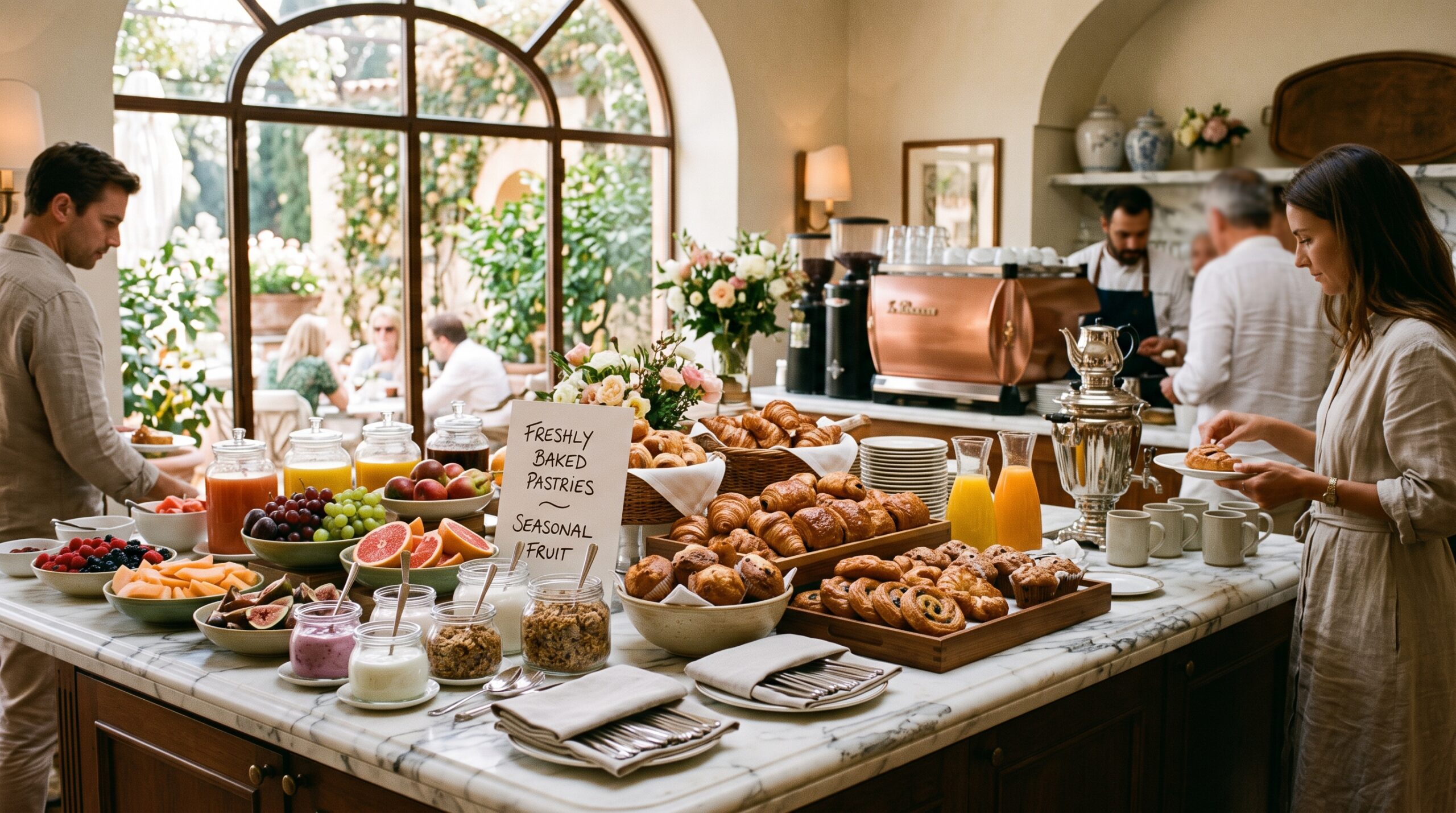
Hotel breakfast is worth booking as a bundle when the per-person rate is USD 20-35, the spread includes hot items and quality coffee, and you would otherwise spend USD 15-25 per person at a nearby cafe. Above USD 40 per person, the buffet is rarely worth it — you are paying for hotel convenience, not food quality.
The hotel breakfast decision looks trivial. It is not. A family of four at a mid-range hotel paying USD 30 per person for breakfast spends USD 120 per day — USD 840 over a 7-night stay. At the luxury tier, where breakfast can run EUR 45-65 per person at properties in Paris, London, or Tokyo, a couple spends EUR 90-130 daily, or roughly EUR 700-900 over a week. The breakfast line item rivals the airfare on a short-haul trip. Understanding when the buffet delivers value and when it extracts margin is a genuine cost-control lever.
The Three Tiers of Hotel Breakfast
Included breakfast (budget and mid-range chains, B&Bs, some boutique properties). Hampton Inn, Holiday Inn Express, and similar mid-range chains include a hot breakfast in the rate. The quality is utilitarian — powdered eggs, pre-cooked sausage, packaged pastries — but the price is effectively zero because it is built into a room rate that is already competitive with breakfast-excluded competitors. At this tier, the question is not whether the breakfast is worth it. It is included. The question is whether the breakfast quality is a reason to choose this hotel over a competitor — and for families with children under 12, the answer is often yes. The savings on feeding a family of four for 5-7 days at a breakfast-included chain versus a breakfast-excluded competitor can reach USD 350-500 over a week.
Premium buffet (USD 25-40 per person). This is the Marriott/Sheraton/Westin tier: a hot buffet with an omelette station, fresh fruit, quality pastries, and espresso-based coffee. At USD 30 per person, the value equation shifts. A comparable breakfast at a standalone cafe — eggs benedict, a latte, a pastry — runs USD 18-25 in most US cities. The hotel buffet at USD 30 is a small premium for unlimited quantity, faster service (no waiting for a table or a check), and the convenience of rolling out of bed and into the restaurant. For business travelers on an expense account, this is the default choice. For leisure travelers, the math favors the buffet when the per-person rate falls below USD 30 and the spread includes made-to-order items.
Luxury a la carte (EUR 40-65 per person). At Four Seasons, Ritz-Carlton, Peninsula, and comparable properties, breakfast is rarely a buffet — it is a la carte table service with items like truffled scrambled eggs (EUR 35), fresh-squeezed juice (EUR 12), and a pastry basket (EUR 15). A full breakfast for two can reach EUR 100-130. At this tier, the food quality is high but the value equation breaks. You are paying for the setting, the service, and the insulation from the outside world. For travelers who budget EUR 500+ per night on a room, the breakfast premium is absorbed into the overall trip cost. For anyone else, skipping the hotel breakfast and walking to a nearby cafe saves EUR 60-80 daily with negligible quality loss.
When the Breakfast Bundle Is Worth It
The rate differential is small. Many hotels offer a “Bed and Breakfast” rate that adds USD 15-25 per person to the room-only rate. At that increment, the breakfast is almost certainly cheaper than buying it a la carte at the hotel restaurant (where the walk-in price is typically USD 30-45) and competitive with a nearby cafe. Book the bundle.
You are using loyalty status benefits. Hyatt Globalist members receive complimentary breakfast at Hyatt properties (including Park Hyatt and Andaz, where breakfast can run USD 40-55 per person). Marriott Platinum Elite and above receive lounge access with continental breakfast. Hilton Gold and Diamond receive a daily food-and-beverage credit (USD 15-25 per person at US properties, full breakfast at international properties). If your status covers breakfast, the calculus is automatic: do not pay for a bundle you already receive free.
You are traveling with children under 12. Many mid-range and upscale chains allow children to eat free from the buffet when accompanied by a paying adult, and some extend this to children under 18. A family of four at a Holiday Inn Express where children under 18 eat free gets four breakfasts for the price of two. This is the strongest breakfast value proposition in the hotel industry.
The hotel is isolated. Resort hotels in Bora Bora, the Maldives, or remote safari lodges have no nearby cafes. The hotel breakfast is your only practical option. In these cases, the breakfast bundle is not a value decision — it is an infrastructure decision. Book it.
When the Breakfast Bundle Is Not Worth It
The hotel is in a food-dense neighborhood. In central Paris, Rome, Tokyo, or Bangkok, the hotel breakfast at EUR 35-50 is competing with a EUR 8-12 cafe breakfast 100 meters from the lobby (cafe creme + croissant in Paris, cornetto + espresso in Rome, onigiri + miso soup in Tokyo). The quality gap is often inverted: the neighborhood cafe serves better coffee and more culturally specific food than the hotel buffet’s international spread. The savings over a 5-day stay: EUR 135-200 per person. Over a couple: EUR 270-400. That pays for a dinner at a one-star Michelin restaurant.
You are a light breakfast eater. If your typical breakfast is coffee and a pastry, the buffet at USD 30-40 is a USD 25-30 overpay. The hotel restaurant’s a la carte menu may offer a coffee-and-pastry option, but many luxury properties do not — the minimum order is the full buffet or a set breakfast menu at EUR 35-45. In these cases, skip the hotel entirely and find a neighborhood cafe.
The breakfast quality is poor. Not all hotel breakfasts are created equal. A 2024 J.D. Power survey of hotel guest satisfaction found breakfast quality to be the second-largest driver of overall satisfaction (after room cleanliness), but the variance between brands is enormous. A Hampton Inn breakfast is predictably average. A four-star independent hotel’s “continental breakfast” can be stale croissants and weak coffee. Check recent guest-review photos — not the hotel’s marketing images — before booking a breakfast-inclusive rate.
Checklist: Breakfast Decision
- Compare the per-person breakfast add-on rate to a la carte hotel restaurant pricing and nearby cafe pricing. The add-on rate should be below both.
- Check your loyalty status: Hyatt Globalist, Marriott Platinum+ lounge access, and Hilton Gold/Diamond credits can eliminate the breakfast cost entirely on qualifying rates.
- Families with children under 12: prioritize chains that offer free kids’ breakfasts. The savings are real — USD 300-500 over a week.
- Urban hotels in food-dense neighborhoods: skip the hotel breakfast. The neighborhood cafe is cheaper, better, and part of the destination experience.
- Resort hotels with no nearby alternatives: book the breakfast bundle. There is no alternative, and the inconvenience of sourcing breakfast off-property outweighs the savings.
- Check guest-review photos of the actual breakfast spread, not the hotel website. Quality variance is high, especially at independent and mid-range properties.
Verdict
Book the breakfast bundle when the per-person rate is USD 20-30, the spread includes hot items and quality coffee, and the hotel is not in a food-dense urban neighborhood with EUR 8 cafe breakfasts within walking distance. Skip it when the per-person cost exceeds USD 35, you have loyalty status that covers breakfast, or you are a light eater who only needs coffee and a pastry. Families with young children at breakfast-inclusive chains get the best value in the hotel industry. Couples at luxury urban hotels who walk to a neighborhood cafe instead of the EUR 45 hotel buffet save enough over a week to fund a dinner at a Michelin-starred restaurant.
FAQ
Q: Does booking a breakfast-inclusive rate cost more than paying at the hotel?
A: Usually less. Hotels price the breakfast add-on at booking below the walk-in restaurant price to incentivize the bundle. Compare the rate with and without breakfast during booking — the differential is the per-day cost.
Q: Can I use Marriott Platinum breakfast benefit at Ritz-Carlton?
A: Ritz-Carlton is excluded from Marriott’s standard Platinum breakfast benefit. Platinum members receive lounge access at Marriott, Sheraton, and Westin properties but do not receive complimentary breakfast at Ritz-Carlton, Edition, or most Autograph Collection properties.
Q: What about Airbnb or vacation rentals?
A: If your rental has a kitchen, self-catering breakfast costs USD 3-8 per person. A week of self-catered breakfast versus a USD 30 hotel breakfast saves USD 150-200 per person. This is a meaningful component of the hotel-vs-rental cost comparison.
Q: Is the buffet sanitary?
A: Hotel buffets are subject to the same health regulations as any commercial kitchen. The primary risk factor is temperature control on hot items — food that sits below 60°C/140°F for extended periods. High-turnover buffets during peak breakfast hours (7-9 a.m.) are safer than low-traffic late-breakfast periods.
Q: What if I am on a special diet?
A: Most hotel buffets label common allergens (gluten, dairy, nuts). Luxury properties can accommodate vegan, halal, and kosher requests with advance notice. Mid-range buffets are less flexible — if you have strict dietary requirements, the buffet value equation weakens because you may not be able to eat enough of the spread to justify the cost.