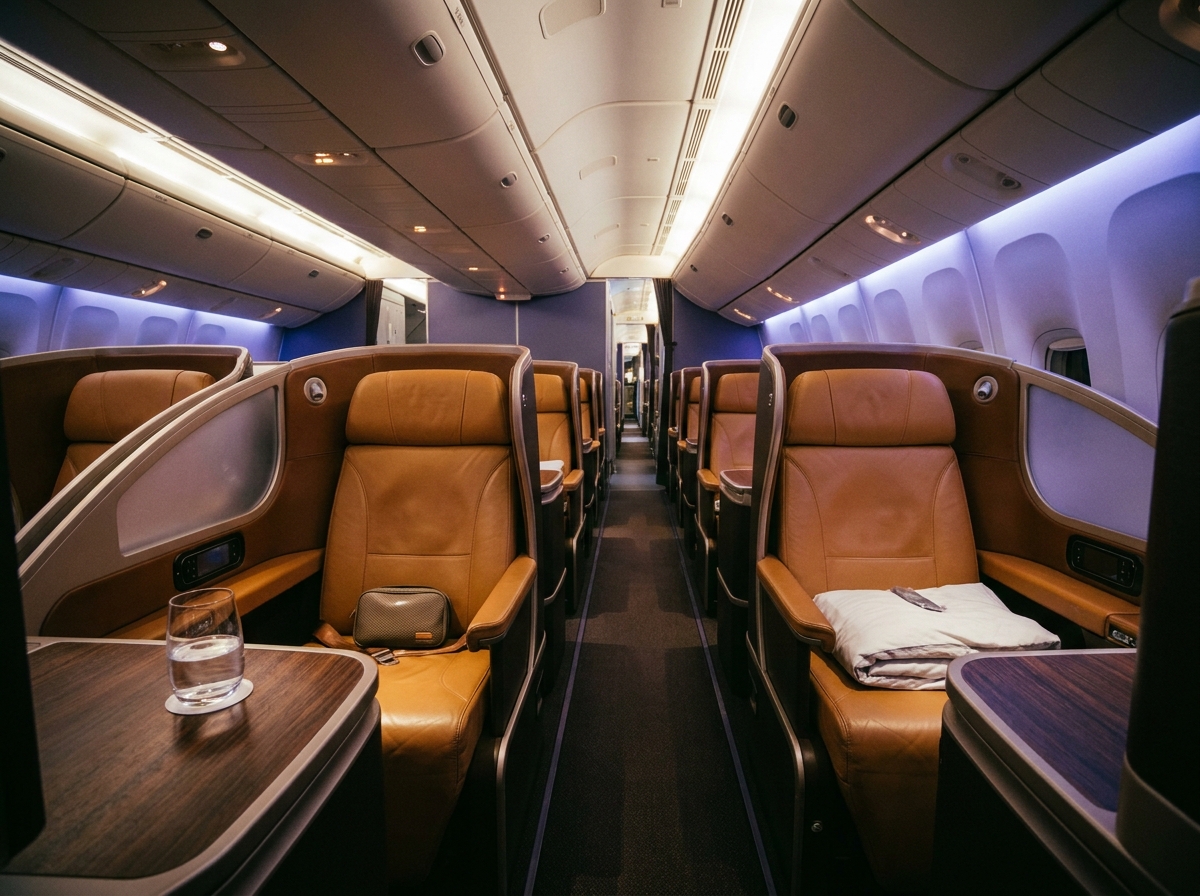
For most travelers on most routes, Delta One’s suite is the most polished all-around product. But the correct answer depends on which aircraft you are actually flying, which hub you are connecting through, and whether you value privacy, food, or the ground experience most.
The three US legacy carriers have spent the past decade closing the gap with their Gulf and Asian competitors on long-haul business class. The result is three genuinely competitive products that differ less in headline specs than in consistency, fleet coverage, and the details you only notice five hours into a flight. What follows is a direct comparison of what each product delivers right now — not what has been announced for next year, not what operates on one showcase route.
The Hard Product: Seats, Doors, and the Aircraft Problem
The single most important variable in US business class is not which airline you book. It is which aircraft operates your specific flight. Each carrier has modernized part of its wide-body fleet and left other parts with seats that are one or two generations behind.
Delta One Suite is the most consistently available enclosed product. On the airline’s A350-900 and A330-900neo fleets, every seat is a suite with a full-height sliding door, direct aisle access in a 1-2-1 layout, a 76-inch flat bed, and a 32-inch OLED screen on newer frames. The seat is built on the Vantage XL platform from Thompson Aero Seating. The upcoming A350-1000 will move to the next-generation VantageNOVA with slimmer doors and 24-inch screens. The problem aircraft for Delta is the older 767-300ER and 767-400ER, which still operate older Delta One seats in a 1-2-1 configuration without doors — narrower, with smaller screens, and noticeably less privacy.
United Polaris sits in the middle on consistency. On 777-300ERs and 787-9s, Polaris uses a 1-2-1 layout with direct aisle access and a flat bed of approximately 76 to 80 inches depending on the frame. The 787-9 uses the Thompson Vantage seat, which provides better shoulder room than the Zodiac Cirrus herringbone on the 777-300ER. United is rolling out a next-generation Polaris seat on its new 787 deliveries beginning in 2025, with doors that are awaiting regulatory certification and will initially be locked open. The screen is expected to be approximately 19 inches. The fleet problem for United is the 767-300ER and, most critically, the 757-200 on transatlantic routes. The 757 operates with a 2-2 Polaris configuration without doors and a 76-inch bed — shorter than competitors — and is widely considered the least competitive business class deployment on any US transatlantic route. If your booking shows a 757, change it.
American Airlines Flagship Business has the widest quality gap within its own fleet — and the gap is moving but has not closed. The airline began retrofitting its 20 Boeing 777-300ERs with the new enclosed Flagship Suite (full sliding door, 78-inch bed, 21-inch HD screen, 1-2-1 layout) in late 2025, with the first reconfigured aircraft entering service in early 2026. However, as of mid-2026 most 777-300ERs still carry the older, non-enclosed alternating seats. New 787-9 deliveries began carrying the Flagship Suite from mid-2025, but only a handful are in service, with the full order of 30 expected by 2029. American’s 777-200ERs and older 787-8s still operate earlier-generation seats without doors. This means you cannot assume a Flagship Suite when you book American business class even on flagship routes — the product depends entirely on whether your specific aircraft has been retrofitted. The gap between American’s best seat and its worst seat remains larger than at United or Delta. Always check the exact aircraft type and seat map before booking.
Food and Soft Product: Where Delta Pulls Ahead
The soft product is where Delta has opened a measurable lead over its US competitors, though the margin is narrower than the airline’s marketing suggests.
Delta One dining is the strongest of the three. The airline invested in regionally influenced menus designed with input from restaurant partners, and the plating, ingredient quality, and wine program are consistently rated above United and American. The Missoni amenity kit partnership, noise-reducing headphones, and mattress pad or lumbar pillow are standard across the fleet. Delta also offers the Delta Studio streaming option on personal devices.
United Polaris dining has improved but remains uneven. The airline offers a multi-course meal with an ice cream sundae cart on most long-haul routes, a feature that passengers genuinely enjoy, but the main course quality varies significantly by catering station. United’s Saks Fifth Avenue bedding and amenity kit are competitive, and the Polaris lounge network is the best ground product of the three carriers.
American Flagship Business dining sits in a clear third place. The food quality is adequate but inconsistent, wine selections are narrower, and the plating lacks the attention to detail that Delta delivers. American’s amenity kit and bedding are functional but unremarkable. The Flagship Lounge network at hubs like JFK, MIA, and DFW is solid but less consistent than United’s Polaris lounges.
The Ground Experience: Lounges Matter
United’s Polaris Lounge network is the best ground product among the US carriers. At Chicago O’Hare, Newark, San Francisco, Houston, Washington Dulles, and Los Angeles, Polaris passengers get a dedicated lounge with sit-down dining, shower suites, quiet areas, and a bar program that would hold its own against an international competitor. Access requires a Polaris same-day boarding pass — no guests, no exceptions.
Delta’s Delta One Lounge at JFK opened in 2024 and matches the Polaris lounge experience with sit-down dining and a dedicated wellness area. LAX and BOS lounges followed, and SEA opened in 2025; all four are now operational. Delta also operates Delta Sky Clubs at most hubs, which Delta One passengers can access, but the Sky Club experience is a tier below the dedicated Delta One Lounge. A second LAX Delta One Lounge is expected in summer 2026.
American’s Flagship Lounges at JFK, Miami, Dallas, Chicago, and Los Angeles offer an elevated experience compared with the standard Admirals Club, with better food, a full bar, and shower suites, but the sit-down dining that defines United’s Polaris lounges is absent. The experience is closer to a premium lounge than a first-class dining room.
Route Network: Where Each Carrier’s Hub System Works Best
Each airline’s hub geography creates natural route advantages.
United dominates trans-Pacific routes from San Francisco and Los Angeles to Tokyo, Sydney, and Singapore, and transatlantic routes from Newark and Washington Dulles. If you are flying to Asia, United’s network is materially stronger than Delta’s or American’s.
Delta controls the strongest transatlantic network from JFK and Atlanta, and a growing Pacific presence from Seattle and Detroit. Delta’s joint ventures with Air France-KLM and Virgin Atlantic make it the most seamless connection to secondary European cities.
American owns Miami to South America and Dallas to Asia, with a competitive transatlantic network from JFK, Philadelphia, and Chicago. American’s partnership with British Airways and Japan Airlines fills key gaps but introduces product inconsistency across codeshare segments.
How to Pick: The Three-Question Filter
1. Which aircraft is actually operating your flight? If the answer is a Delta 767, a United 757, or an American 777-200ER, adjust your expectations downward or rebook. On modern aircraft, all three products are strong and similar. On older frames, the drop-off is steep. For related analysis, see our destination comparison guide.
2. Which hub are you connecting through? If you have time for a lounge, United’s Polaris lounges are the best. If the airport experience is irrelevant because your connection is tight, the onboard product matters more. See also our related analysis.
3. Which route are you flying? For trans-Pacific, United is the network winner. For transatlantic, Delta’s JFK and ATL strength plus joint ventures give it a scheduling edge. For Latin America, American’s Miami hub is hard to beat.
The bottom line: Delta One Suite on a modern aircraft is the most complete product. United Polaris on a 787-9 with a Polaris lounge connection is a close second and may win on network for Asia-bound travelers. American’s Flagship Suite, where available, competes well on hard product but falls behind on food, lounges, and fleet consistency — and availability remains limited as the retrofit program is still in early stages.
Frequently Asked Questions
Q: Which US carrier has the best business class seat?
A: Delta One Suite on the A350 or A330-900neo, with a full-height sliding door, 76-inch bed, and 32-inch OLED screen. American’s new Flagship Suite (on retrofitted 777-300ERs and new 787-9s) is a close second with a 78-inch bed and full enclosure, but as of mid-2026 it is available on only a fraction of the fleet. Always check the exact aircraft before booking.
Q: Does United Polaris have doors?
A: On select routes only. The existing Polaris seats do not have doors. The next-generation Polaris seat introduced on new 787 deliveries in 2025 includes doors, but they are awaiting certification and initially remain locked open.
Q: Is the food actually better on Delta?
A: Yes, by a consistent margin. Delta’s restaurant-partnered menus, wine program, and plating quality are rated above United and American across independent reviews. United has improved but varies by catering station. American is a clear third.
Q: Which lounge network is best?
A: United’s Polaris lounges, with sit-down dining and shower suites at six US hubs, are the strongest. Delta’s four Delta One Lounges (JFK, LAX, BOS, SEA) are all now operational and competitive, though the network is smaller than United’s. American’s Flagship Lounges lack the sit-down dining experience.
Q: What is the worst aircraft to avoid?
A: United’s 757-200 on transatlantic routes operates the least competitive hard product of the three carriers, with a 2-2 layout without doors and a shorter bed. Delta’s 767-300ER without the suite and American’s 777-200ER with older seats are the other aircraft to avoid if alternatives exist.