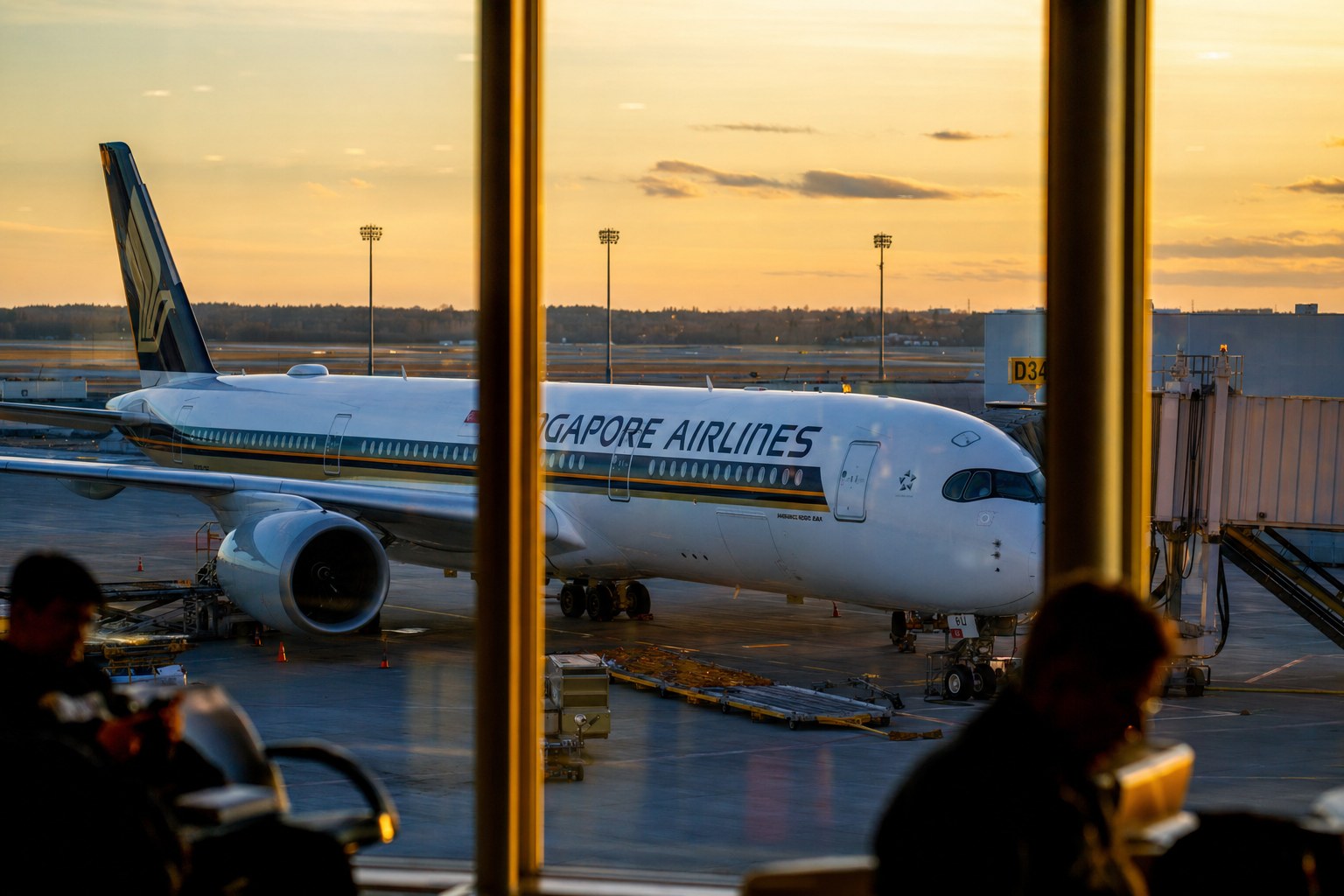
Singapore Airlines has been the default answer to the question “which business class?” for most of the last decade. The recommendation appears everywhere: points blogs, travel magazines, Skytrax rankings. It is treated less like a conclusion reached through analysis and more like a settled fact. The problem is that the product those recommendations were built on has not materially changed since the A350 entered the SQ fleet, while Qatar Airways and Emirates have each introduced hard products with closing privacy doors, reconfigured dining models, and wider entertainment screens. The benchmark has not moved. The competition has.
This piece does not argue that Singapore Airlines business class is bad. It is not. It argues that the reflexive recommendation — book SQ, full stop — is now insufficient, and that for a meaningful segment of long-haul travelers, a direct comparison will produce a different answer.
What This Is
Singapore Airlines operates its Airbus A350-900 in three configurations. The long-haul variant carries 42 business class seats in a 1-2-1 layout across two cabins (Simple Flying, March 2024). The ultra-long-haul (ULR) variant serves routes including Singapore to New York JFK and Singapore to Los Angeles. It carries 67 business class seats and 94 premium economy seats, with no economy cabin (Simple Flying, March 2024). The seat product is the same across both variants: a forward-facing, fully flat bed measuring 78 inches (198 cm) in length and approximately 28 inches (71 cm) in width. The upholstery is Scottish leather in a diamond-stitch pattern.
The cabin was designed by James Park Associates. It has received consistent acclaim for its proportions, materials quality, and lighting. There are no closing privacy doors on any SQ business class seat. The tall shell provides meaningful visual separation, and the center seats have a retractable divider, but passengers in adjacent seats are visible to each other and to the aisle. This was not a notable limitation when the product launched. It is now, because every serious competitor in the category has moved to enclosed suites.
The seat reclines into a flat bed via a mechanism that folds the seatback forward rather than reclining backward — a design that requires crew assistance to operate and results in an angled footwell on the long-haul configuration. Multiple published reviews, including those from The Bulkhead Seat (August 2024) and Cranky Boss (updated January 2026), note that the angled sleeping position is the product’s most significant ergonomic limitation on overnight flights. Side-sleepers in particular will find the footwell geometry uncomfortable on routes exceeding ten hours.
What Works
Service execution. Singapore Airlines’ cabin crew reputation is not marketing. The airline has won the Skytrax World’s Best Airline Cabin Crew award consistently, including in 2025 (Skytrax, 2025). The crew-to-passenger ratio in business class is high, service is proactive rather than reactive, and the level of execution is consistent across routes and departure markets. This is the product’s strongest differentiator and the one that competing hard products cannot easily replicate.
The Book the Cook program. Pre-ordered meals must be requested at least 24 hours before departure. The selection — 50-plus dishes depending on the departure city (The Luxury Travel Expert, November 2025) — is among the broadest of any airline’s pre-order program, and execution at altitude is considerably more reliable than the standard meal service. Signature dishes like Lobster Thermidor and the satay service are consistently praised in published reviews as the strongest individual dishes in the program. The consistency of the culinary program is a function of the pre-order discipline, not ambient cabin service.
Aircraft comfort factors. The A350’s cabin altitude of 6,000 feet — versus the industry standard of 8,000 feet — lower engine noise, and higher relative humidity produce measurably lower passenger fatigue on long-haul routes (Emirates media release, November 2024; Simple Flying, March 2024). These are aircraft-level advantages, not airline-level ones. Singapore Airlines has structured its long-haul fleet heavily around the A350 and A350-900ULR, which means passengers booking SQ on 12-plus-hour routes are more reliably getting these benefits than they would with an airline flying a mixed 777/A350 fleet.
Seat width. At 28 inches, the A350 business class seat is among the widest in the category. For travelers who sleep in an upright or slightly reclined position, the additional width is a meaningful comfort factor. Qatar’s QSuite seat measures 21 to 22 inches wide; the enclosed shell compensates, but the raw width difference is real.
What Does Not Work
No closing door. Every major competitor offering a premium business class product has moved to enclosed suites with sliding or folding privacy doors. Qatar Airways introduced the QSuite with closing doors in 2017 — eight years ago. Emirates’ A350 business class launched in early 2025 with sliding doors on all seats (Emirates media release, November 2024). Singapore Airlines has acknowledged it is developing a next-generation business class product, but as of early 2026, no delivery timeline has been confirmed. Travelers booking SQ today are booking a product that was designed before privacy doors became a category standard.
Angled footwell on long-haul configuration. The bed mechanism on the A350 long-haul variant creates a narrow, angled footwell that accommodates feet at an angle rather than flat. This is a structural limitation of the seat design, not a configuration choice. It is not present on the ULR variant in the same way, but the long-haul configuration — used on routes including Melbourne to Singapore, Istanbul to Singapore, and Brussels to Singapore — is the one most travelers outside Asia will encounter first.
Entertainment screen size. The 18-inch HD screen is functional but not competitive. Emirates’ A350 features a 23-inch 4K screen with a content library of 6,500-plus titles (Emirates media release, November 2024). Qatar’s QSuites carry 21.5-inch screens, with the next-generation product moving to a movable 21-inch 4K OLED Panasonic unit (Simple Flying, December 2025). The SQ screen does not support 4K content. This is not a deal-breaker, but it is a visible gap for travelers who use the entertainment system extensively.
Fare premium without a product premium. Based on published fares in Q1 2026 (Altitudes Magazine, April 2026), average one-way cash fares from Singapore to New York JFK run approximately $7,800 in SQ business class. Qatar’s equivalent Doha to JFK fare runs approximately $6,200. The $1,600 difference is not matched by a superior hard product. The SQ premium is justified by service consistency and direct routing — not by a seat that outperforms the competition.
Who This Is For
Travelers who prioritize service consistency above all other variables, particularly on ultra-long-haul routes of 14-plus hours where the gap between an excellent and a mediocre crew has the largest impact on the experience. It is also the correct choice for passengers originating in Southeast Asia who can board in Singapore, skip a hub connection, and access the ULR nonstops to North America. On SIN-JFK, there is no equivalent nonstop product from either Qatar or Emirates.
Solo travelers who sleep on their back and prioritize seat width over enclosure will find the SQ product genuinely comfortable. The 28-inch width is the widest single seat in the comparison set.
Who This Is Not For
Travelers optimizing for suite privacy should book Qatar QSuites. The closing door produces a categorically different level of isolation — relevant on daytime flights, heavily booked cabins, and any route where the passenger mix is uncertain. No shell design replicates an enclosed door.
Travelers connecting through a Gulf hub who have QSuites availability guaranteed on their specific aircraft should book Qatar, not SQ, if the fare differential is $1,000 or more one-way. The hard product justifies the switch at that threshold.
Travelers who value entertainment breadth and screen quality will find Emirates’ 4K 23-inch screen and content library of 6,500-plus titles (Emirates media release, November 2024) a meaningful advantage over SQ’s current IFE configuration.
Tradeoffs
You are trading suite-level privacy for service consistency and seat width. Whether that exchange is worth it depends on one variable: whether QSuites is guaranteed on your specific aircraft, not just your route.
Does every Qatar Airways flight actually have QSuites?
No — and this is the variable that changes the entire comparison. Qatar flies QSuites on its A350-1000 fleet and on many, but not all, 777-300ER and A350-900 frames. Older aircraft including the 777-200LR, the A330, and the 787-8 do not carry QSuites, and equipment swaps happen without notice. Passengers who book Qatar without verifying the specific aircraft configuration may find themselves on a non-QSuites frame. When that risk exists, SQ’s consistent product is a stronger guarantee.
Emirates’ A350 business class (the “S Lounge” seat) entered service on primarily short and medium-haul routes in 2025, with long-haul deployment expanding through 2026 (One Mile at a Time, November 2024). As of early 2026, long-haul A350 coverage from Emirates is still limited. The 777X with its new business suite was not confirmed for widespread deployment on all long-haul routes within the comparison window. Emirates remains a stronger value story than a hard-product story on most long-haul bookings.
Singapore Airlines’ soft product premium is real. The fare premium is also real. They do not fully offset each other. Travelers who can confirm QSuites availability on their Qatar flight and whose fare difference exceeds $1,000 one-way should take the upgrade.
Comparison Table
| Variable | Singapore Airlines A350 | Qatar Airways QSuites | Emirates A350 Business |
|---|---|---|---|
| Privacy door | No (shell only) | Yes, sliding (all seats) | Yes, sliding (all seats) |
| Seat width | 28 in (71 cm) | 21-22 in (53-56 cm) | Not publicly specified |
| Bed length | 78 in (198 cm) | 79-82 in (200-208 cm) | Fully flat, length unspecified |
| IFE screen | 18 in HD | 21.5 in (4K on Next Gen) | 23 in 4K |
| Dining model | Book the Cook (pre-order) | Dine on demand | Dine on demand |
| Avg. one-way fare (to JFK) | ~$7,800 (SIN-JFK) | ~$6,200 (DOH-JFK) | ~$5,900 (DXB-JFK) |
| QSuites/suite guarantee | N/A | Aircraft-dependent | Route-dependent (A350 still limited long-haul) |
| Lounge (home hub) | SilverKris, Changi T2/T3 | Al Mourjan, Doha HIA | Business, Dubai T3 |
| Cabin crew ranking | Skytrax Best Crew 2025 | Skytrax Top 5 | Skytrax Top 10 |
Fare data: Altitudes Magazine Q1 2026 comparison. Dimensions: airline specifications and published reviews. Skytrax rankings: 2025 awards.
Verdict
At what fare premium does Singapore Airlines business class stop making sense?
Based on published cash fare comparisons and the hard product differential, the SQ premium is defensible up to approximately $1,000 one-way if QSuites availability is confirmed on the Qatar flight. Above that threshold, the service consistency advantage does not offset the product gap — no privacy door, smaller screen, narrower entertainment library. The current SIN-JFK to DOH-JFK spread of roughly $1,600 exceeds that threshold for most travelers who have a confirmed QSuites frame.
Singapore Airlines business class on the A350 is the right choice in two specific situations: when you are flying a nonstop route that only SQ operates (SIN-JFK, SIN-LAX, SIN-EWR), and when QSuites availability on your Qatar flight cannot be confirmed. Outside those conditions, the case for paying the SQ fare premium weakens considerably. For travelers who board in Singapore with no hub connection to weigh, SQ is the correct answer. For travelers connecting through either Gulf hub who have confirmed QSuites availability, book Qatar.
Singapore Airlines has not lost its status as a top-tier business class product. It has lost its status as the automatic answer. That is a different problem, and the airline has acknowledged it by signaling a next-generation seat development. Until that product arrives, the SQ recommendation requires conditions attached — and most coverage still omits them.
Frequently Asked Questions
Does Singapore Airlines A350 business class have privacy doors?
No. As of early 2026, no Singapore Airlines business class seat on any aircraft type includes a closing privacy door. The A350 seat uses a tall shell design that provides visual separation but not full enclosure. Singapore Airlines has indicated a next-generation product is in development; no confirmed delivery or rollout timeline has been announced.
Is QSuites available on every Qatar Airways flight?
No. Qatar flies QSuites on its A350-1000 fleet and on many, but not all, 777-300ER and A350-900 frames. Older aircraft including the A330 and 787-8 do not carry QSuites. Passengers should verify the specific aircraft type at booking and again 72 hours before departure, as equipment swaps occur. Routes with the most consistent QSuites deployment include DOH-JFK, DOH-LHR, and DOH-SYD.
How does Singapore Airlines’ Book the Cook work, and is it worth using?
Book the Cook allows business class passengers to pre-select from an expanded menu at least 24 hours before departure. The program produces more reliably executed meals than the standard onboard service, particularly on flights departing Singapore where the full menu is available. It is worth using on any flight over eight hours. On non-Singapore departures, menu options are more limited but still broader than standard service.
Is Singapore Airlines business class on the A350 comfortable for sleeping?
The answer depends on which configuration you are on. The long-haul A350-900 has an angled footwell that requires feet to rest at an angle rather than flat, which side-sleepers in particular find uncomfortable on overnight routes. The ULR configuration has received fewer complaints about this specific issue. Bulkhead seats in rows 11 and 19 (on the long-haul variant) have a full-width ottoman that avoids the angled footwell geometry and are the strongest sleep seats in the cabin.
At what fare premium does Singapore Airlines business class stop making sense versus Qatar QSuites?
Based on published cash fare comparisons and the hard product differential, the SQ premium is defensible up to approximately $1,000 one-way if QSuites availability is confirmed on the Qatar flight. Above that threshold, the service consistency advantage does not offset the product gap — no privacy door, smaller screen, narrower entertainment library. Below $500 difference, SQ is the stronger overall booking for travelers who value service reliability over suite architecture.