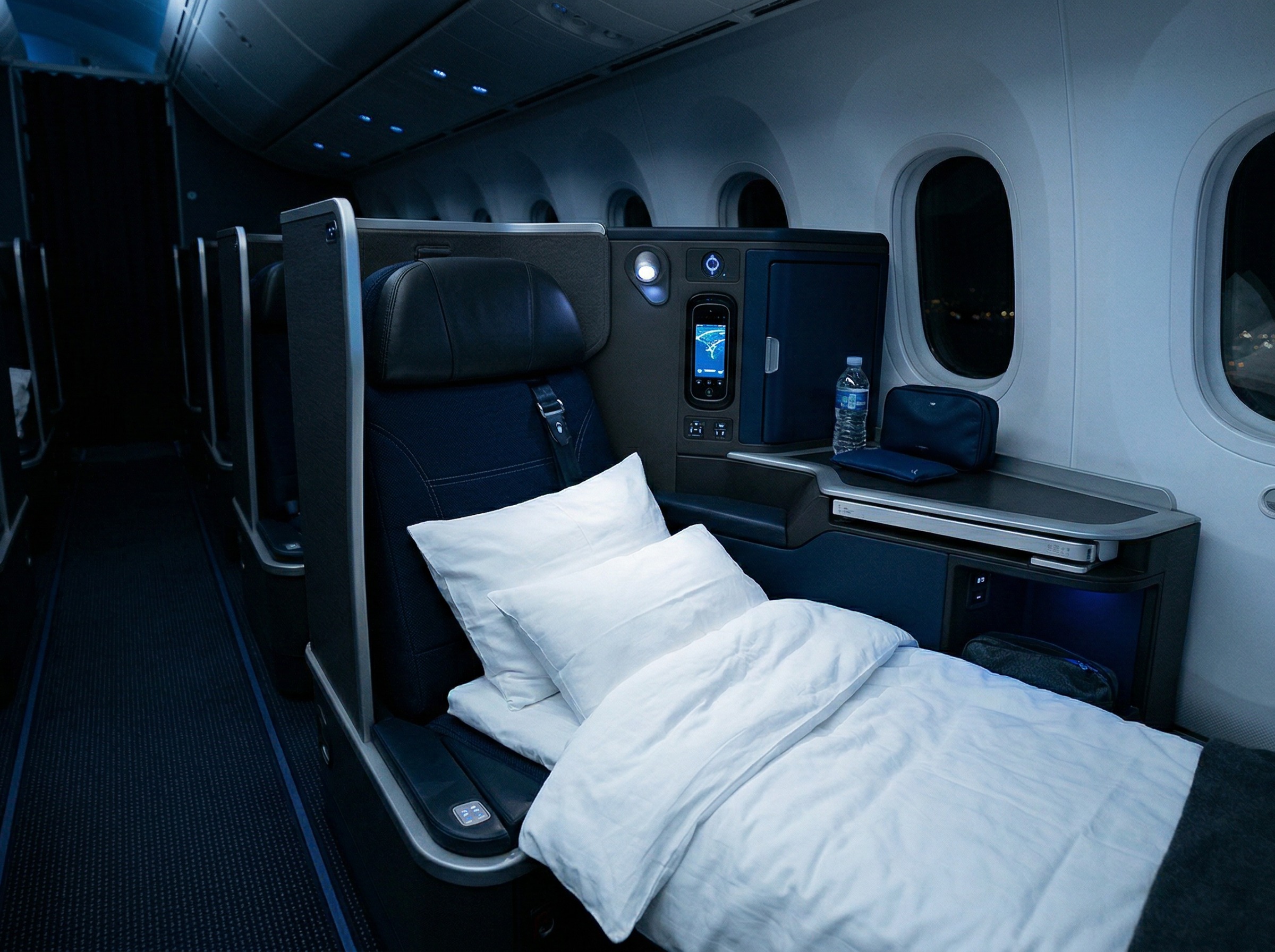
What Business Class on a 5-Hour Flight Actually Gets You
The phrase “five-hour flight” is doing a lot of work in the business class conversation. New York to London is not five hours. Eastbound, JFK to LHR runs roughly six hours and forty-five minutes to seven hours and twenty minutes depending on the jet stream. Westbound — against the wind — it stretches closer to eight and a half. The “five-hour” framing persists because it is how the route feels in comparison to a transpacific crossing, and because it is how airlines pitch transatlantic routes to make the upgrade seem more justifiable.
The duration question matters because business class on a seven-hour flight is a fundamentally different proposition than business class on a twelve-hour haul. You have less time to use the bed. The meal service occupies a larger fraction of the flight. The lounge access is either valuable or irrelevant depending on your departure time. The math on premium pricing shifts.
This piece covers exactly what you receive in transatlantic business class — seat specs, meal service, lounge access, and sleep usability — across the six carriers operating the most significant New York to Europe routes in 2026. It does not argue that business class is or is not worth it. It gives you a precise account of what you are buying so you can make that call yourself.
The Duration Reality
A transatlantic crossing from New York to London, Paris, or Frankfurt falls into a range that airline marketing does not handle honestly. Published schedule times for JFK-LHR in 2026 range from approximately 6h45m to 7h20m eastbound. Frankfurt runs similarly. Paris (CDG) is comparable, sometimes a few minutes shorter.
These are not short-haul routes. They are not long-haul in the transpacific sense either. They occupy a middle tier — long enough for one full sleep cycle if you board late enough, short enough that sleeping for the entire flight is not a realistic expectation. That distinction shapes every component of the business class value calculation.
One clarification on terminology: no major carrier operating New York to London, Paris, or Frankfurt in 2026 puts a recliner seat in their business class cabin on those routes. Every carrier covered below offers a fully flat bed on transatlantic service. The recliner vs. lie-flat debate is a domestic and regional business class question. On transatlantic J, the product floor is flat.
The Seat: What Flat Means in Practice
All six carriers below offer lie-flat seats in business class on transatlantic routes. The differences are in configuration, privacy, and bed dimensions — not in whether the seat reclines flat.
British Airways — Club Suite
The Club Suite, deployed on 777-300ER and select 787-9 aircraft on transatlantic routes, operates in a 1-2-1 configuration with direct aisle access for all passengers. Each suite has a sliding door — a genuine privacy door, not a symbolic partition. Bed length runs to approximately 79 inches. The suite design is narrow relative to some competitors, which is noticeable for wider-framed travelers. Window seats in the Club Suite have a consistent diagonal orientation; the footwell angles toward the fuselage wall. For solo travelers in a window seat, this is fine. For couples traveling together in the center pairs, the configuration allows conversation when upright but requires effort to interact lying flat.
Delta Air Lines — Delta One Suite
On A350-900 and A330-900neo aircraft serving transatlantic routes, Delta One runs a 1-2-1 layout with full privacy doors. Bed length is approximately 76 inches; width at the widest point is around 22 inches. The privacy door on Delta One is currently the most substantive door product among US carriers on transatlantic service. Westin Heavenly bedding is standard. For a solo traveler prioritizing sleep quality, Delta One on the A350-900 is consistently cited in independent cabin reviews as the strongest US-carrier sleep environment on transatlantic routes.
United Airlines — Polaris
United Polaris on the 777-300ER and 787-9 runs in a 1-2-1 layout with direct aisle access. Bed length is approximately 78 inches — competitive with Delta One and the Club Suite. There is no privacy door on standard Polaris (select 787-9 aircraft now carry Polaris Studios, an enclosed suite configuration, but deployment on specific transatlantic routes varies and should be verified at booking). Bedding quality is high; Polaris lounges at select airports are a noted strength of the product.
Lufthansa — Business Class / Allegris
Lufthansa’s long-haul business class on A350-900 aircraft runs a 1-2-1 configuration with lie-flat seats. Lufthansa’s newer Allegris product, rolling out on select aircraft, introduces an armchair-style angled seat option alongside the standard lie-flat in the same cabin — a design choice that has drawn mixed reception. On routes served by standard A350-900 configured aircraft without Allegris, the flat bed remains consistent and direct-aisle access applies to all passengers. Allegris deployment on specific JFK-FRA dates should be verified against Lufthansa’s fleet assignment, as the rollout is ongoing through 2026.
Air France — Business Class (La Premiere excluded)
On 787-9 and A350-900 aircraft operating CDG-JFK and CDG-EWR routes, Air France business class runs a 1-2-1 configuration with fully flat seats and direct aisle access. The product has been updated in recent years and is considered competitive with British Airways Club Suite in the European-carrier category. Bed length is approximately 78 inches on the A350 configuration.
American Airlines — Flagship Suite
American’s 787-9 Flagship Suite, introduced in 2025 and rolling out to transatlantic routes through 2026 (including London and select European capitals), runs a 1-2-1 layout with 51 suites total. Eight “Flagship Suites Preferred” seats in rows 1 and 10 offer additional space. The suite includes a sliding privacy door (FAA-approved; all in-service Flagship Suite deliveries feature functional doors). Bed length converts to flat at approximately 78 inches. Seat pitch in standard suites is approximately 42 to 44 inches depending on position.
Seat Comparison Table
| Carrier | Product | Aircraft (transatlantic) | Config | Bed Length (approx.) | Privacy Door | Direct Aisle Access |
|---|---|---|---|---|---|---|
| British Airways | Club Suite | 777-300ER, 787-9 | 1-2-1 | ~79 in | Yes | All seats |
| Delta Air Lines | Delta One Suite | A350-900, A330-900neo | 1-2-1 | ~76 in | Yes | All seats |
| United Airlines | Polaris | 777-300ER, 787-9 | 1-2-1 | ~78 in | No (standard) | All seats |
| Lufthansa | Business / Allegris | A350-900 | 1-2-1 | ~78 in | No (standard) | All seats |
| Air France | Business Class | A350-900, 787-9 | 1-2-1 | ~78 in | No | All seats |
| American Airlines | Flagship Suite | 787-9 | 1-2-1 | ~78 in | Yes (rolling out) | All seats |
| JetBlue | Mint Suite | A321LR | 1-1 | ~80 in | No | All seats |
Seat dimensions are approximate and vary by aircraft subfleet. Verify configuration for your specific flight number before booking.
JetBlue Mint note: JetBlue’s A321LR operates a small number of transatlantic routes — primarily JFK-LHR and JFK-CDG — with Mint Suite seats in a 1-1 layout and approximately 80-inch bed length. Mint Studio (seats 1A and 1F) adds additional storage and table space. JetBlue’s transatlantic Mint is notable for pricing that can undercut legacy carriers significantly on equivalent routes. The product is premium-competitive; the airline’s lounge network and reliability record are the qualifying considerations.
Meal Service: What Short-Haul J Actually Delivers
On a seven-hour transatlantic flight, the meal service is compressed relative to a twelve-hour haul but substantively different from domestic first class. What you receive across all six carriers is a plated, multi-course meal with proper tableware, a structured wine program, and attentive service in the main service window.
What is consistent across carriers:
– A starter (salad, charcuterie, or seafood course)
– A choice of two to four mains (presented from a printed or screen-based menu)
– A dessert course
– A cheese course on European carriers (BA, Lufthansa, Air France consistently; Delta and United vary)
– A wine list with between four and eight options, typically weighted toward a single champagne pour on boarding, whites with starter, reds with mains
What varies:
– Dine-on-demand availability. On a seven-hour flight, full dine-on-demand is less structurally relevant than on a twelve-hour haul — there is typically one service window and a lighter snack option later in the flight. Delta offers pre-order on transatlantic routes; United’s Book the Cook applies to select transatlantic routes. Verify by route, not by carrier assumption.
– Meal quality consistency. Air France and Lufthansa tend to receive higher marks for food quality in independent cabin reviews. Delta One meal quality varies by route and seasonal menu. United Polaris has made improvements to its catering program since 2023 but remains inconsistent relative to European carrier competition.
– The light second service. On evening departures arriving in Europe for morning connections, most carriers offer a lighter snack or small breakfast before arrival. This is not equivalent to a second full meal service.
What you do not get on a seven-hour flight that you get on a twelve-hour haul:
A full second meal service. Substantial free time between service windows. The ability to order multiple courses independently across hours of the flight. On a transatlantic business class flight, the meal service is one structured event followed by the rest period, not a sequence of dining experiences.
The Flat Bed Question: Is It Actually Usable?
On a seven-hour transatlantic crossing, the flat bed is usable — with conditions.
The window is real. On a typical departure from JFK in the 9:00 to 11:00 PM range, a seven-hour flight arrives in London around 9:00 to 11:00 AM GMT. If you fall asleep within the first ninety minutes after the meal service concludes, you have four to five hours of potential sleep before the arrival preparation window begins. That is enough for a functional rest cycle. It is not a full night’s sleep, but it is categorically different from the two to three hours of disrupted recline sleep achievable in premium economy on the same route.
On a daytime departure — JFK to London leaving at 9:00 or 10:00 AM — the calculation changes. A flat bed does not manufacture sleepiness. If you cannot sleep during the day, the lie-flat seat gives you a more comfortable workspace and a better meal, but not rest. Daytime transatlantic travelers who cannot sleep on planes will get less utility from the seat upgrade than the price differential suggests.
Three factors determine actual sleep quality on a transatlantic business class crossing:
- Departure time. Evening departures align with the body’s sleep window and are the correct pairing for a lie-flat investment.
- Privacy configuration. Seats with full doors (Club Suite, Delta One Suite, AA Flagship Suite) meaningfully reduce ambient light and aisle disturbance. The difference is measurable for light sleepers. JetBlue Mint previously offered privacy doors but disabled them in 2024; the cabin now operates without the door functionality.
- Bed length relative to your height. At 78 inches, the Polaris bed provides adequate length for most travelers. At 79 to 80 inches (Club Suite), the constraint is further reduced.
The Price Gap: Business Class vs. Premium Economy
Published round-trip fares on transatlantic routes in 2026 show a consistent spread between premium economy and business class. The numbers below reflect typical published fares, not sale fares or points redemptions.
| Cabin | Typical RT Published Fare (JFK-LHR) | Notes |
|---|---|---|
| Economy | $500 – $900 | Wide variability by season and advance purchase |
| Premium Economy | $1,200 – $2,500 | Varies significantly by carrier and timing |
| Business Class | $3,500 – $7,000 | Peak routes and dates at the high end |
| Upgrade (PE to J) | $1,000 – $2,800 | Cash upgrade offers vary; last-minute can exceed $3,000 |
Fare ranges sourced from published 2026 reporting. Exact fares depend on route, carrier, booking window, and date. Points redemptions and upgrade bids can alter effective cost substantially.
The gap between premium economy and business class on transatlantic routes typically runs $1,500 to $4,500 round-trip at published rates. On a per-flight basis (round-trip divided by two), that is $750 to $2,250 per direction for the upgrade.
What that buys is: a flat bed instead of a 38-inch-pitch recliner, lounge access at origin and destination, priority boarding and baggage, a plated meal service with tableware, and — on most carriers — a substantially quieter cabin environment.
What it does not guarantee: better sleep than premium economy on a daytime flight, dramatically faster airport processing on routes where priority lanes are congested, or a significantly different food quality experience at the starter and bread course level.
Lounge Access: What Is Actually Included
Business class on a transatlantic ticket includes lounge access at the departure airport. The quality of that lounge varies significantly by carrier and airport.
- JFK departures: The new American Airlines / British Airways joint lounges at Terminal 8 (Chelsea, Soho, Greenwich) are the current benchmark for US-departure transatlantic business class. Delta Sky Club at JFK is solid. United’s Polaris Lounge at Newark (EWR) is a notable product; United’s JFK offering is weaker. Air France and Lufthansa departures from JFK funnel through shared or less-distinguished lounge arrangements.
- LHR arrivals: BA operates Galleries Club at Terminal 5. Lufthansa connects into Terminal 2; its lounge is functional. Delta’s LHR lounge situation is less distinguished than its domestic product. Lounge quality at arrival airports is rarely the lead factor in choosing a transatlantic carrier.
On a seven-hour overnight flight, lounge access at departure typically means two to three hours in the lounge before boarding. That time has compounding value: a real meal before the flight (reducing reliance on onboard service), shower facilities if departing after a full workday, and a quiet environment versus the terminal. The lounge access component of the business class ticket is most useful for the evening transatlantic departure pattern — and nearly irrelevant for a midday departure.
Who This Is For
The overnight transatlantic traveler with a morning commitment. If you board at 10:00 PM JFK and land at 10:00 AM London with a board meeting, client lunch, or important site visit at noon, the lie-flat seat is doing genuine work. The four to five hours of sleep you extract from it — compared to the disrupted recline in premium economy — is measurable in arrival-day performance.
The frequent transatlantic traveler managing cumulative fatigue. If you cross the Atlantic four or six times per year, the compound effect of sleep quality matters differently than it does on a single trip.
The traveler flying on points at a favorable redemption rate. At 50,000 to 70,000 miles for a one-way transatlantic business class seat on programs with strong transatlantic partner awards, the cash-equivalent value calculation changes entirely. The question of whether business class is “worth it” at $4,500 cash is different from the question of whether it is worth 60,000 miles plus $150 in fees.
Who This Is Not For
The daytime transatlantic traveler who cannot sleep on planes. A lie-flat bed is not a sleep guarantee. On a JFK-LHR departure at 9:00 AM arriving at 9:00 PM London time, the bed is a comfortable workspace with better food. That may be worth $1,500 to some travelers. It is not the same product as the overnight crossing.
The traveler on a one-time leisure trip at full published fares. At $6,000 round-trip cash for business class versus $1,800 for premium economy, the $4,200 differential buys a flat bed, a lounge, and a plated meal. On a once-a-year vacation budget, that arithmetic rarely resolves in favor of business class unless points close the gap.
The traveler who prioritizes the destination over the journey. If the flight is a means to an end and you can sleep anywhere, premium economy’s 38-inch pitch and recline is genuinely adequate for a seven-hour overnight crossing. Not ideal. Adequate.
The Tradeoffs
You gain: A flat bed with real sleep potential on overnight routes. Lounge access worth two to three hours of genuine productivity or rest before boarding. Priority handling throughout. A structured, plated meal that is categorically different from premium economy catering. A quieter, lower-density cabin.
You do not gain: A dramatically longer usable sleep window than premium economy on a seven-hour flight — the flight duration caps the benefit regardless of seat quality. First-class isolation or dining formality. A guaranteed upgrade in arrival-day performance if the flight is daytime.
The hidden variable: Aircraft. All six carriers covered here have business class products that vary by subfleet. Booking British Airways Club Suite on a 777-300ER delivers a different experience than booking it on a 787-9. Verifying the aircraft type — and the specific seat configuration — for your flight number is not optional research if you are spending $4,000 or more on the ticket.
Verdict
Business class on a transatlantic overnight crossing is a defensible purchase when the flat bed is doing real work — specifically, when you board late at night, need to arrive functional in the morning, and are either paying with points at a favorable rate or splitting the cash premium against a professional purpose.
On a daytime transatlantic flight at full published fares, the premium over a well-selected premium economy seat is harder to justify. You are buying comfort and service, not the sleep return that makes the price rational.
The carrier distinction matters less than the aircraft distinction, which matters less than the departure time. Get the timing right, verify the aircraft before booking, and the flat bed earns its keep. Get any of those variables wrong, and you will spend $2,000 more for a better meal and a marginally less uncomfortable daytime ride.
One rule applies across all scenarios: do not book business class on a transatlantic route without confirming the seat product on your specific flight number. The carrier name on the ticket does not tell you what seat is on the plane.
FAQ
Is there a 5-hour transatlantic flight from New York to Europe?
No. New York to London runs approximately 6 hours 45 minutes to 7 hours 20 minutes eastbound. New York to Paris and Frankfurt are comparable. Westbound crossings against prevailing winds run closer to 8 to 8.5 hours. The “5-hour” framing is a popular shorthand but does not reflect actual block times on any major transatlantic route.
Do all business class seats lie flat on transatlantic flights?
On the major carriers operating New York to London, Paris, and Frankfurt in 2026 — British Airways, Delta, United, Lufthansa, Air France, American Airlines, and JetBlue — yes. There are no recliner-only business class products on these transatlantic routes. The variation is in bed length, width, configuration, and whether a privacy door is included, not in whether the seat converts to flat.
How much more does business class cost than premium economy on a transatlantic route?
At published fares, the gap typically runs $1,500 to $4,500 round-trip, with business class ranging from approximately $3,500 to $7,000 and premium economy from approximately $1,200 to $2,500. The actual price depends on carrier, route, booking window, and date. Points redemptions can reduce the effective cost substantially.
Is the flat bed usable on a 7-hour flight?
On an overnight departure, yes. If you board at 10:00 PM and have a meal service followed by four to five hours of potential sleep before arrival preparation, the flat bed delivers a measurable sleep advantage over premium economy. On a daytime departure, the bed is a comfortable workspace. The departure time is the primary variable.
Which carrier has the best business class on transatlantic routes?
For solo travelers prioritizing sleep, Delta One Suite on the A350-900 and British Airways Club Suite on the 777-300ER are consistently cited as the leading products in independent cabin reviews based on privacy door effectiveness and bed quality. JetBlue Mint on A321LR transatlantic routes is competitive on bed length at pricing that can undercut legacy carriers. The product no longer features privacy doors (disabled by JetBlue in 2024), but the 1-1 layout still provides physical separation. The “best” product depends on departure airport, route, and whether you can verify the aircraft type before booking.
Does business class include lounge access?
Yes. A business class ticket on a transatlantic route includes access to the operating carrier’s lounge (or partner lounge) at the departure airport and, on many itineraries, at the arrival airport. Lounge quality varies by airport and carrier. On an overnight departure, two to three hours in a premium lounge before boarding adds substantive value to the ticket.
What happens to the meal service if I want to sleep instead of eat?
Most transatlantic business class cabins allow passengers to defer or decline the meal service. Delta’s pre-order system allows you to have your meal ready on boarding so you can eat immediately, maximize sleep time, and decline the later service. On most carriers, informing the crew before departure that you prefer to sleep through the service will result in a lighter snack or light breakfast being offered near arrival instead.
PRE-BOOKING CHECKLIST
- [ ] Confirm the aircraft type for your specific flight number before purchasing — not the route, the flight number
- [ ] Verify the seat product on that aircraft (1-2-1 layout, bed length, whether a privacy door is included)
- [ ] Check departure time: overnight departures maximize the flat bed investment; daytime departures do not
- [ ] Compare published fares against premium economy on the same route to calculate the actual cash differential
- [ ] Check points redemption value before paying cash — transatlantic business class is one of the highest-value award categories
- [ ] Review the lounge situation at your departure airport for that carrier
- [ ] If sleep is the priority, confirm whether the carrier offers pre-order meal service so you can board, eat, and go flat immediately
- [ ] Check the seat map for your specific aircraft and select your seat before check-in opens
- [ ] Note westbound return duration (add roughly 60–90 minutes vs. eastbound) when evaluating whether sleep is achievable on both legs