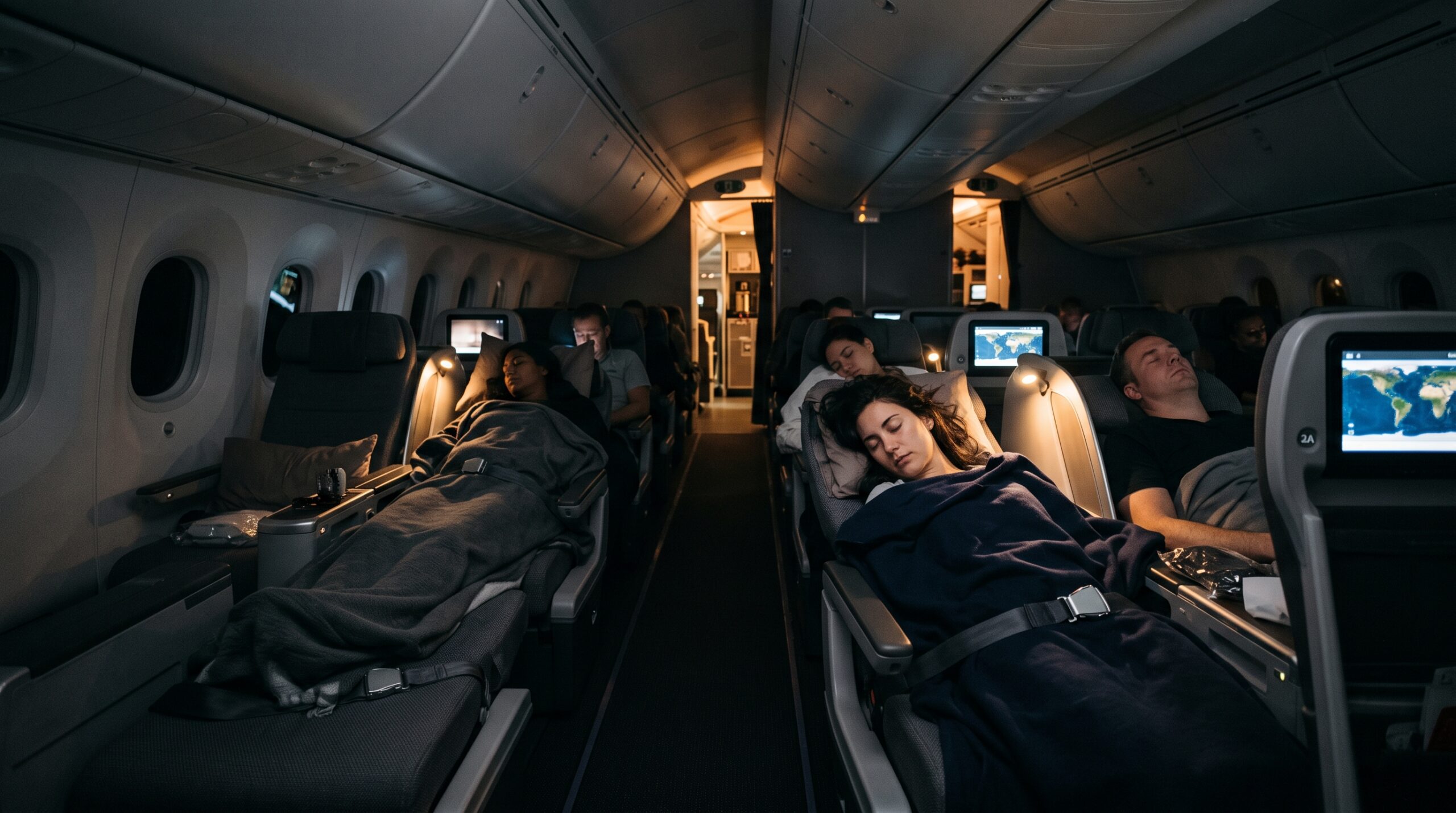
A red-eye flight saves a hotel night and a workday but costs you a night of sleep — and the math only works if you can sleep on planes, fly direct with a lie-flat seat, or arrive with a light first day ahead of you. For anyone who cannot sleep upright, a red-eye in economy is a productivity tax paid in exhaustion.
Red-eyes exist because airlines optimize fleet utilization: a 787 that lands at 11 p.m. can turn and depart at midnight, earning revenue during hours it would otherwise sit at a gate. For travelers, the calculus is different. You gain a full workday at your origin and skip a hotel night at your destination. You lose a night of restful sleep — and the research on cognitive performance after sleep deprivation is unambiguous. A 2019 study in the Journal of Sleep Research found that a single night of 4 hours or less of sleep impairs reaction time and decision-making at levels comparable to a 0.05% blood alcohol concentration. The red-eye tradeoff is not whether the savings exist. It is whether you will arrive functional.
When a Red-Eye Makes Sense
You are flying an eastbound route of 6-8 hours. A New York to London flight departing at 9 p.m. EST and arriving at 9 a.m. GMT aligns reasonably well with your body clock. You board, eat, sleep 3-4 hours, and land in the morning. This is the natural red-eye: short enough that partial sleep works, timed so you arrive at the start of a local day. Westbound red-eyes (Los Angeles to New York, departing 10 p.m. PST, arriving 6 a.m. EST) are harder: the flight is only 5 hours, leaving at most 3 hours of actual sleep time, and your body clock is fighting a time zone shift in the wrong direction.
You have a lie-flat seat. The difference between sleeping in a Delta One or United Polaris seat versus an economy seat on a red-eye is not incremental. It is the difference between arriving functional and arriving impaired. In a lie-flat seat, you can get 4-5 hours of actual sleep on a 7-hour flight. In economy, turbulence, cabin announcements, seat neighbors, and the 30-degree recline limit mean 1-2 hours of fragmented sleep is typical. Paying for premium cabin access on a red-eye has a higher ROI than on a daytime flight because the product does something functional — enables sleep — rather than just making the experience nicer.
You can afford a zero-commitment first day. Land at 6 a.m., clear immigration by 7:30 a.m., and check in to your hotel knowing you will not do anything demanding until the following morning. A light walk, a good lunch, an early dinner, bed by 8 p.m. local time. This is the standard jet lag protocol, and it works. The problem: travelers who land at 6 a.m. and schedule a 9 a.m. meeting. Do not do this.
When a Red-Eye Does Not Make Sense
You know you cannot sleep on planes. Some people cannot — 30% of air travelers report getting zero sleep on overnight flights, according to a 2022 survey by Sleep Junkie. If you are in this group, a red-eye economy ticket is not a money-saving strategy. It is a guaranteed 36-hour day followed by a 12-hour recovery sleep. You save on the hotel and lose the first 24 hours of your trip.
You have a connecting flight after the red-eye. A 6 a.m. landing followed by a 7:30 a.m. connection is still a poor setup, but not because red-eyes are unusually unreliable. A ChampionTraveler analysis of Bureau of Transportation Statistics data found that in 2025, 82.4% of red-eyes arrived within 15 minutes of schedule, compared with 77.6% of other flights; cancellations were also lower, 1.05% versus 1.47%. The reason to leave extra time is human: you are sleep-deprived, navigating an unfamiliar airport, and less equipped to absorb a long walk, gate change, or routine delay. Minimum connection time logic still applies doubly on red-eyes.
You are traveling westbound on a route under 5 hours. A Los Angeles to New York red-eye departs around 10-11 p.m. PST and lands at 5-6 a.m. EST. You might get 2-3 hours of sleep. The circadian disruption — landing at what your body thinks is 2-3 a.m. — amplifies the sleep loss. West Coast to East Coast red-eyes are the worst value proposition in commercial aviation for anyone who needs to function on arrival day.
You are traveling with children under 12. Children do not sleep well in economy seats, and a sleep-deprived child at 6 a.m. in a new city is not a vacation starter. Fly during the day or book a premium cabin with space for children to lie down.
Checklist: Red-Eye Decision Framework
- Eastbound red-eyes (US to Europe, US West Coast to East Coast) align with circadian rhythms better than westbound. Prioritize these if you must fly overnight.
- Premium cabin access on a red-eye has higher functional value than on a daytime flight. The seat pays for itself in next-day productivity.
- Schedule a light first day: no meetings, no driving, no complex navigation. Hotel check-in, a walk, an early dinner, bed by 8 p.m.
- Treat 90 minutes as the minimum after a red-eye landing. Red-eyes are statistically more punctual than other flights, but the extra buffer protects against routine disruption when you are tired and slower to recover.
- If you know you cannot sleep on planes, book a daytime flight — even if it costs more or costs a workday. The red-eye savings are not real if you arrive non-functional.
- Avoid alcohol and caffeine on the flight. Both fragment sleep quality. Melatonin at 0.5-3 mg timed to destination bedtime is backed by stronger evidence than any over-the-counter sleep aid.
Verdict
Red-eyes are worth booking when the flight is eastbound, you have a lie-flat seat or can sleep upright, and you budget a zero-commitment arrival day. The saved hotel night and workday are real value — potentially $200-500 for the hotel alone. But if you fly economy, cannot sleep on planes, or have a morning commitment at your destination, book a daytime flight. The money saved on a red-eye is rapidly consumed by a lost first day and the cognitive penalty of operating on 2 hours of sleep.
FAQ
Q: What is the best seat for sleeping on a red-eye in economy?
A: Window seat, preferably on the left side of the aircraft (most people tilt their head left when sleeping). Avoid seats near lavatories and galleys. Bulkhead rows offer more legroom but often have fixed armrests that prevent leaning against the wall.
Q: Should I eat the meal served on a red-eye?
A: Eat before boarding if possible. An in-flight meal at 11 p.m. delays sleep by 1-2 hours while your body processes the food. If you must eat, choose the lightest option.
Q: How does a red-eye interact with jet lag?
A: A red-eye eastbound across time zones compresses your night. If you normally sleep 11 p.m.-7 a.m. and the flight departs at 9 p.m., you have already lost 2 hours of wind-down time. The net sleep loss compounds with circadian disruption on arrival. Westbound red-eyes on short routes are worse because the flight itself is too short for meaningful sleep.
Q: Are red-eye flights cheaper?
A: Often, but not always. Red-eyes are off-peak inventory that airlines price to fill. On high-demand routes (New York to London weekday departures), the discount may be minimal. Compare all-in pricing against the value of a hotel night saved.
Q: Is premium economy good enough for a red-eye?
A: Marginally. Premium economy offers 5-7 extra inches of pitch and 2-3 extra inches of recline. It helps. It is not a lie-flat seat. If you can sleep at a 135-degree recline, premium economy on a red-eye is reasonable. If you need 180 degrees, it is not.