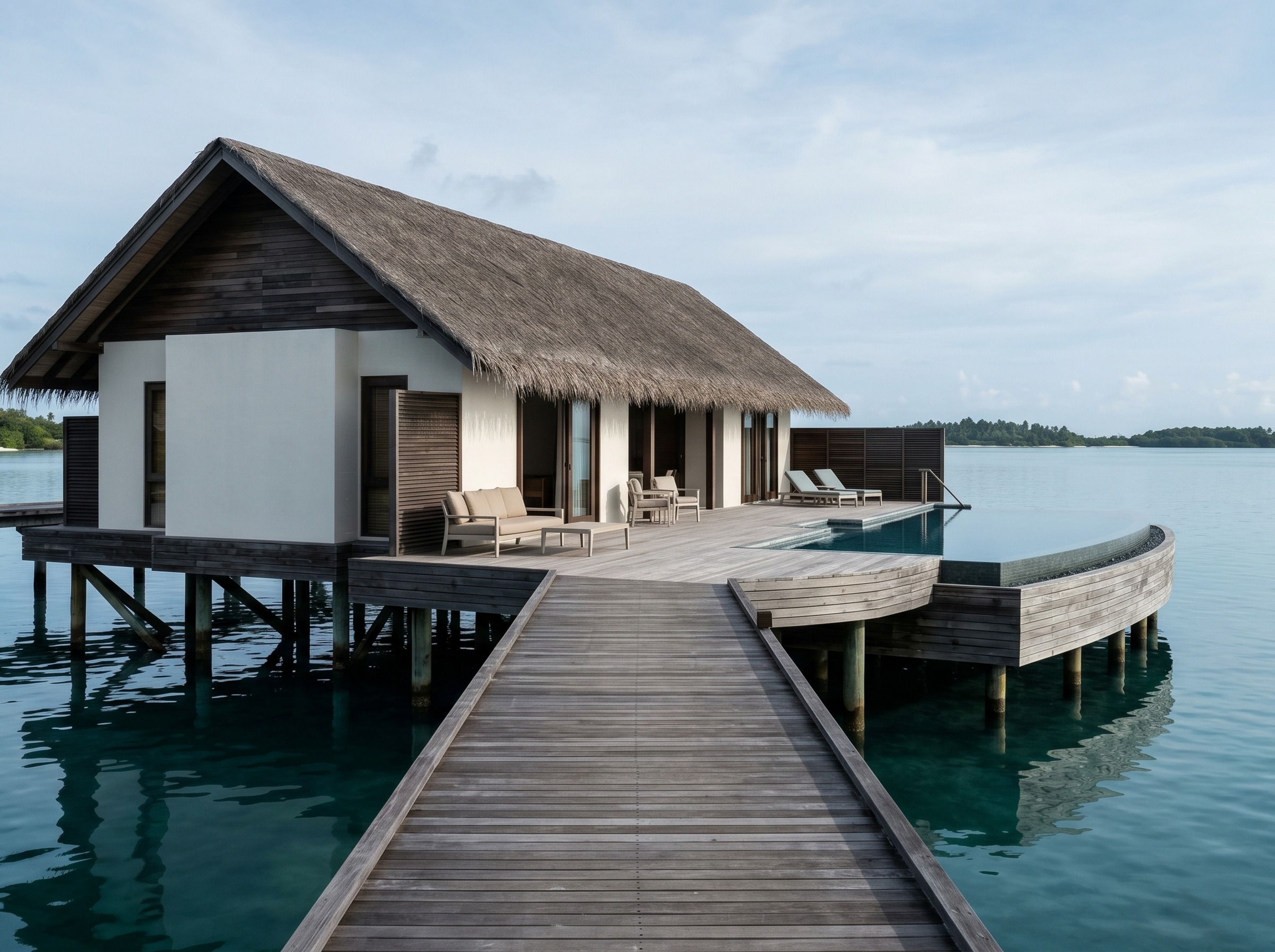
The overwater bungalow originated in French Polynesia in the 1960s. The Maldives industrialized it. Today, both destinations sell essentially the same aspiration — private deck, turquoise water below, nothing on the horizon — at radically different price structures, with different access logistics, different marine environments, and fundamentally different dining philosophies. Choosing between them requires understanding those differences precisely, not picking based on which photographs better.
This piece compares the two markets on the dimensions that actually determine value: flight cost and routing from the United States, inter-resort transfer mechanics, overwater villa specifications, snorkeling and diving quality, seasonal windows, dining model economics, and total trip cost at comparable tiers. Neither destination wins outright. The right answer depends on your budget architecture and what you expect the water to deliver.
Flight Logistics: The First Asymmetry
Getting to either destination from the continental United States is a long-haul commitment, but the routing structures differ significantly and carry real cost implications.
Maldives (Velana International Airport, MLE): From the US East Coast, round-trip economy fares typically run $1,000–$1,800, routed through Middle Eastern hubs (Emirates, Etihad, Qatar Airways) or European connections. West Coast travelers face similar ranges, with occasional promotional fares as low as $750 appearing on specific date windows. Total flight time from New York runs approximately 18–22 hours each way depending on layover duration. There is no nonstop option from any US gateway.
French Polynesia (Faa’a International Airport, PPT, Papeete): Air Tahiti Nui operates the primary route from Los Angeles (approximately 8.5 hours nonstop), making French Polynesia significantly more accessible from the West Coast than the Maldives. Promotional economy fares on this route have appeared at $514–$759 round-trip from Los Angeles and Seattle in 2025–2026 sale windows. Delta and Air France also operate the LAX–PPT route, with comparable promotional fares. East Coast travelers connecting via LAX typically face total round-trip costs of $1,100–$1,900.
The asymmetry: West Coast travelers face a material cost and time advantage flying to French Polynesia over the Maldives. East Coast travelers see comparable total flight costs to both destinations but significantly longer routing to the Maldives. For anyone based west of Chicago, French Polynesia wins the flight calculation by a meaningful margin.
Transfer Costs: Where the Maldives Gets Expensive
Both destinations require secondary transfers after the international flight. The mechanics — and costs — are structurally different.
Maldives transfers: Velana International Airport sits on an artificial island adjacent to Malé. Resorts are distributed across 26 atolls spanning roughly 500 miles of ocean, which means transfer distance and method vary dramatically by property.
- Speedboat: Practical for resorts within Kaafu Atoll (North Malé) and a handful of adjacent atolls. Typical round-trip cost: $100–$200 per person for near-Malé routes; longer private charters can reach $400 per person. Available around the clock.
- Seaplane: Required for resorts in more remote atolls — Baa, Noonu, South Ari, Gaafu Alifu. Shared seaplane transfers run approximately $290–$700 per person round-trip. Private charters: $1,200–$15,000 one-way depending on aircraft size and distance. Four Seasons Landaa Giraavaru (Baa Atoll) published per-person one-way seaplane rates of $520–$980 for its 2024–2026 rate sheet. Seaplanes operate daylight hours only; late-arriving international flights may require an overnight in Malé.
- Domestic flight + speedboat: For the most remote southern atolls. Round-trip cost: approximately $200–$400 per person.
Important: Most premium Maldives resorts bundle transfers into package pricing, but this is not universal. Verify before booking. At luxury tier, a couple staying at a remote atoll property should budget $600–$1,600 in transfers alone if not included.
French Polynesia transfers: Papeete’s Faa’a airport is on Tahiti’s main island. Bora Bora — the primary overwater bungalow destination — requires a 50-minute Air Tahiti inter-island flight to Motu Mute airport (BOB), then a short boat shuttle across the lagoon to the main island or directly to your resort’s dock.
- Air Tahiti PPT–BOB: Published round-trip fares run approximately 35,500–43,000 XPF (roughly $290–$360 USD at current exchange rates), with the lagoon shuttle included in the fare. Air Tahiti Nui passengers may receive discounted inter-island rates through companion passes.
- Resort boat transfer from BOB airport: Typically arranged by the resort and included in rates at most four- and five-star properties.
The transfer verdict: French Polynesia’s transfer model is simpler, more predictable, and generally less expensive — particularly for properties on or near Bora Bora. The Maldives transfer system is more variable and, at remote-atoll luxury properties, adds meaningful cost that is often underestimated in initial budget planning.
Overwater Villa Specifications: Size, Structure, and What You Actually Get
The overwater bungalow concept originated in French Polynesia but has been developed most extensively in the Maldives. The structural differences matter.
Maldives overwater villas — representative specs:
| Property | Villa Type | Interior Size | Key Features |
|---|---|---|---|
| Conrad Maldives Rangali | Deluxe Water Villa with Pool | 115 m² | Private pool, lagoon access, deck |
| Conrad Maldives Rangali | Premier Water Villa with Pool | 152 m² | Private pool, sunset deck |
| Four Seasons Landaa Giraavaru | Sunrise/Sunset Water Villa with Pool | 90 m² interior / 183 m² outdoor | Private pool, outdoor living pavilion |
| Soneva Jani | 1BR Water Reserve with Slide | 555 m² total | Waterslide, retractable roof, catamaran net, private pool |
| Soneva Jani | 2BR Water Retreat with Slide | ~610–772 m² total | Multiple pools, slide, stargazing roof |
Maldives villas at the luxury tier tend to be architecturally ambitious: private plunge pools are standard above entry level, retractable roofs (Soneva) allow open-air sleeping, and deck footprints are generous. The water beneath is typically open ocean or lagoon, with house reef access a selling point at select properties.
French Polynesia overwater bungalows — representative specs:
| Property | Bungalow Type | Interior Size | Key Features |
|---|---|---|---|
| Four Seasons Bora Bora | One-Bedroom Lagoon View OWB Suite | 100 m² | Private deck, lagoon views, lounge furniture |
| Four Seasons Bora Bora | Otemanu OWB Suite with Plunge Pool | 147 m² | Private plunge pool, Mount Otemanu views |
| InterContinental Bora Bora Thalasso | Overwater Villa | 95 m² interior + 30 m² terrace | Glass-bottomed coffee table, direct lagoon access |
French Polynesia bungalows sit directly over Bora Bora’s famous turquoise lagoon — a specific and visually distinctive setting. The Mount Otemanu backdrop visible from Four Seasons villas is one of the most recognizable resort views in the world. However, interior square footage at comparable price points tends to be smaller than Maldives luxury villas, plunge pools are available only in premium categories, and the structural vocabulary is more traditional (thatched roof, timber deck) than the modernist architecture that defines top-tier Maldives properties.
Glass floor panels, often featured in marketing imagery, are not standard across all French Polynesia bungalows. InterContinental Bora Bora Thalasso offers a glass-bottomed coffee table rather than a full floor panel. Verify specific features property by property before booking based on this expectation.
Snorkeling and Diving Quality: Different Marine Environments
The underwater experience at each destination is genuinely different in character, not merely in degree.
Maldives: The Maldives sits within one of the world’s most productive marine ecosystems. House reefs — the coral formations directly accessible from a resort’s shoreline or villa deck — vary significantly in quality across properties, with independent ratings spanning roughly 6.5–9.2 out of 10 across reviewed resorts. Visibility commonly exceeds 30 meters. Marine life is diverse: reef sharks, eagle rays, reef fish, and — at the right atoll and season — manta rays and whale sharks. Hanifaru Bay in Baa Atoll is a UNESCO-designated manta feeding aggregation site, accessible during the southwest monsoon season (May–October). Remote atolls — Haa Alifu in the north, Gaafu Alifu in the south — consistently produce stronger reef health than the heavily visited central atolls near Malé.
The Maldives advantage for serious divers is significant: the house reef concept means underwater access often begins steps from your villa, and dedicated dive centers with live-aboard options extend range further.
French Polynesia / Bora Bora: Bora Bora’s lagoon environment is calmer and shallower than typical Maldives reef systems — excellent for snorkeling but structurally different for diving. The primary experience is lagoon-based: encounters with blacktip reef sharks and stingrays on guided tours are reliable and well-documented, with operators running organized shark-and-ray snorkel excursions daily during the dry season. Manta ray sightings occur but are less predictable than in the Maldives’ dedicated aggregation sites. Coral health in Bora Bora’s lagoon has faced bleaching pressure; conditions vary by site and year.
For non-divers and casual snorkelers, Bora Bora’s calm, clear lagoon with its reliable shark-and-ray encounters is a strong and accessible experience. For divers and marine wildlife specialists, the Maldives offers more depth — literally and ecologically.
Seasonality: When to Go and When to Avoid
Maldives seasons:
– Dry season (November–April): Northeast monsoon. Best overall conditions: low humidity, clear skies, calm seas, excellent underwater visibility. Peak tourist season runs December–March, with corresponding rate increases and advance booking requirements.
– Wet season (May–October): Southwest monsoon. More rain, higher humidity, stronger winds in some atolls. Rates are lower, crowds thinner. Strong surfing conditions in specific break zones. September–November offers reliable manta and whale shark sightings in key atolls.
– Planning note: Neither season is universally bad. The wet season’s “monsoon” is intermittent rain, not week-long storms. Many guests traveling May–October report predominantly sunny conditions with afternoon showers. Book the dry season for certainty; the wet season for value and wildlife concentration.
French Polynesia / Bora Bora seasons:
– Dry season (May–October): Southeast trade winds. Best conditions for snorkeling and diving: clear lagoon, calm seas, reliable marine life encounters. Whale watching peaks July–October. Higher prices, peak demand.
– Wet season (November–April): Warmer, more humid, higher rainfall. Cyclone season officially runs November–April, though actual cyclone strikes on Bora Bora are rare. February carries the highest statistical cyclone risk. Lush green island appearance; lower rates. Some activities may be weather-disrupted.
– Planning note: Both destinations share the general pattern of dry-season premium pricing and wet-season value. The Maldives’ dry season (Nov–Apr) overlaps with French Polynesia’s wet season, creating a potential arbitrage for travelers flexible on destination: travel to French Polynesia in its dry season (May–Oct) when Maldives rates are also lower, or travel to the Maldives in its peak season (Dec–Apr) when French Polynesia rates are reduced.
Dining Models: All-Inclusive vs. A La Carte
The two destinations operate on structurally different dining philosophies, and the difference has real budget implications.
Maldives — all-inclusive is available and often rational:
Maldives resorts offer a full spectrum of meal plans: bed and breakfast, half board (breakfast and dinner), full board, and premium all-inclusive. At entry-level luxury properties, all-inclusive supplements run approximately $165–$230 per night for two. At mid-luxury tier, $230–$380 per night. At ultra-luxury properties like Dusit Thani, supplements reach $450+ per night.
A la carte dining on a Maldives overwater property runs approximately $100–$200 per day for two in meals alone, before premium beverages. The 27% total tax applied to resort bills in the Maldives (10% service charge + 17% TGST effective July 2025) amplifies this significantly. For guests who drink wine or spirits with meals, the all-inclusive upgrade frequently pays for itself within five to seven nights — the break-even threshold is typically $800–$900 in supplement cost against anticipated beverage spend for a week.
French Polynesia — primarily a la carte, all-inclusive is the exception:
Most luxury resorts in Bora Bora — Four Seasons, InterContinental, St. Regis — operate on bed and breakfast or half-board models rather than true all-inclusive packages. Promotional all-inclusive packages do exist (Conrad Bora Bora Nui has marketed breakfast-plus-dinner packages at approximately $10,200–$11,900 per couple for six to seven nights including inter-island flights), but these are promotional inventory rather than standard rack-rate offerings.
Resort restaurant dining in Bora Bora typically runs $60–$150 per person for dinner before beverages at property restaurants, with higher-end tasting menu experiences pushing $200+. French Polynesia applies a 16% VAT on most restaurant meals, plus a 5% tourism promotion fee on hotel accommodation. Budget accordingly.
Local dining options on Bora Bora’s main island — accessible by free resort shuttle — run $15–$30 per person and provide a meaningful cost alternative for lunch or casual meals, though the logistics of leaving an overwater bungalow property for a meal are not trivial.
The dining verdict: For guests who want cost predictability, the Maldives’ all-inclusive structure (when priced rationally against a la carte alternatives) is the cleaner budget model. French Polynesia’s primarily a la carte market makes total food and beverage cost harder to predict and control, particularly for guests who do not actively manage off-property dining as an option.
Total Trip Cost: What a 7-Night Overwater Stay Actually Costs
The following ranges reflect two adults, seven nights, at comparable tier properties, including resort accommodation, inter-resort transfers, and typical meal costs, but excluding international flights.
| Category | Maldives (per couple, 7 nights) | French Polynesia (per couple, 7 nights) |
|---|---|---|
| Entry luxury overwater | $7,000–$12,000 | $5,600–$9,000 |
| Mid luxury overwater | $12,000–$22,000 | $9,000–$16,000 |
| Ultra luxury overwater | $22,000–$50,000+ | $16,000–$30,000+ |
| Inter-resort transfer (add) | $600–$1,600 (seaplane tier) | $580–$720 (Air Tahiti + shuttle) |
| Dining (a la carte, add) | $100–$200/day for two | $120–$300/day for two (resort) |
Ranges reflect published 2025–2026 rate data from resort pages, aggregators, and travel industry guides. Ultra-luxury Maldives figures reflect Soneva Jani, Six Senses, and comparable tier properties.
The cost reality: At comparable overwater quality, the Maldives runs approximately 20–35% more expensive than French Polynesia on accommodation. The transfer gap is modest in absolute terms. Dining economics favor whichever destination offers better all-inclusive value for your consumption pattern — which at luxury tier generally resolves in the Maldives’ favor for guests who engage the AI supplement.
Who This Is For
Book the Maldives if:
– You are a serious diver or snorkeler who wants a house reef directly accessible from your villa or beach
– You want the largest, most architecturally sophisticated overwater villas at the luxury tier
– You want access to genuine megafauna: mantas, whale sharks, eagle rays on a predictable seasonal basis
– You are booking from the US East Coast or any city requiring a long-haul connection regardless of destination
– You want the clearest possible all-inclusive dining budget and predictable total cost
Book French Polynesia if:
– You are based on or near the US West Coast and want a materially shorter, cheaper flight
– The Bora Bora lagoon setting — calm water, the Mount Otemanu backdrop, blacktip shark encounters — is specifically what you want
– You are a casual snorkeler rather than a serious diver
– You are traveling in May–October (French Polynesia’s dry season) when conditions are excellent and pricing at both destinations is comparable
– Your budget sits at entry-to-mid luxury tier, where French Polynesia offers better per-dollar accommodation value
This comparison does not apply if:
– You are considering guesthouse or budget accommodation in either destination — the overwater villa market is the scope of this piece
– You are evaluating other French Polynesian islands (Moorea, Rangiroa, Tikehau have distinct profiles not covered here)
– You are considering the Maldives’ local island guesthouse market, which operates on an entirely different cost basis
Tradeoffs at a Glance
| Dimension | Maldives | French Polynesia (Bora Bora) |
|---|---|---|
| Flight from US East Coast | $1,000–$1,800 RT economy | $1,100–$1,900 RT economy |
| Flight from US West Coast | $750–$2,000 RT economy | $514–$926 RT economy |
| Inter-resort transfer | $290–$700/person RT (seaplane); bundled at some properties | ~$290–$360/couple RT (Air Tahiti + shuttle) |
| Overwater villa entry size | 86–115 m² interior | 95–100 m² interior |
| Private plunge pool | Standard above entry tier | Premium category only |
| Snorkeling/diving quality | High; house reef varies by property; megafauna seasonal | Good; lagoon-based; sharks and rays reliable |
| Peak season | November–April | May–October |
| All-inclusive availability | Yes; common; economically rational | Rare; primarily a la carte |
| Entry luxury overwater (7 nights, couple) | ~$7,000–$12,000 | ~$5,600–$9,000 |
| Tax burden on dining | ~27% combined (service + TGST) | ~16% VAT + 5% tourism fee |
FAQ
Is the Maldives more expensive than French Polynesia?
Generally, yes — at comparable overwater villa tiers. Maldives accommodation typically runs 20–35% more expensive than French Polynesia at equivalent quality, and transfer costs (particularly seaplanes to remote atolls) add meaningful additional spend. The flight cost gap narrows for East Coast US travelers but widens for West Coast travelers, who face cheaper fares to French Polynesia.
Which destination has better snorkeling?
For access and marine diversity, the Maldives has a structural advantage: house reefs directly accessible from resort grounds, visibility commonly exceeding 30 meters, and reliable megafauna (mantas, whale sharks) in designated seasons. Bora Bora’s lagoon offers excellent shark-and-ray encounters on guided tours, calm conditions, and very high accessibility for non-divers. Serious divers will find the Maldives more rewarding; casual snorkelers will be well-served by either.
Do I need a seaplane to get to a Maldives resort?
Not necessarily. Resorts within Kaafu Atoll (North Malé) are accessible by speedboat, typically at lower cost and without the daylight-only scheduling constraints of seaplanes. The most photographed luxury properties — Soneva Jani, Four Seasons Landaa Giraavaru — require seaplanes or domestic flights. Confirm your specific resort’s transfer method and cost before booking.
Are French Polynesia overwater bungalows smaller than Maldives villas?
At entry-to-mid tier, the sizes are broadly comparable: 95–147 m² for Bora Bora’s primary luxury options versus 86–152 m² for Maldives entry-to-mid luxury. At ultra-luxury tier, the Maldives pulls significantly ahead — Soneva Jani’s overwater reserves run 555–772 m² total — with no French Polynesia equivalent at that scale.
What is the best time to visit both destinations?
The ideal windows do not overlap: Maldives peaks November–April; French Polynesia peaks May–October. This creates a natural planning framework — if you want to visit both, alternate destinations across different years to hit each in its optimal season. If choosing one trip, align with your travel dates and accept that shoulder-season conditions at either destination are generally still good.
Is all-inclusive a good deal in the Maldives?
At mid-luxury tier and above, the all-inclusive supplement frequently makes economic sense for guests who drink alcohol with meals and dine primarily on-property. The 27% total tax on resort bills amplifies a la carte costs; a premium AI supplement that absorbs beverages and meals can be cheaper than paying individually. Run the math against your expected daily consumption before committing.
Do I need a visa for the Maldives or French Polynesia?
US passport holders receive a 30-day visa on arrival for the Maldives at no charge. French Polynesia, as a French overseas collectivity, allows US citizens to stay up to 90 days without a visa. Neither destination requires advance visa application for US travelers.
Pre-Booking Checklist
- [ ] Confirm your resort’s specific transfer method (speedboat, seaplane, domestic flight) and whether transfers are bundled in the rate
- [ ] Calculate total transfer cost per person round-trip if not bundled; add to accommodation cost before comparing destinations
- [ ] Verify the dining plan options available at your chosen property and calculate a la carte daily spend against all-inclusive supplement cost
- [ ] Check the house reef quality rating for your Maldives property if snorkeling is a priority — not all house reefs are equal
- [ ] Confirm whether your French Polynesia bungalow has a plunge pool, direct lagoon stairs, or glass floor if these features are priorities
- [ ] Book inter-island Air Tahiti flights simultaneously with your international ticket; seats on peak-season Bora Bora routes book early
- [ ] For Maldives travel December–March, book both accommodation and seaplane transfers well in advance — seaplane capacity is limited
- [ ] Verify whether your overwater property charges for snorkeling equipment or includes it; in the Maldives, house reef gear is usually included or available at dive center rates
- [ ] Factor in Maldives tax surcharges (~27% total on bills including TGST) and French Polynesia VAT (~16% on dining) when budgeting daily spend
Verdict
French Polynesia is the better-value overwater market for West Coast US travelers with budgets at entry-to-mid luxury tier who want a definitive lagoon setting without maximizing dive time. The shorter flight, lower accommodation cost, and reliable shark-and-ray encounters in Bora Bora’s sheltered lagoon deliver a coherent, high-impact experience at lower total outlay.
The Maldives is the correct choice for serious divers, travelers prioritizing villa scale and architectural ambition, guests who need the all-inclusive structure to control dining costs, and anyone for whom marine biodiversity — not just marine encounters — is the point of the trip. The transfer complexity and cost are real but manageable; the underwater quality at the right property is not replicated elsewhere.
Do not choose based on photographs. Both markets produce extraordinary images. Choose based on where you are flying from, what you expect to do in the water, and whether you need a dining budget that doesn’t require daily mental arithmetic in a currency you do not use at home.