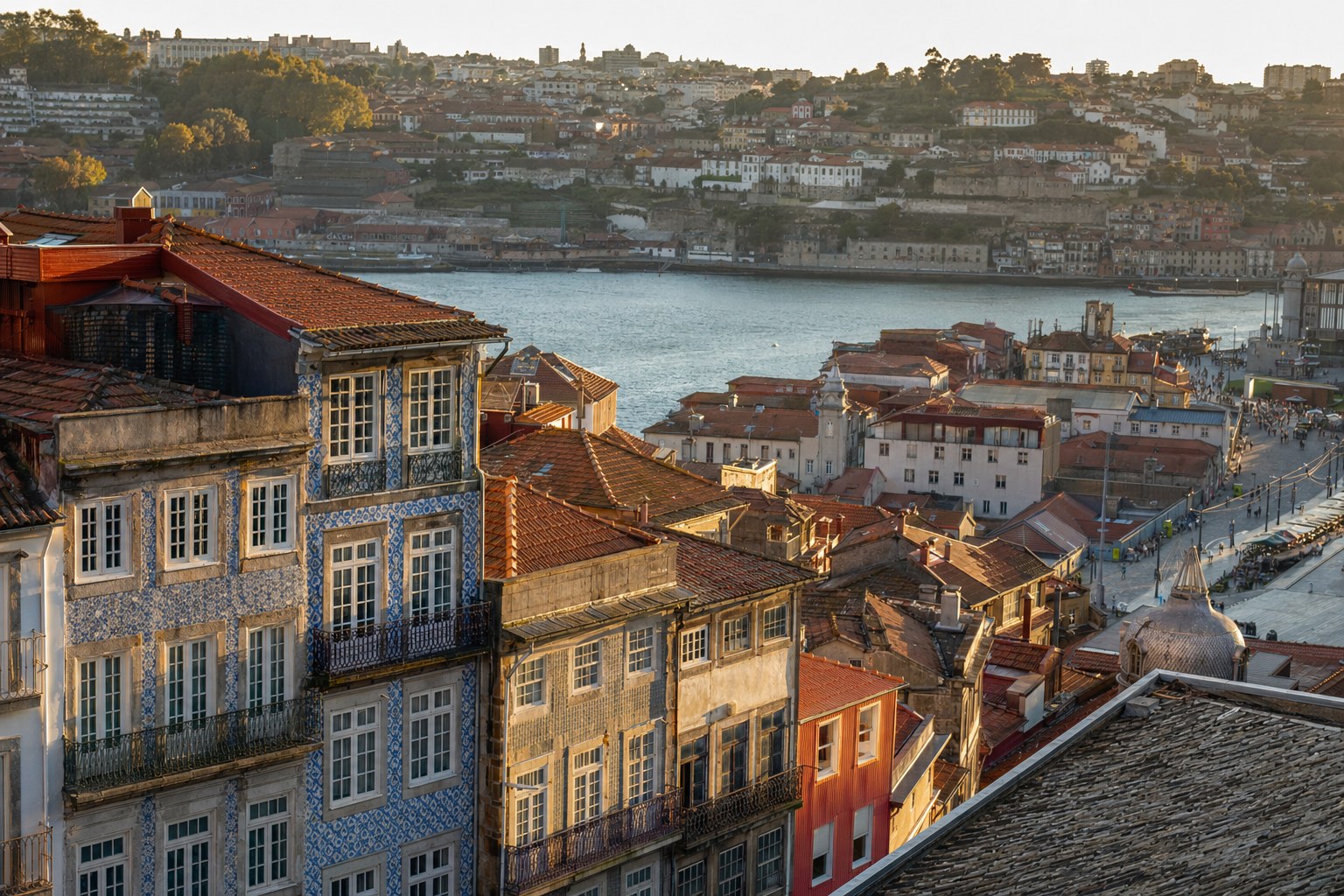
Portugal’s hotel and restaurant investment narrative has been dominated by Lisbon for the better part of a decade. That gap has closed. Porto now has two-Michelin-star restaurants, Small Luxury Hotels of the World members, and a pipeline of new openings that would have been implausible five years ago. The practical question for a traveler planning a Portugal base is no longer which city is more developed. It is which city is right for the specific trip.
The answer turns on four variables: how many days you have, whether beach access matters, whether this is your first time in Portugal, and how much weight you place on food and wine over sightseeing volume. Get those four variables right and the choice is clear.
This piece does not argue one city is better. It makes the honest case for each.
The Case for Lisbon
What Lisbon Offers That Porto Cannot Match
Lisbon’s primary advantage is scale. The city has eighteen distinct neighborhoods, each with enough density of hotels, restaurants, and street life to occupy several days independently. Alfama, Chiado, Bairro Alto, Belem, and Principe Real are not variations on the same experience. They are structurally different environments that happen to share a city.
For a traveler on a seven-night itinerary, that scale matters. Lisbon absorbs long stays without running out of content. Porto, at roughly 280,000 residents to Lisbon’s 518,000, is walkable and tight. That is an asset for a three-night stay. For six nights, the city’s walkable center is largely covered by day three.
Flight connectivity is Lisbon’s second structural advantage. Humberto Delgado Airport (LIS) handled 36.1 million passengers in 2025, operating direct routes to 139 destinations across 63 airlines. North American travelers can fly direct from New York JFK, Boston, Miami, Los Angeles, Chicago, San Francisco, and Washington DC. Porto’s Francisco Sa Carneiro Airport (OPO) serves 104 international routes and has added transatlantic service — Newark and seasonal Boston — but the depth of nonstop options from North America remains thinner. For travelers whose itinerary begins and ends in Portugal, Lisbon’s connectivity reduces friction on both ends of the trip.
Coast access is the third differentiator. Cascais is 30 minutes by train from Cais do Sodre. Sintra’s Praia Grande and Praia das Macas are 45 minutes out. The beaches at Costa da Caparica — a long Atlantic strand popular with Lisboetas — are reachable by ferry and bus in under an hour. Porto has Matosinhos and Foz do Douro via metro (15-20 minutes), which are functional urban beaches. They are not destination beaches in the same category as the Cascais coast or the Arrabida peninsula south of Lisbon.
The hotel tier in Lisbon remains the deepest in Portugal. The Four Seasons Ritz is the only Forbes Travel Guide Five-Star property in Portugal. The Bairro Alto Hotel, Palacio Principe Real, and Hotel Avenida Palace form a cluster of legitimate five-star options in the historic center. The Lumiares in Bairro Alto operates in an 18th-century former palace with a rooftop terrace rated by Time Out as best boutique in the city. Average nightly rates for five-star properties run approximately EUR 365 year-round, rising to EUR 400-600 in peak summer.
The Michelin restaurant count in Lisbon is higher in absolute terms, anchored by two two-star restaurants and a dense concentration of one-star options across neighborhoods.
What Lisbon Cannot Offer
Lisbon is not compact. Getting from Alfama to Belem requires a tram or Uber. The hills are real: Tram 28 is not a scenic indulgence but a functional necessity for navigating elevation changes. Visitors who expect a walkable, contained experience on the model of Porto’s Ribeira will be disoriented by Lisbon’s spread.
The city is also Portugal’s most-visited, and the volume shows. Alfama’s miradouros draw crowds that make considered exploration difficult in peak months. Sintra — the obvious day trip — requires booking Pena Palace tickets weeks in advance in summer and arriving before 10am to avoid queues. The tourism infrastructure is well-developed but calibrated for mass throughput, not for the quieter, more personal experience Porto delivers.
Lisbon’s food scene is broad but its identity is diffuse. The city excels at variety — Japanese, modern Portuguese, international bistros, food markets — more than at a singular, legible culinary tradition. Travelers who want depth in one direction rather than range across many will find Porto more rewarding.
The Case for Porto
What Porto Offers That Lisbon Cannot Match
Porto’s primary advantage for the right traveler is concentration. The city’s historic center — Ribeira, Miragaia, and the streets climbing toward Batalha — is dense, walkable, and legible within a day of arrival. The Dom Luis I Bridge, the Douro riverfront, and the port wine lodges in Vila Nova de Gaia directly across the water form a coherent geography that rewards extended wandering. Porto does not require a transportation strategy. It requires good shoes.
Can you do the Douro Valley as a day trip from Porto?
Yes — and it is Porto’s most exclusive logistical advantage over Lisbon. The Douro is 360 kilometers from Lisbon, a multi-night commitment rather than a day excursion. From Porto, Peso da Regua is 2 hours 20 minutes by train (EUR 13.60-15 one-way) and Pinhao is 3 hours 20 minutes. A full-day guided tour — two to three quintas, a river cruise on a traditional rabelo boat, lunch — runs EUR 85-115 per person. Properties like Quinta do Bomfim, Quinta do Crasto, and Quinta do Vallado (established 1716) offer tastings and private experiences directly on the river. September harvest season adds grape-picking and blending activities.
The restaurant trajectory in Porto has accelerated. The 2026 Michelin Guide awarded four new one-star recognitions in a single cycle — dop, Eon (at Palacete Severo), Gastro by Elemento, and In Diferente. Antiqvvm holds two stars with Douro views that are part of the dining proposition. The Yeatman Gastronomic Restaurant in Vila Nova de Gaia holds two stars and one of Portugal’s most serious wine cellars. Casa da Cha da Boa Nova in Leca da Palmeira, 15 minutes north of the city center, holds two stars in Alvaro Siza Vieira’s cliffside building. For a food-focused itinerary, Porto’s concentration of high-end options relative to its size is now competitive with comparably sized cities across Iberia (based on the 2026 Michelin count).
Is Porto actually cheaper than Lisbon at the same hotel quality level?
Yes — consistently, by 20-35% at equivalent tier. The Yeatman (two Michelin stars, SLH member, infinity pool over the Douro) averages around EUR 302 per night; a comparable Lisbon property starts closer to EUR 380-400. Boutique properties in Porto’s Ribeira and historic center cluster in the EUR 150-300 range where Lisbon’s equivalent tier starts at EUR 220-280 and rises sharply. Across a five-night stay at the five-star level, that gap represents EUR 400-800 — enough to fund a private Douro wine tour.
Porto’s geography is an asset for repeat Portugal visitors. Travelers who have already spent time in Lisbon and want a different register will find Porto structurally distinct, not a smaller version of the capital. The food is heavier and more regionally specific — the francesinha is a Porto institution that travels poorly — the wine culture is centered on port rather than Alentejo reds, and the pace is slower by design rather than by accident.
Is Porto a viable base for a trip of seven nights or more?
No — not as a single-city stay. Three to four nights covers the historic center with depth. Five nights allows for a Douro day trip plus a half-day to Braga or Guimaraes. Beyond that, the city’s concentrated geography becomes a constraint rather than an asset. Travelers planning a week or more in a single Portuguese city should base in Lisbon; travelers who want both cities should split the trip or use Porto as the second leg after Lisbon. Porto also lacks Lisbon-caliber beach access — Matosinhos serves its purpose as an urban beach but is not a destination in the same category as the Cascais coast or Arrabida.
Head-to-Head Comparison
| Variable | Lisbon | Porto |
|---|---|---|
| Hotel tier depth | Five-star stock, Forbes Five-Star property | Growing boutique tier, SLH members, strong mid-luxury |
| Avg. five-star nightly rate | EUR 365 (year-round avg.) | EUR 280 (year-round avg.) |
| Rate gap at equivalent quality | — | 20-35% cheaper |
| Michelin restaurants | Higher absolute count, two two-star properties | 2 two-star, 4 new one-stars in 2026 cycle |
| Beach access | Cascais 30 min, Arrabida 45 min | Matosinhos 20 min (metro), not destination-grade |
| Douro Valley access | Full-day minimum, 360 km | Day trip viable, 2h20m-3h20m by train |
| Flight connectivity (international) | 139 destinations, 7 US nonstops | 104 destinations, Newark + seasonal Boston nonstop |
| Walkability | Spread across 18 neighborhoods, transport required | Compact historic center, walkable in 2-3 days |
| Optimal stay length | 5-10 nights | 3-5 nights |
| Ideal traveler | First-timer, beach-focused, longer itinerary | Repeat visitor, food/wine-focused, Douro access |
Who Each City Is For
Lisbon is the right base for:
– First-time Portugal visitors who want the full scope of what the country offers in a single city
– Travelers whose itinerary includes beach days on the Cascais coast or the Arrabida peninsula
– Longer stays of seven nights or more where scale and neighborhood variety sustain the trip
– North American travelers who want a nonstop option and maximum routing flexibility
– Travelers who want the deepest hotel tier in Portugal, including the only Forbes Five-Star property in the country
Porto is the right base for:
– Repeat Portugal visitors who have already covered Lisbon and want a different register
– Food-focused itineraries where Michelin density relative to city size matters more than total count
– Travelers whose primary non-urban interest is the Douro Valley — quintas, port wine, river cruises, harvest season
– Stays of three to five nights where a compact, walkable city is a feature rather than a limitation
– Travelers for whom a 20-35% reduction in accommodation costs at equivalent quality is a meaningful variable
Neither city is right for travelers who want:
– A beach resort as a primary base (consider the Algarve)
– A single city covering both the Douro Valley and Lisbon’s coastal day trips (the cities are 274 km apart; commit to one)
Verdict
Which city should anchor a first trip to Portugal?
Lisbon. The scale rewards unfamiliarity: eighteen walkable neighborhoods, a day-trip radius that covers Cascais, Sintra, and Arrabida, and flight connectivity from seven North American cities nonstop. For a traveler who has not been to Portugal before, Lisbon delivers more of the country’s range in a single base than Porto can. Porto is the correct answer on a return visit, or for any itinerary organized around the Douro Valley, port wine culture, and maximizing accommodation value at a given quality tier — where the 20-35% cost difference across a five-night stay at the five-star level represents EUR 400-800, enough to fund a private Douro wine tour. The cities are not in competition; they are sequential in the way most destinations worth returning to are.