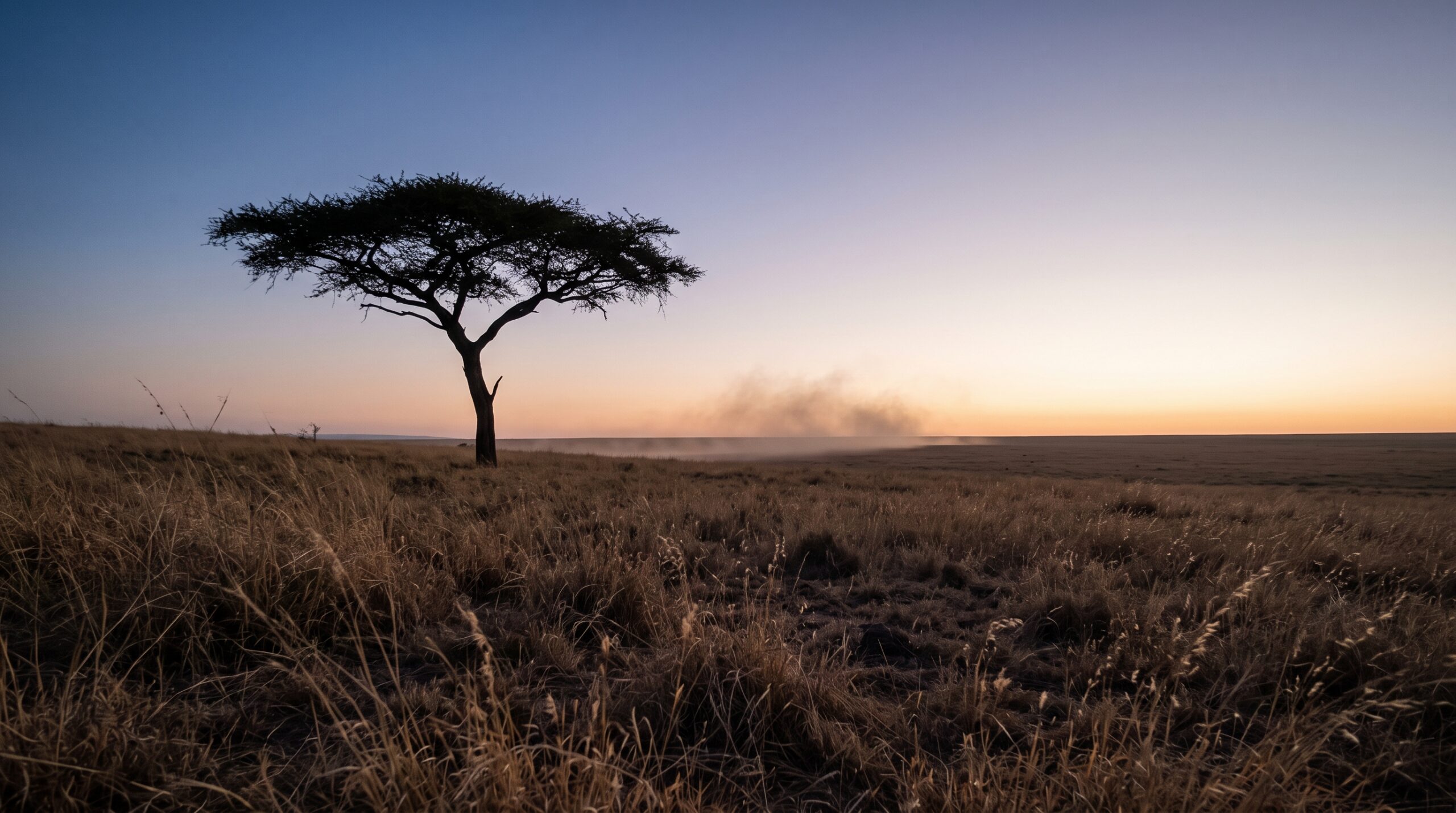
For first-time safari travelers with 5-7 days and no specific migration timing, Kenya is the easier choice: the Masai Mara is 1 hour from Nairobi, the game viewing is excellent year-round for big cats, and the lodge infrastructure makes logistics straightforward. Tanzania is the better choice for travelers who can commit 8-12 days, want to combine multiple ecosystems (Serengeti plus Ngorongoro Crater plus Tarangire), or are timing a trip for the Great Migration river crossings between July and October.
Kenya and Tanzania share an ecosystem. The Masai Mara and the Serengeti are ecologically contiguous — the Mara River runs through both, the wildebeest migration moves across the international border seasonally, and the same wildlife corridor underlies both experiences. The question is not which country has better wildlife. It is which entry point, logistics structure, and timing works for your specific trip.
The Case for Kenya: Masai Mara
The Masai Mara National Reserve covers 1,510 square kilometers — compact by East African standards, which means high wildlife density in a manageable area. From Nairobi, a scheduled charter flight takes 45-60 minutes, with departures from Wilson Airport throughout the day. The same journey by road takes 5-6 hours. Most travelers fly. The Mara’s concentration of game — particularly lion, cheetah, leopard, elephant, and buffalo — is among the highest in Africa year-round. The reserve is well-served by a mature lodge and camp infrastructure, ranging from well-run mid-market camps at USD 300-500 per night to exclusive conservancy properties at USD 800-1,200+ per night.
The Mara’s concentration makes it ideal for short safaris. In 3-4 days of game drives in the Masai Mara, a traveler on a well-planned itinerary will typically encounter all of the Big Five. The same outcome in the Serengeti requires more time simply because of the larger area to cover.
Kenya entry fee for the Masai Mara: USD 80 per person per day. Park fees are typically included in lodge package rates.
The Case for Tanzania: Serengeti and Beyond
The Serengeti National Park covers 14,750 square kilometers — nearly 10 times the size of the Masai Mara — and is part of a total ecosystem of 30,000 square kilometers. Game viewing is excellent but the scale means driving between sightings takes longer. The compensation is a stronger sense of wilderness: in the northern and western Serengeti in low season, you can drive for an hour without seeing another vehicle. In the southern Serengeti during calving season (January-February), tens of thousands of wildebeest calves are born within weeks — one of the most concentrated wildlife events on Earth, with no equivalent in Kenya.
Tanzania’s strongest argument is the circuit. A well-designed Tanzania safari combines Serengeti with the Ngorongoro Crater — a UNESCO World Heritage Site containing approximately 25,000 large animals within a 260-square-kilometer volcanic caldera, producing the highest density of mammalian predators in Africa — plus optionally Tarangire National Park for elephant concentrations and Zanzibar for beach recovery. This circuit cannot be matched in Kenya in terms of ecosystem diversity.
Tanzania Serengeti entry fee: USD 60 per person per day (typically included in lodge rates).
The Great Migration: Timing and Location
The Great Migration is not a single event. It is a year-round circular movement of 1.5 million wildebeest and 500,000 zebra through the Serengeti-Mara ecosystem. The dramatic river crossings — wildebeest and zebra plunging across the crocodile-inhabited Mara River in hundreds or thousands at a time — occur in the northern Serengeti and the Masai Mara between July and October. Both Kenya and Tanzania offer access to river crossings during this window, with Kenya having marginally shorter logistics for travelers based in Nairobi.
For calving season (late January to February), the action shifts to the southern Serengeti (Ndutu area) — Kenya offers no equivalent. For the February-May northward migration, Tanzania’s central and western Serengeti are optimal. The migration is year-round and always in Tanzania; it is in Kenya only during the July-October window.
Verdict
For most first-time safari travelers, Kenya is the starting point: more accessible, equal wildlife quality for big cat and elephant sightings, and sufficient for a strong first safari within 5-7 days. Return to Tanzania for the Serengeti circuit, Ngorongoro Crater, and calving season. Travelers with 10+ days and a single trip available should consider Tanzania’s full circuit — the combination of Serengeti and Ngorongoro has no equivalent in Kenya and delivers a more complete East African wildlife experience.
FAQ
Q: Do I need a visa for Kenya and Tanzania?
A: Kenya introduced the Electronic Travel Authorization (ETA) in 2024, replacing the visa-on-arrival. Apply online before travel. Tanzania requires a visa; US, EU, and UK citizens can obtain it on arrival or online in advance. Costs are approximately USD 30-50 per country.
Q: What is the best time of year for an East Africa safari overall?
A: The long dry season (June-October) produces the best overall game viewing in both countries — dry conditions concentrate wildlife around water sources, and vegetation is lower, improving visibility. January-February (calving season) is the best time for southern Serengeti specifically. Avoid the long rains (April-May) if possible.
Q: Is it possible to do both Kenya and Tanzania in one trip?
A: Yes, with 12-16 days. A common routing: Nairobi arrival, Masai Mara (3-4 nights), return Nairobi, fly Kilimanjaro or Arusha, Serengeti (3-4 nights), Ngorongoro (2 nights), Zanzibar (3-4 nights). This requires a multi-country itinerary and adds cost but covers the strongest elements of both ecosystems.
Q: What is the price range for a quality safari in each country?
A: Mid-range camps run USD 300-500 per person per night all-inclusive in Kenya; slightly higher in Tanzania (USD 350-550). Luxury conservancy camps in Kenya and private Serengeti camps in Tanzania run USD 800-1,500+ per person per night. Budget options (public campsites, shared vehicle safaris) exist but are not covered here.
Q: Can I self-drive a safari in Kenya or Tanzania?
A: Self-driving is permitted in both countries and is significantly cheaper than guided safaris. It requires a 4WD vehicle, good navigation tools, and experience reading animal behavior. For first-time safari travelers, guided safaris are strongly recommended — a good guide produces 3-5x more sightings through knowledge of animal movement patterns and radio communication networks between camps.