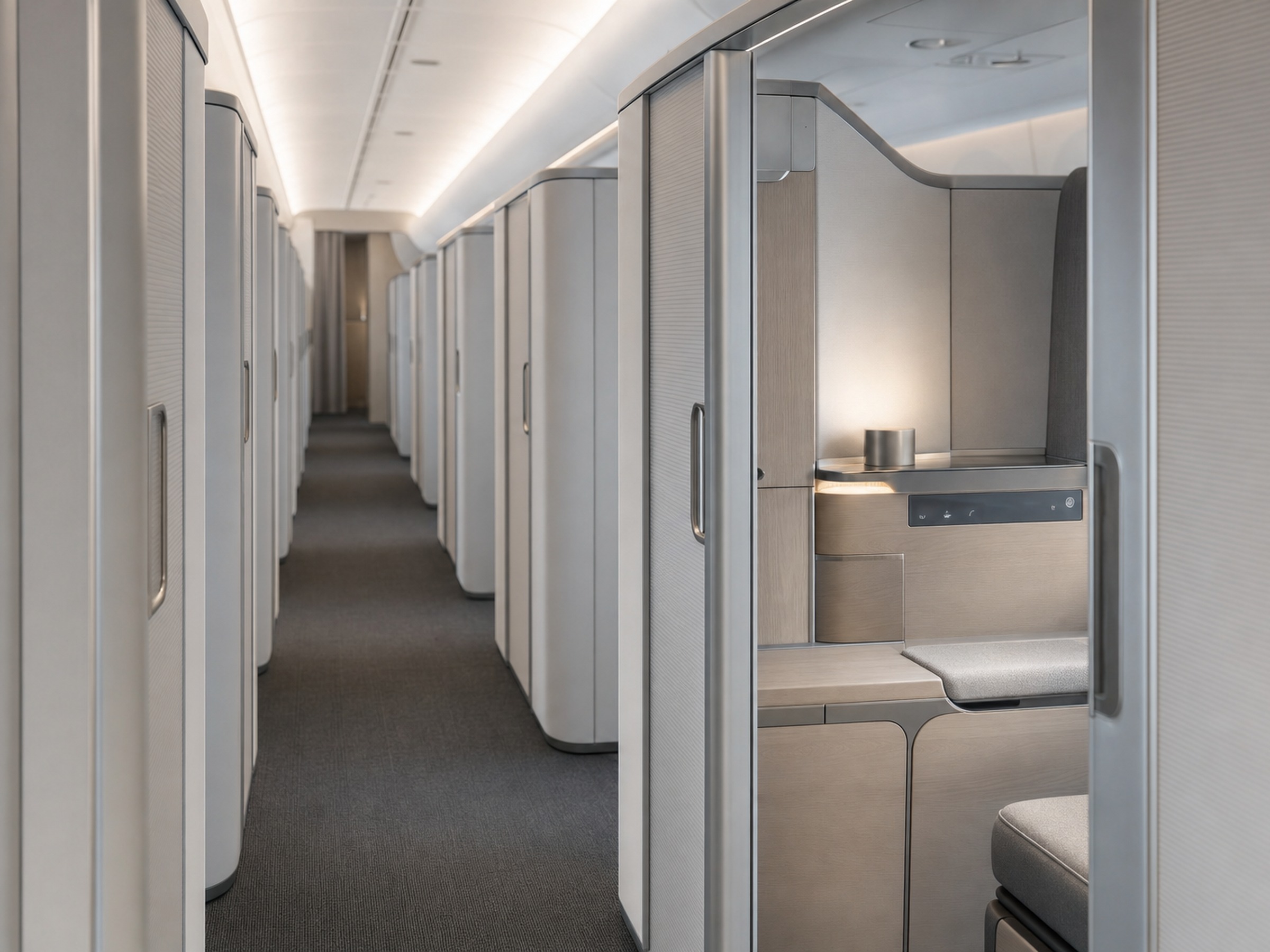
Qatar’s Qsuite and Etihad’s Business Studio look similar on a seat map and behave differently once you are on board. Qatar wins on the peak seat: a Qsuite with a closing door and movable panels that join two or four suites into one space, but only on the aircraft that actually carry it, and its 787-9 flies a different suite again. Etihad wins on predictability on its flagship: every A350-1000 business seat is the door-equipped Business Studio, so the product does not swing between cabins the way Qatar’s can, though no schedule is immune to a substitute aircraft. Its 787 fleet is mixed. If you can confirm the aircraft before you pay, book Qatar. If you book by route and date and want the fewest surprises, book the A350-1000.
Both carriers fly the same long-haul corridors through the Gulf and both run a one-stop hub model through a single airport. Service culture sits close enough that it rarely decides the booking. The real decision is the seat, and each airline sells more than one generation of business class under a single brand name. This comparison is built from the airlines’ current published cabin and seat specifications, business-class product details, and loyalty-program terms.
What Each Business Cabin Actually Is
Etihad’s flagship business seat is the Business Studio, a Collins Aerospace Super Diamond platform built as a reverse-herringbone suite. On the A350-1000 every seat faces forward, every seat reaches the aisle directly in a 1-2-1 layout, and every seat closes with a sliding privacy door. The A350-1000 carries 44 of them, and the seat converts to a 79-inch flat bed that is over 20 inches wide. Etihad flies no first class on the A350, so business is the top cabin on that aircraft. On the 787 the picture is mixed: Etihad has introduced a new, door-equipped suite, a customised Collins Elements seat it describes as the second evolution of the Business Studio, on aircraft delivered from 2023, while older 787s still fly the earlier Business Studio without a door.
Qatar’s premium business seat is the Qsuite, the first business cabin to mix forward-facing and rear-facing seats. It also closes with a door and lies flat, but its defining feature is not the door, it is the panels: the divider between selected center suites folds away to create a twin, a double, or a four-seat quad. That configurability is what separates a Qsuite cabin from a standard enclosed-suite cabin, and it is examined in more detail in our assessment of what the Qsuite reviews leave out. The 787-9 does not carry Qsuite at all: that aircraft introduced a separate product, the Adient Ascent Business Class Suite, with its own sliding door, sliding panels between adjoining centre suites, wireless charging, and a 79-inch flat bed, sold under its own name rather than as Qsuite.
The Aircraft Decide Which Cabin You Get
This is the part that decides most bookings and the part travelers skip. Qatar fits the Qsuite to its entire A350-1000 fleet, to many A350-900s, and to a growing share of its 777-200LR and 777-300ER aircraft. It does not fit the Qsuite to any of its 787s, nor to its A330s, its A380s, or its narrowbody aircraft. The 787-9 is not a Qsuite aircraft either: it flies the separate Adient Ascent Business Class Suite, and the older 787-8 flies an earlier business cabin. Those aircraft still fly business class on some of the same routes, which means the same fare can buy a Qsuite on one flight and a different cabin on the next.
Qatar states directly that Qsuite is available on select routes only and that it can be withdrawn when the aircraft is substituted. An operational swap on the day is the single most common way a confirmed Qsuite becomes an older seat, so the aircraft check matters twice: once at booking and once in the days before departure, which is the same discipline we set out in when airlines change equipment.
Etihad’s position is simpler on one aircraft and messier on another. On the A350-1000, the door-equipped Business Studio is the standard seat, and Etihad flies the A350 between Abu Dhabi and Atlanta, Chicago, Milan, New York, and Sydney. On those routes the scheduled seat is consistently the door-equipped Business Studio, which removes the Qsuite-or-not lottery Qatar’s fleet poses. It does not remove the chance of a last-minute aircraft substitution, which any carrier can make, so the equipment check is still worth a final confirmation, it is simply far less likely to change the cabin here. The 787 is the exception. Etihad’s newer 787 deliveries carry the door-equipped Collins Elements suite, but the earlier 787s still fly a Business Studio without a door, so a 787 booking is not a guaranteed door. On the rest of the Etihad widebody fleet the cabins are older still. At Etihad, confirming the aircraft protects the product at the top of the range; at Qatar the same check is what protects the product at all.
The Seat Itself
Onboard, the two seats are close cousins. Both close for privacy, both recline to a fully flat bed, and both include a large entertainment display, USB and mains power, and storage designed around a long flight. The Etihad Business Studio adds an 18.5-inch screen, Bluetooth pairing for personal headphones, and wireless charging, and the A350 cabin is fitted without center overhead bins, which opens up the ceiling and makes the cabin read as taller than the row count suggests.
Qatar’s Qsuite is stronger as a shared space and weaker as a private one. The quad and twin configurations are the reason, and they are the only genuine structural difference between the two seats: Etihad Group seating exists on the A380 in business, but the door-and-panel combination that lets four suites become one is unique to the Qsuite within this pair. On a flight where two or four people want to eat and work together, that is a decisive advantage. For a solo traveler who wants a quiet box, it does nothing.
Qatar’s soft product differs by route. A Diptyque amenity kit is issued from Doha, and The White Company sleepwear and slippers are provided on long-haul and ultra-long-haul flights only. Treat those as route-specific and confirm them against the flight rather than the brand.
Hub, Lounge, and Loyalty
Qatar routes through Doha and Etihad through Abu Dhabi, and both hubs are built around the same connecting model. Lounge access at the hub is tied to the fare family rather than to the cabin, so the same business seat can board with or without it. Qatar, for example, withholds complimentary Qatar Airways lounge access on its Business Lite fare, granting it only on its Comfort, Classic, and Elite fares. What a business lounge actually includes, and how access is granted on connecting itineraries, is a separate question and worth checking before you assume it, as set out in what business class lounge access actually covers.
The loyalty question is the clearest structural difference between the two airlines, and it has nothing to do with the seat. Qatar Airways Privilege Club earns Avios and Qatar is a member of the oneworld alliance, so a Qatar flight feeds a program that also covers a large group of partner airlines. Etihad Guest earns Etihad Guest Miles, and Etihad belongs to no global alliance, so the miles you earn stay inside Etihad and its bilateral partners. For frequent flyers building toward status or a partner award, that single fact often outweighs any difference in the seat, and it is why the wide view in which alliance delivers more on long-haul is worth reading alongside this comparison.
If you are paying cash and the seat is what you are buying, the alliance question is close to irrelevant. If you are booking with points, the program attached to the cabin changes the value of the redemption, and the tradeoffs are laid out in cash versus miles for long-haul business class.
The Two Cabins Side by Side
| Factor | Etihad Business Studio | Qatar business class |
|---|---|---|
| Aircraft with the seat | A350-1000 (door standard); 787 mixed, newer deliveries only | A350-1000, many A350-900, some 777 (Qsuite); 787-9 flies a separate suite |
| Privacy door | Yes, on every A350-1000 seat; newer 787s only | Yes, on Qsuite and on the 787-9 suite |
| Layout | 1-2-1, all forward-facing | 1-2-1, forward and rear-facing mix |
| Aisle access | Every seat | Every seat |
| Bed length | 79 inches, over 20 inches wide (A350) | Fully flat; 79 inches in the 787-9 suite |
| Group seating | Standard pairs only, Group seats are an A380 business feature | Movable panels create twin, double, and quad on Qsuite; the 787-9 suite also has sliding centre panels |
| Screen and charging | 18.5-inch screen on the A350 Business Studio, Bluetooth pairing, wireless charging | Seat-back entertainment display; the 787-9 suite adds wireless charging |
| Cabin consistency across the fleet | High on the A350-1000; 787 mixed | Route and aircraft dependent; no 787 flies Qsuite |
| Alliance | None, Etihad Guest standalone | oneworld, Privilege Club earns Avios |
Who Should Book Which
Book Qatar when the aircraft is confirmed as a Qsuite jet, when two or more people want to sit together and use the quad or twin configuration, and when you are building Avios or oneworld status. The Qsuite is the better business seat when you can be certain you will get it.
Book Etihad when the route is served by the A350-1000, where the door-equipped Business Studio is on every seat, and when the departure city and date matter more than the cabin’s peak version. Etihad’s advantage is not a better seat on its best day, it is the same seat on every A350-1000. A 787 is not that promise: only Etihad’s newer 787 deliveries carry the door-equipped suite, so a 787 booking still needs the aircraft check.
Frequently Asked Questions
Q: Is Qatar business class always a Qsuite?
A: No. Qsuite is fitted to the A350-1000, many A350-900s, and some 777s, and even a Qsuite route can be swapped for an older aircraft on the day. The 787 does not carry Qsuite at all: the 787-9 flies the separate Adient Ascent Business Class Suite, and the 787-8 flies an earlier business cabin.
Q: Does Etihad business class have privacy doors?
A: On the A350-1000, yes: every business seat is a Business Studio with a sliding door. On the 787 it depends on the aircraft, because Etihad’s newer deliveries carry the door-equipped Collins Elements suite while older 787s fly an earlier Business Studio without a door. Other older Etihad widebody cabins do not have the door-and-suite layout either.
Q: Which cabin has the better bed?
A: Both recline to fully flat. Etihad publishes a 79-inch bed that is over 20 inches wide in the A350 Business Studio, and the Qsuite is a comparable fully flat bed. The difference is small enough that group seating and fleet consistency decide more bookings than the bed does.
Q: Can two people sit together in these cabins?
A: Yes. The Qsuite is the stronger option because the divider between selected center suites folds away to create a twin, double, or quad. Etihad’s center seats are adjacent but are not joined into a shared space on the A350.
Q: Which airline has better lounge access?
A: Not automatically. It depends on the fare family, not just the cabin. Qatar withholds complimentary Qatar Airways lounge access on its Business Lite fare and grants it on Comfort, Classic, and Elite, and Etihad’s lounge terms are fare-specific too, so confirm access against the fare you booked and the itinerary rather than assuming a business ticket includes it.
Q: Do the loyalty programs matter in this decision?
A: They can decide it. Qatar Privilege Club earns Avios inside oneworld, while Etihad Guest earns Etihad Guest Miles outside any alliance. If you fly enough to chase status or awards, that gap often outweighs the seat.
Verdict
Qatar builds the better peak seat and Etihad builds the more predictable one, but only on the right aircraft. The Qsuite’s door and its movable panels make it the stronger cabin for anyone who can confirm the aircraft and wants to share the space, and Qatar’s oneworld alliance adds a loyalty advantage Etihad cannot match. That recommendation holds only on confirmed Qsuite metal, because Qatar does not fly Qsuite on its 787s or on several other aircraft types still in service, and the aircraft can be substituted on the day.
Etihad is the correct choice when consistency matters more than peak quality, and on the A350-1000 that consistency is high: one Business Studio, a door on every seat, and the product is what it says it is. That is not an absolute guarantee against a substitute aircraft, which any carrier can still operate, but it removes the routine variation between Qsuite and non-Qsuite cabins. The 787 does not offer the same guarantee, because only Etihad’s newer 787 deliveries carry the door-equipped suite. If you book by route and date and the route is an A350-1000, Etihad turns the aircraft check into a low-risk confirmation rather than a gamble. If you will do that check and you can get a Qsuite, Qatar is the cabin that delivers more.