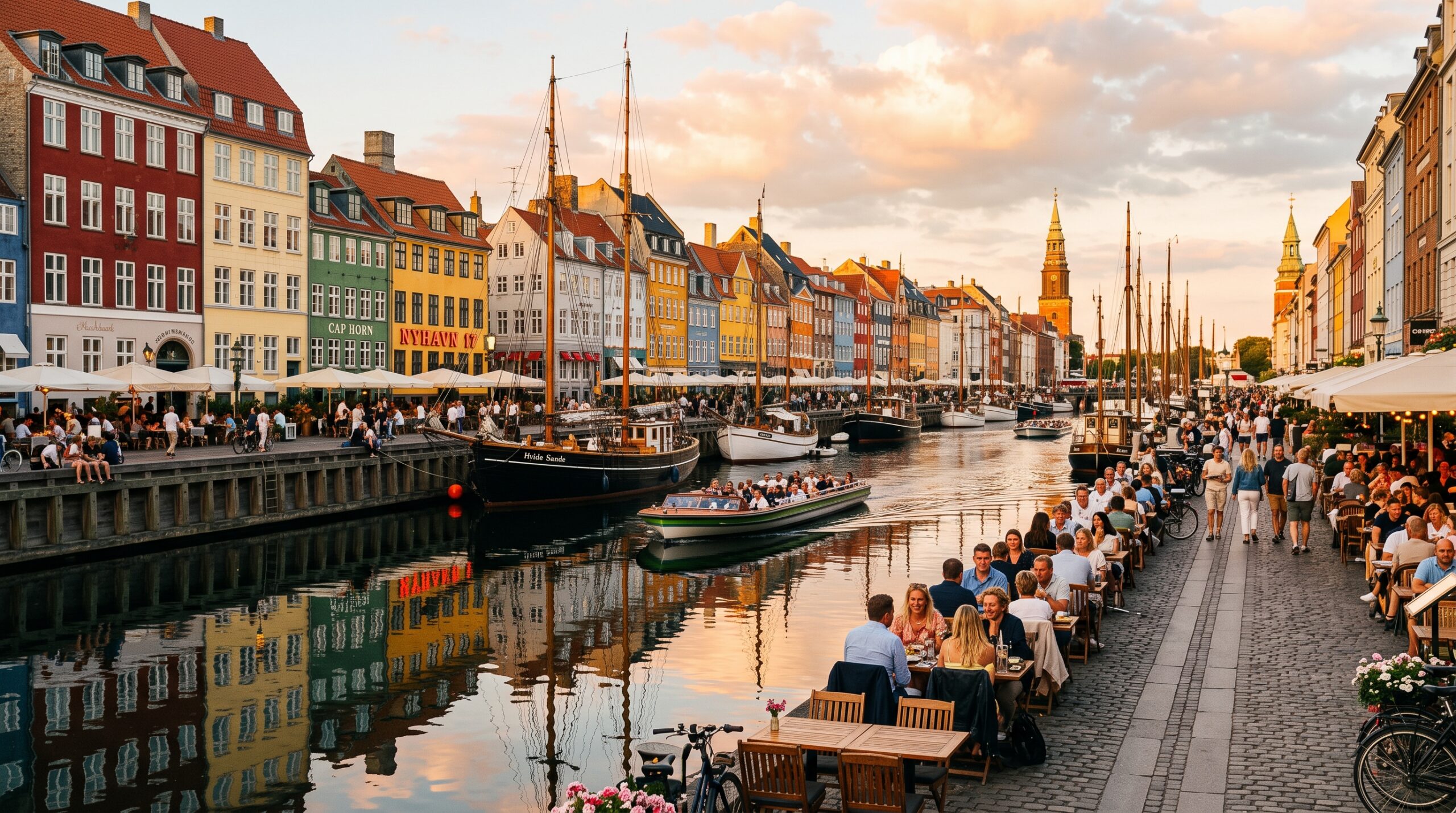
Copenhagen is the best all-around Scandinavian capital for a first visit: compact, walkable, and dense with design, food, and urban livability in a way that Stockholm and Oslo cannot match at the same scale. Stockholm is the strongest choice for travelers who want an archipelago experience plus a capital city. Oslo is the right pick if you are using the city as a gateway to Norway’s fjords, not as the primary destination.
Scandinavian summer is a specific window: late May through August, when daylight stretches to 17-19 hours and the cities empty into parks, waterfronts, and outdoor cafes. The season is short, the weather is unpredictable (expect rain at least one day in three), and prices are high year-round. Choosing between Copenhagen, Stockholm, and Oslo is not about finding the cheapest option — none qualifies — but about matching the city’s rhythm to your travel style.
Copenhagen: The Most Livable Capital
Copenhagen’s advantage is concentration. The city is small enough that you can walk from Nyhavn (the 17th-century canalfront) to Norrebro (the city’s most diverse and interesting neighborhood) in 40 minutes, passing through the old city center, the design district, and the lakes along the way. The cycling infrastructure is the best in the world — dedicated bike lanes, traffic lights timed for bike speeds, and a culture where cycling is the default transport mode, not a recreational activity.
What to do: The Design Museum Denmark reopens in 2025 after a major renovation and anchors a design-first itinerary. Tivoli Gardens is a genuine pleasure garden — 1843 vintage, Walt Disney’s admitted inspiration for Disneyland — and best visited in the evening when the lights come on. The food scene punches above the city’s weight: 14 Michelin-starred restaurants, plus a street-food culture (Reffen on Refshaleoen, a 15-minute bike ride from the center) that offers 50+ food stalls ranging from Danish smørrebrød to Korean-Mexican fusion.
The day trip: Louisiana Museum of Modern Art (35 minutes by train from Copenhagen Central) sits on the Oresund coast with a sculpture garden overlooking Sweden. It is arguably the best modern art museum in Northern Europe, and it makes Copenhagen the strongest Scandinavian capital for art travelers — a claim that Stockholm (Moderna Museet) contests but cannot quite match.
When Copenhagen is the wrong choice: If you want nature beyond parks and waterfronts. Copenhagen is a city experience. The Danish countryside is gentle and pastoral but does not provide the dramatic landscapes accessible from Stockholm (archipelago) or Oslo (fjords).
Stockholm: The Archipelago Capital
Stockholm spreads across 14 islands connected by 57 bridges. The city is physically more dramatic than Copenhagen — Gamla Stan (the old town) sits on its own island, Sodermalm is the elevated southern district with the best views, and Djurgarden is a green island of museums and parkland accessible by a 10-minute ferry from the city center.
What to do: The Vasa Museum houses a 17th-century warship that sank on its maiden voyage in 1628 and was raised intact 333 years later — it is the best single museum experience in Scandinavia. Skansen, the open-air museum and zoo on Djurgarden, is a full-day excursion that works for families and adults alike. The photography museum Fotografiska is open until 11 p.m. and has a strong restaurant (seasonal Nordic) on the top floor.
The archipelago: Stockholm’s decisive advantage over Copenhagen and Oslo is the Stockholm Archipelago — roughly 30,000 islands stretching 80 km into the Baltic. A day trip by public ferry (Waxholmsbolaget) from central Stockholm to Vaxholm, Sandhamn, or Grinda costs roughly SEK 150-300 round-trip (USD 15-30) and lands you on islands with walking trails, cafes, and swimming coves within 1-2 hours. This is the experience Copenhagen and Oslo cannot offer: a capital city with a genuine island-hopping dimension.
When Stockholm is the wrong choice: If you want compact walkability. Stockholm’s 14-island geography makes it harder to navigate on foot than Copenhagen. The distances are longer, and public transit — efficient as it is — is a necessity rather than an option.
Oslo: The Gateway to Fjords
Oslo is the smallest and least architecturally dramatic of the three capitals, but it has two things the others do not: the Oslofjord and Norway’s rail network connecting to the western fjords. Treating Oslo as a destination in its own right for more than 2-3 days is a mistake. Treating it as the start or end point of a fjord-focused trip is the correct framing.
What to do in Oslo: The Opera House (walkable on the sloping marble roof, views of the fjord and islands), the Munch Museum (new building, 2021, 13 floors, houses The Scream and other major Munch works), and the Vigeland Sculpture Park (212 bronze and granite sculptures by a single artist, open 24 hours in summer). The food scene has improved significantly — Maaemo (three Michelin stars) is one of the world’s best restaurants, and Mathallen food hall in Vulkan offers a more accessible entry point to Norwegian cuisine.
The Norway in a Nutshell route: Oslo to Bergen via train (Bergensbanen, roughly 7 hours, one of Europe’s most scenic rail journeys), connecting to the Flam Railway (one of the steepest standard-gauge railways in the world) and a fjord cruise through Aurlandsfjord and Naeroyfjord. This route works as a 2-3 day extension from Oslo and is the strongest argument for choosing Oslo as your Scandinavian entry point. The fjord experience is singular — Copenhagen and Stockholm have nothing comparable.
Checklist: Scandinavian Capital Decision
- Design, food, and walkability: Copenhagen.
- Archipelago, museums, and island-hopping: Stockholm.
- Fjords, nature, and rail journeys: Oslo (as a gateway, not a destination).
- Best for 3-4 days as a standalone city trip: Copenhagen.
- Best for a 5-7 day trip with day trips: Stockholm (archipelago adds 2-3 days).
- Best for a 7-10 day trip incorporating nature: Oslo plus Norway in a Nutshell.
- Budget: All three are expensive. Copenhagen and Oslo are roughly equal (EUR 150-200/day for mid-range). Stockholm is marginally cheaper on accommodations.
- Weather: Copenhagen and Stockholm are comparable (18-22°C average in July). Oslo can be wetter in summer but also warmer (up to 25°C).
Verdict
Copenhagen for a first Scandinavian visit: the most concentrated, the most walkable, the best food and design density, and the strongest single day trip (Louisiana). Stockholm for travelers who want an archipelago experience bundled with a capital city — the islands are the differentiator. Oslo for travelers using the city as a launch point for the western fjords and Norway’s rail network — but not as a standalone destination beyond 48 hours. An ideal 10-day itinerary pairs Copenhagen (4 nights) with Stockholm (4 nights) via a 5-hour high-speed train, with Oslo visited on a separate fjords-focused trip.
FAQ
Q: How do I travel between the three capitals?
A: Copenhagen to Stockholm: high-speed train (SJ, roughly 5 hours, from SEK 295/USD 28). Stockholm to Oslo: train (roughly 5.5 hours) or flight (1 hour). Copenhagen to Oslo: overnight ferry (DFDS, 17 hours) or flight (1 hour 10 minutes).
Q: When is the best time for Scandinavian summer?
A: Late June through mid-August for maximum daylight and the warmest temperatures. Late May and early September are shoulder periods with fewer crowds, lower prices, and still-reasonable weather (15-18°C averages). Midsummer (late June) is a national holiday period — some restaurants and shops close, but the celebrations are a cultural experience in themselves.
Q: Do I need to speak Swedish, Danish, or Norwegian?
A: No. English proficiency in all three countries is among the highest in the world. You will never encounter a situation where English is insufficient in any tourist-facing context.
Q: Is Scandinavia too expensive to visit?
A: It is expensive by global standards but manageable with planning. Street food and food halls (Reffen in Copenhagen, Mathallen in Oslo, Hötorgshallen in Stockholm) provide high-quality meals at EUR 10-15. Museum passes (Copenhagen Card, Stockholm Pass) bundle admission and transit. Accommodations are the largest cost driver — book 2-3 months ahead for the best rates.
Q: Can I see the northern lights in summer?
A: No. Summer means near-continuous daylight above the Arctic Circle. Northern lights require darkness and are visible only from late September through March. If aurora borealis is the goal, plan a winter trip to Tromso or Abisko, not a summer capital visit.