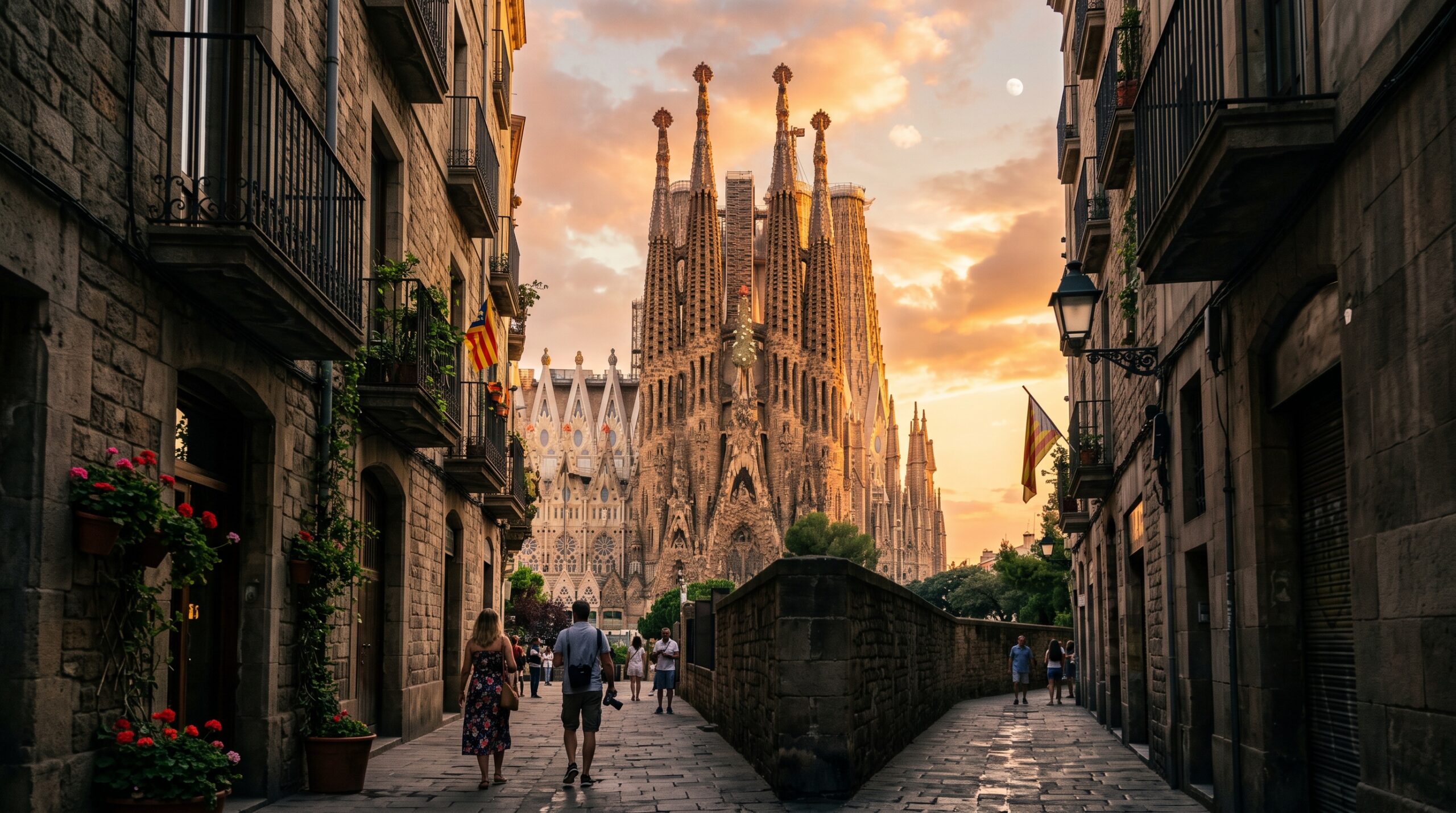
Choose Barcelona for art, architecture, and a coastal Mediterranean rhythm. Choose Madrid for food culture, day trips to UNESCO cities, and a city that feels lived in rather than staged for visitors. Neither is the wrong answer — but they are wrong for different kinds of travelers.
Spain’s two largest cities sit 620 km apart but belong to different cultural ecosystems. Barcelona is the capital of Catalonia, a Mediterranean port city with Gaudi’s architectural fingerprint on every other block, a beach 15 minutes from the Gothic Quarter, and an economy powered by design, tech, and tourism in roughly equal measure. Madrid is the national capital, set on a high plateau at 650 meters elevation, landlocked, dense with art museums and late-night tapas bars, and less visibly shaped by tourism infrastructure. Choosing between them is not a question of which city is better. It is a question of what you want a Spanish city to do for you.
Barcelona: What Works
The architecture is the attraction. Antoni Gaudi’s Sagrada Familia, Park Guell, Casa Batllo, and Casa Mila are singular — there is no equivalent architectural density in Madrid or in most European cities. You can spend three days doing nothing but Gaudi and modernist architecture and leave feeling you only scratched the surface. The Gothic Quarter and El Born provide the medieval counterpoint: narrow alleys, 14th-century churches, and a density that rewards walking without a map.
The beach is functional, not aspirational. Barcelona’s beaches (Barceloneta, Bogatell, Nova Icaria) are city beaches — clean, accessible by metro, and perfectly adequate for an afternoon. They are not the Costa Brava calas 90 minutes north, and they are not the Balearics. If a beach vacation is the primary goal, Barcelona is not the answer. But as an amenity — a place to decompress after a morning of museums — the beaches serve their purpose better than Madrid’s Retiro Park serves as a natural-landscape substitute.
The food scene is strong but narrower than Madrid’s. Catalan cuisine — seafood, pa amb tomàquet, calcots in season, crema catalana — is distinct and excellent. Barcelona has more Michelin-starred restaurants than Madrid (31 to 24 as of 2026), concentrated in the fine-dining segment (Disfrutar, ABaC, Lasarte). But Madrid wins on the breadth of casual eating — the vermouth-and-tapas bar culture is deeper and more accessible, and the price point for a casual high-quality meal is consistently lower.
The day-trip options are outstanding. Girona (40 minutes by high-speed train), Sitges (35 minutes), Montserrat (1 hour by train plus cable car), and the Costa Brava (90 minutes by car) are all viable half-day or full-day trips. The high-speed AVE train also makes Valencia reachable in under 3 hours.
Madrid: What Works
The art museums are collectively unmatched in Europe. The Prado (Velazquez, Goya, El Greco), the Reina Sofia (Picasso’s Guernica), and the Thyssen-Bornemisza (a survey of Western art from the 13th to 20th centuries) form a triangle — the “Golden Triangle of Art” — within a 15-minute walk of each other. Spending three days in these three museums is a defensible Madrid itinerary on its own.
The food culture is the best casual dining value in Western Europe. A caña (small beer) and a tapa at a standing bar in La Latina or Lavapies can run EUR 3-5. The tradition of bar-hopping — one drink, one tapa, move on — is embedded in daily life, not staged for tourists. Madrid’s food markets (Mercado de San Miguel for visitors, Mercado de la Cebada for locals) and the vermouth-on-tap culture on Sunday mornings are experiences Barcelona cannot match at the same price point.
Day trips from Madrid are arguably better than from Barcelona. Toledo (30 minutes by high-speed train), Segovia (27 minutes), Avila (90 minutes), and El Escorial (1 hour) are UNESCO World Heritage sites. Each is distinct — Toledo is a medieval city with Moorish, Jewish, and Christian architectural layers; Segovia has a Roman aqueduct and a fairy-tale castle; Avila has intact 11th-century walls. In a 5-day Madrid trip, two day trips to Toledo and Segovia add more variety than any Barcelona day-trip pairing.
Madrid feels less crowded by tourism. Barcelona receives roughly 12 million overnight visitors annually versus Madrid’s 10 million, but because Barcelona’s tourist infrastructure is concentrated in a smaller geographic area (Ciutat Vella, Eixample, Gracia), the density of overtourism is higher. Madrid distributes visitors across a larger urban footprint. You will hear more Spanish on the street in Madrid than in Barcelona’s old city during peak season.
Checklist: Decision Matrix
- Architecture-first traveler: Barcelona. Gaudi, modernism, and the Gothic Quarter are the strongest single draw in either city.
- Art museum traveler: Madrid. The Prado-Reina Sofia-Thyssen triangle is unparalleled in concentration and quality.
- Food-first traveler (casual dining): Madrid. The vermouth-and-tapas culture at EUR 3-5 per stop is unmatched value.
- Food-first traveler (fine dining): Barcelona. More Michelin stars and a stronger avant-garde culinary scene.
- Beach as amenity: Barcelona. Madrid has no beach.
- Day trips: Madrid edges Barcelona on UNESCO density and train accessibility (Toledo, Segovia in under 30 minutes).
- Summer travel: Madrid is hot (35°C+ in July/August, no coastal breeze). Barcelona is hot but coastal. Neither is ideal in August, but Barcelona is more tolerable.
- Language: Barcelona is bilingual Catalan/Spanish. Madrid is Spanish only. If you speak Spanish and want to practice, Madrid is more immersive.
Verdict
Barcelona is the better first-time Spanish city for travelers who want visual drama — Gaudi’s architecture, the Mediterranean, the Gothic Quarter’s medieval density — and do not mind sharing the experience with crowds. Madrid is the better city for return visitors to Spain, food-focused travelers, and anyone who values casual dining culture and day trips over a single overwhelming architectural attraction. An ideal 10-day Spain trip splits 5 days in each city with the high-speed AVE train (2.5 hours) connecting them. If you can only pick one: Barcelona for the spectacle, Madrid for the lifestyle.
FAQ
Q: How easy is it to visit both cities in one trip?
A: Very. The AVE high-speed train connects Barcelona Sants to Madrid Atocha in 2.5 hours with departures roughly every 30 minutes during peak hours. One-way fares start around EUR 35 if booked 4-6 weeks in advance.
Q: Which city is better for a family trip?
A: Barcelona has more kid-friendly attractions — the beach, Park Guell, the cable car to Montjuic, the aquarium. Madrid’s museums require more patience from young children, though Retiro Park (with its rowboats and puppet shows) and the zoo are strong counterpoints.
Q: Is Barcelona safe to visit given the political situation?
A: Yes. The Catalan independence movement occasionally produces demonstrations, but these are concentrated in specific areas on specific dates and do not affect tourist safety. Standard urban awareness applies in both cities.
Q: Which city is more expensive?
A: Barcelona is marginally more expensive for accommodations in the central districts (Eixample, Gothic Quarter). Madrid is slightly cheaper for food and drink at equivalent quality levels. The difference is not large enough to be the deciding factor for most travelers.
Q: Do I need to speak Spanish in either city?
A: In Barcelona, English is widely spoken in tourist-facing businesses, and Catalan signage is common. In Madrid, English is also spoken in the city center but less uniformly — basic Spanish phrases will be appreciated and sometimes necessary in neighborhood bars and smaller shops.