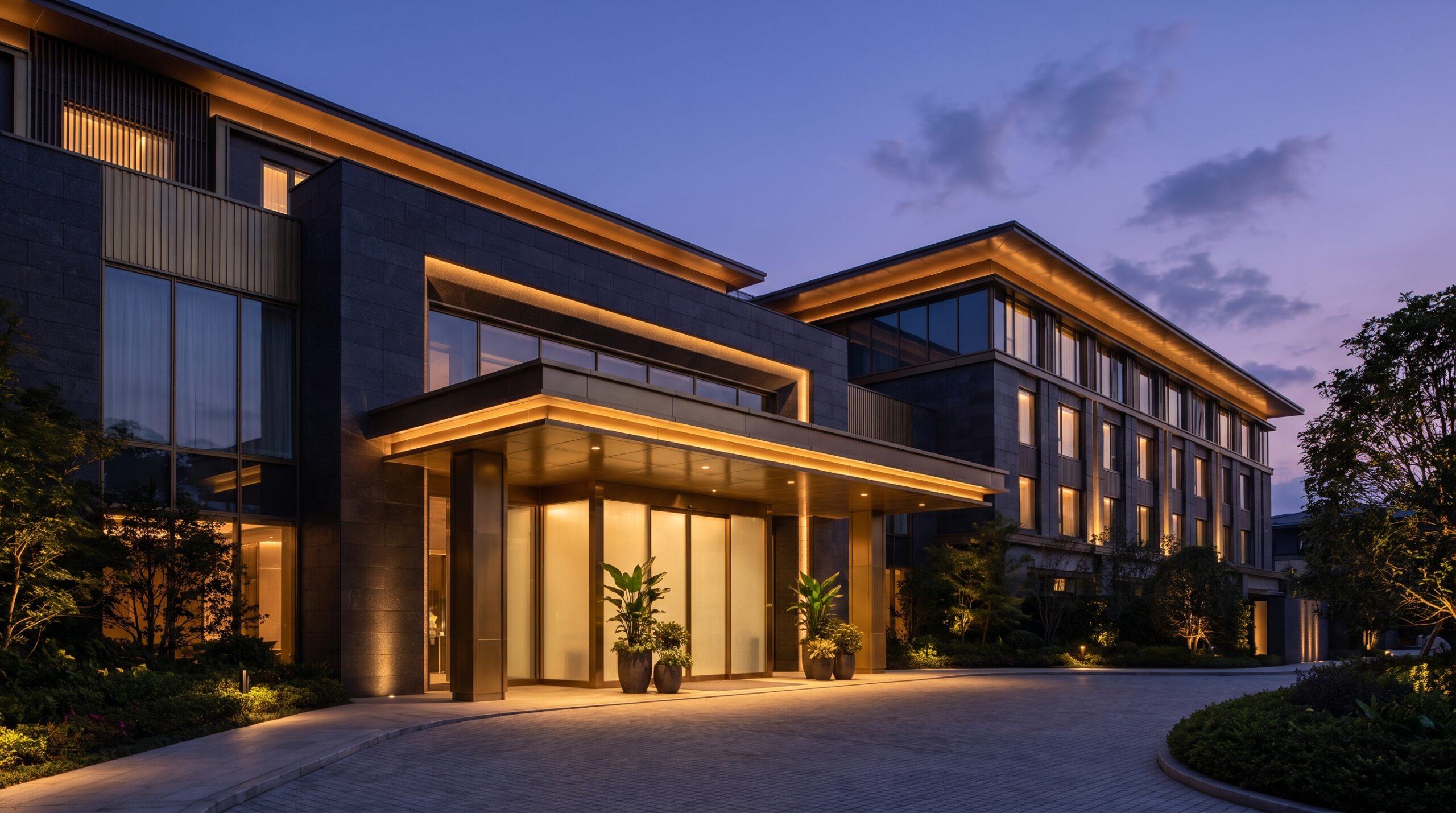
Park Hyatt is the pure-luxury flagship for travelers who want understated, art-forward design and residential-scale service. Andaz is the creative-lifestyle brand for travelers who want personality and place-specific design without the formality. Thompson is the boutique-adjacent urban brand for design-conscious travelers who want hotel-as-scene. Grand Hyatt is the convention-scale workhorse hotels for business and event travel. Hyatt Regency is the reliable mid-tier for logistics-first travelers. Hyatt Centric is the compact urban brand for tourists who want a well-located launchpad and nothing more.
Hyatt operates the smallest footprint of the major hotel loyalty programs — roughly 1,400 properties to Marriott’s 8,800 — but the most valuable points currency per award night. Understanding which brand does what matters because a Park Hyatt and a Hyatt Regency under the same loyalty umbrella are not two versions of the same thing. They are different products for different trips, and booking the wrong one wastes either money or expectations.
The Hyatt Brand Architecture, Tier by Tier
Hyatt organizes its brands into five tiers based on category, service model, and point cost. This framework groups them by what they actually deliver to a guest, not by Hyatt’s internal marketing.
Park Hyatt (Category 7-8, 25,000-40,000 points/night)
What it is: Hyatt’s flagship luxury brand, positioned against Four Seasons, Mandarin Oriental, and the top tier of Ritz-Carlton. Properties are small by luxury-hotel standards — typically 100-200 rooms. Design is contemporary, art-forward, and architecturally intentional. Service is residential-scale: fewer staff per guest than a St. Regis but more personalized interactions. The brand’s highest expression — Park Hyatt Tokyo (Lost in Translation), Park Hyatt Kyoto, Park Hyatt New York — defines the ceiling.
What it actually delivers: Excellent hard product (rooms, bathrooms, public spaces) that prioritizes materials and light over opulence. Better dining on property than the average luxury hotel — many Park Hyatts have destination restaurants. Service that is present without performing. The tradeoff: fewer amenities than a resort brand. No butler service, no children’s programs, no sprawling pool complexes. This is luxury for adults who want quiet and quality, not spectacle.
Best for: Couples, solo travelers, and business travelers who want luxury without crowd. City stays where the hotel is the calm center, not the main event. Not ideal for families needing kids’ clubs or travelers who equate luxury with grand lobbies and visible staffing ratios.
Andaz (Category 5-7, 17,000-30,000 points/night)
What it is: Hyatt’s creative-lifestyle luxury brand, built to compete with EDITION, W Hotels, and the upper end of Autograph Collection. Every Andaz is designed to reflect its specific location rather than a brand template. The brand removes the traditional check-in desk — staff roam the lobby with tablets — and emphasizes local art, open kitchen dining, and informal public spaces.
What it actually delivers: The best-designed rooms in Hyatt’s portfolio at the mid-luxury price point. Mini-bars with non-alcoholic items are free. The lobby-as-living-room concept works when occupancy is moderate and breaks down when the hotel is full. Service style is casual to a fault — some guests find the absence of a front desk disorienting. The best Andaz properties (Tokyo Toranomon Hills, Mayakoba, Amsterdam) compete with Park Hyatts on room quality. The weakest are hotels that feel like upscale Hyatt Regencys with a better furniture budget.
Best for: Design-conscious travelers, creative professionals, guests who want a hotel that feels specific to its city. Not ideal for travelers who want formal luxury service or a traditional check-in experience.
Thompson Hotels (Category 5-7, 17,000-25,000 points/night)
What it is: Hyatt’s boutique-adjacent urban brand, acquired in 2018 and still expanding. Thompson properties are scene-driven: rooftop bars, destination restaurants, lobbies designed to be seen in. The brand competes with Standard Hotels, Soho House, and independent boutique properties.
What it actually delivers: Strong food and beverage — Thompson rooftops and restaurants are often among the best in their neighborhoods. Rooms are stylish but smaller than the luxury tier. Service is competent but not pampering. Noise is a known issue at urban Thompsons — the same scene energy that makes the bar popular makes the rooms above it loud. The brand works best when you want the hotel to be part of the city experience, not a retreat from it.
Best for: Travelers who want a social hotel with strong bar and restaurant programming. Nightlife-first urban stays. Not ideal for light sleepers, families, or anyone seeking quiet luxury.
Grand Hyatt (Category 4-6, 12,000-25,000 points/night)
What it is: Hyatt’s convention-scale flagship brand. Grand Hyatts are big — often 500-1,000+ rooms — and positioned in gateway cities and major business hubs. They are designed for events, conferences, and large-group business travel.
What it actually delivers: Excellent meeting and event infrastructure. Club lounges at most properties (Grand Club) that are among the best in the mid-tier category. Rooms are comfortable and predictable — no design risks, no boutique touches. The tradeoff is scale: a 700-room Grand Hyatt at a conference center is fundamentally a different experience from a 150-room Park Hyatt. Grand Hyatts serve volume. They are very good at it, but volume has limits.
Best for: Business travelers, conference attendees, travelers who want lounge access and predictable quality at a mid-tier point cost. Not ideal for romantic getaways or travelers seeking intimacy.
Hyatt Regency (Category 2-4, 6,500-15,000 points/night)
What it is: Hyatt’s workhorse brand, the largest in the portfolio by property count. Hyatt Regencys are the default business hotel in most markets — reliable, clean, well-located, and unremarkable in the best sense.
What it actually delivers: Consistent mid-tier quality. Rooms are functional and clean. Location is usually good — Regencys tend to be in city centers and near airports. Club lounges at many properties offer breakfast and evening snacks. The brand does not attempt to be anything more than a solid, logistics-first hotel, and it succeeds at that. It is the brand you book when the hotel is not the point of the trip.
Best for: Overnight transits, business trips where you need a reliable base, travelers burning low-category points. Not ideal for travelers who want any kind of experiential stay.
Hyatt Centric (Category 3-5, 9,000-20,000 points/night)
What it is: Hyatt’s compact, urban, tourist-oriented brand. Centric properties are smaller than Regencys, located in walkable central neighborhoods, and designed as launchpads for exploring a city.
What it actually delivers: Great locations — Centrics are placed where tourists want to be, not where convention centers are. Rooms are smaller than Regencys but better designed. The lobby functions as a bar/lounge rather than a formal hotel entrance. Service is limited — fewer staff, fewer amenities — but the price reflects it.
Best for: City-break tourists who will spend minimal time in the room. Travelers who prioritize location and price over service and amenities. Not ideal for business travelers needing workspace or families needing space.
The Points Math: Why Brand Tiers Matter for World of Hyatt Members
Hyatt’s award chart is directly tied to brand positioning. A Category 1 Hyatt Place costs 3,500-6,500 points per night. A Category 8 Park Hyatt costs 35,000-45,000. The value curve is steep: the top-tier properties cost roughly 7-10x the bottom, but the cash-rate difference can be 15-20x. This makes Hyatt points uniquely valuable for luxury redemptions — a 35,000-point Park Hyatt Kyoto night that would cost $1,500 in cash yields roughly 4.3 cents per point, among the highest redemption values in travel loyalty. The flip side: Hyatt has fewer low-category options than Marriott or Hilton, so budget-conscious award travelers have less to work with.
What This Can’t Tell You
Individual properties vary enormously within each brand. An exceptional Hyatt Regency can outperform a mediocre Grand Hyatt. The Park Hyatt brand ceiling is high, but the floor is not zero — a handful of older Park Hyatts trade on the name with rooms that have not been renovated in a decade. This framework covers brand-level positioning. Always check the specific property’s age, recent renovations, and guest reviews before booking. And it does not cover Hyatt’s all-inclusive brands (Ziva, Zilara, Secrets, Dreams), which operate on an entirely different service model.
Verdict
Park Hyatt is the luxury pick — book it for quiet, art-forward stays where the hotel is a destination, not a launchpad. Andaz is the design pick — book it when you want a hotel that reflects its city, not a brand template. Thompson is the scene pick — book it for urban energy and good bars, not for sleep. Grand Hyatt is the business pick — book it for conferences, lounges, and predictable scale. Hyatt Regency is the logistics pick — book it when the hotel is not the point. Hyatt Centric is the tourist pick — book it for location and price, not for amenities. The right question is never “which Hyatt brand is best.” It is “which Hyatt brand fits this specific trip.”
FAQ
Q: Is World of Hyatt worth joining if I do not stay at Hyatts often?
A: Yes, if you can earn transferable points (Chase Ultimate Rewards transfers 1:1 to Hyatt). Hyatt points are the most valuable hotel currency per unit. Even occasional stays — especially at Park Hyatts and top-category Andaz properties — justify membership. If you earn points only through paid stays and stay fewer than 10 nights per year, Marriott or Hilton offer more earning opportunities.
Q: What is the difference between a Grand Hyatt and a Hyatt Regency in practice?
A: Scale and event infrastructure. Grand Hyatts are larger, have more meeting space, and typically have better club lounges. Hyatt Regencys are smaller, more numerous, and positioned for individual business travelers. The room product is similar at both — the difference is the building around the room.
Q: Which Hyatt brand is best for families?
A: Grand Hyatt (space, pools at resort locations, club lounge breakfast) or Hyatt Regency (reliable, predictable, often has connecting rooms). Park Hyatt and Andaz are not designed for children. For resort families, Hyatt’s all-inclusive brands (Ziva, Zilara) are purpose-built for the use case.
Q: Are Andaz hotels as luxurious as Park Hyatts?
A: Sometimes on room quality, rarely on service. The best Andaz properties have rooms that compete with Park Hyatts, but the service model is lower-touch and the amenities are fewer. Andaz is luxury-adjacent, not luxury flagship.