Mexico City is the better cultural base for most first-time visitors to central Mexico. It has superior flight access, a broader hotel market, stronger English-language infrastructure, and enough cultural density to fill two weeks without repeating yourself. Oaxaca is the better base if your trip is five days or fewer, your primary interest is food and craft culture, and you want a single compact city where you can walk to everything. For trips of 10 days or more, the correct answer is usually both, with Mexico City as the anchor.
These are not sibling cities fighting for the same traveler. Mexico City operates at metropolitan scale: 22 million people, world-class museums, canteens and tasting-menu restaurants in the same block, neighborhoods that feel like separate cities. Oaxaca operates at human scale: a walkable centro, market stalls and mezcalerias, artisan villages 30 minutes away. The choice is not about which city is better. It is about which city matches your trip length, your appetite for logistics, and what you want your days to look like.
The Variables That Matter
Trip length. Mexico City needs four days minimum to cover the core: Centro Historico, Chapultepec museums, Roma/Condesa, and either Coyoacan or Xochimilco. At seven days you add Teotihuacan and a deeper neighborhood rotation. At 10 days you are still discovering. Oaxaca’s core is compact: three days covers the centro, the Santo Domingo cultural complex, Monte Alban, and a few markets. Five days lets you add artisan villages and a cooking class. After five days, Oaxaca rewards slowing down but does not reveal new categories of experience. Mexico City keeps unfolding.
Hotel market. Mexico City has the deepest hotel bench in Latin America outside Sao Paulo. You can stay in a $500-per-night Four Seasons on Paseo de la Reforma, a $180 design hotel in Roma Norte, or a $70 boutique in Juarez that outperforms its price. Oaxaca’s hotel market is concentrated in the centro and divided into two tiers: charming courtyard properties in the $150 to $300 range, and budget options that require tradeoffs on noise, hot water, and bed quality. Oaxaca has no true luxury property at the Four Seasons or St. Regis level. If your hotel is central to your trip experience, Mexico City offers more range at every price point. We have covered the logic of booking direct versus using an OTA elsewhere; in both Mexico City and Oaxaca, the boutique properties that dominate the market often offer better rates and inclusions through their own sites.
Food. Both cities are world-class eating destinations, but the structure is different. Mexico City is a volume play: you can eat at a different excellent restaurant for every meal for a month and not repeat yourself. The street food, the mercado fondas, the midrange contemporary places, and the Pujol/Quintonil tier all deliver. Oaxaca’s food culture is deeper per square block but narrower in total range: moles, tlayudas, memelas, chapulines, and the seven canonical mole varieties dominate. You will eat extremely well in Oaxaca, but you will eat a narrower band of the Mexican repertoire.
Mexico City as a Base
Mexico City rewards the traveler who likes cities as cities: transit, walking, neighborhoods that shift character every 20 blocks, and the sense that you are only scratching the surface. It has the best museums in Latin America: the Museo Nacional de Antropologia alone merits a full morning, and the Chapultepec complex could fill two days. The architecture spans Aztec ruins, Spanish colonial, Art Deco, and contemporary. The cultural production, from gallery openings to independent theater to electronic music, operates at a global-city level.
The logistical tradeoff is real. Mexico City’s traffic is punishing, and the metro, while extensive, can be overwhelming for first-time visitors during rush hour. Uber is inexpensive by North American standards and is the default for most visitors, but a crosstown trip from Condesa to Centro Historico can still take 40 minutes. The altitude, at 2,250 meters, affects some visitors for the first 24 to 48 hours. And the sheer size of the city means you will spend meaningful time in transit every day.
Safety perception is the primary concern travelers raise. The data is clear: the neighborhoods where visitors spend their time — Roma, Condesa, Polanco, Juarez, Centro Historico, Coyoacan — are broadly safe during daylight and evening hours with the same precautions you would take in any large city. The security challenge in Mexico City is property crime, not violent crime against tourists. Phone snatching is a real risk on crowded transit and in Centro Historico side streets after dark. The solution is not avoidance; it is awareness and the same practices you would use in Barcelona or Rio.
Oaxaca as a Base
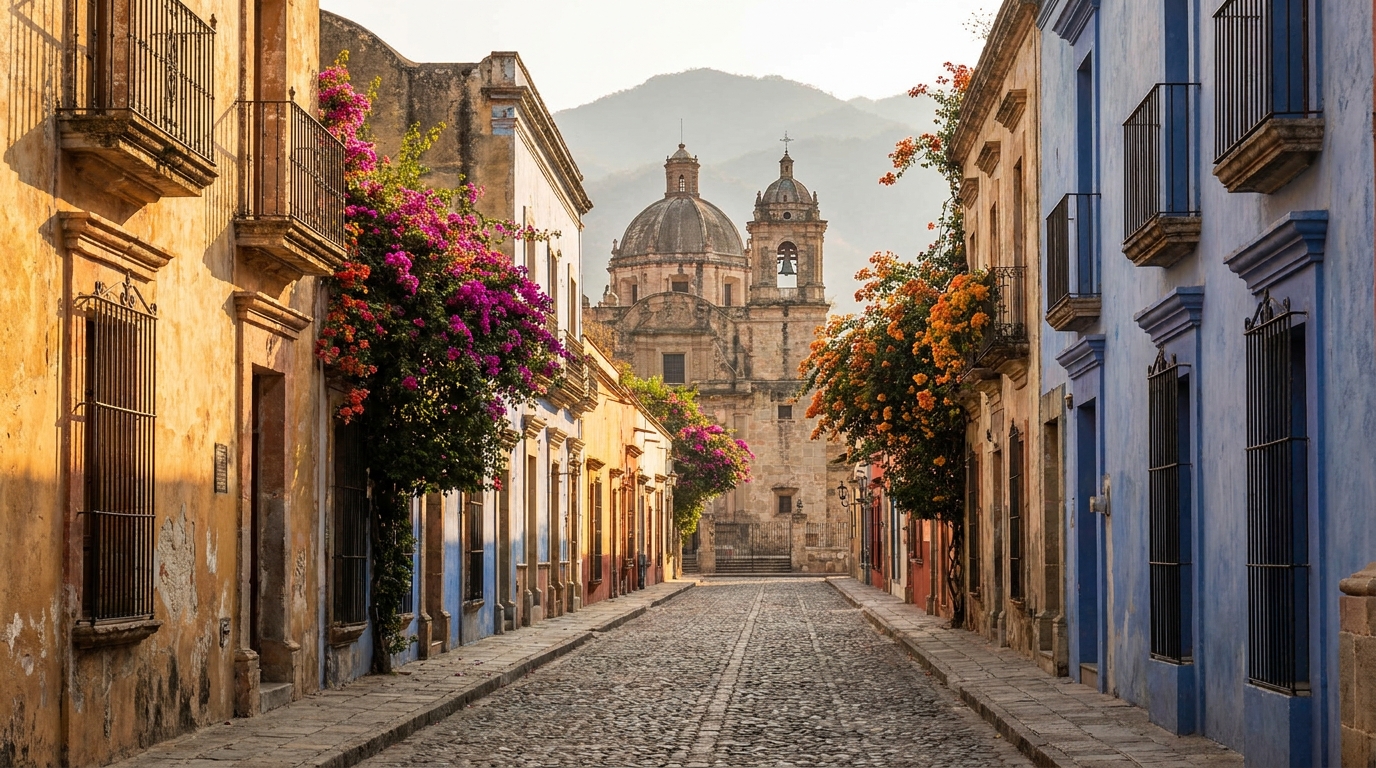
Oaxaca is what travelers imagine a Mexican cultural city should feel like. The centro is built from green volcanic stone, organized around the Zocalo and the Santo Domingo complex, and almost entirely walkable. You can navigate the city without a car, without transit, and without ever opening a ride-hailing app. The rhythm is slower: mornings at markets, afternoons at Monte Alban or a weaving village, evenings in a mezcaleria with the doors open to the street.
The artisan economy is the strongest reason to choose Oaxaca over Mexico City for a short trip. The villages around the city — Teotitlan del Valle (weaving), San Bartolo Coyotepec (black pottery), San Martin Tilcajete (alebrijes) — offer a direct craft-to-maker pipeline that does not exist at comparable quality anywhere near Mexico City. A half-day trip gets you into a workshop talking to the artisan. In Mexico City, the craft experience is mediated through galleries and museum shops. In Oaxaca, you can buy directly from the hands that made the object.
The weakness of Oaxaca as a base is its limited reach beyond the craft-and-food circuit. If your interests include contemporary art, architecture, music, fashion, or design, Oaxaca has pockets of each but nothing approaching Mexico City’s depth. You exhaust Oaxaca’s primary cultural offerings faster than you expect. For the right traveler, that is the point: Oaxaca is a city to settle into, not a city to conquer. But if you are the kind of traveler who wants a new neighborhood every day, Oaxaca is not big enough.
Safety and Logistics: The Honest Version
The State Department guidance for Mexico is granular by state, and the distinction matters. Mexico City, like most global capitals, has neighborhoods where visitors should not wander at night. The visitor zone (Roma, Condesa, Polanco, Juarez, Centro Historico, Coyoacan, San Angel) is well-policed and accustomed to international visitors. The risk profile is comparable to London or New York.
Oaxaca State is under a lower-level advisory than several surrounding states, but the caution is about highway travel and remote areas, not the city itself. Oaxaca City is broadly safe. For a comparison of how safety, logistics, and trip infrastructure stack up against coastal Mexico, see our assessment of Tulum versus Riviera Maya. The concern visitors should actually plan around is altitude sickness in Mexico City, not crime in Oaxaca. Give yourself 24 hours of reduced activity in CDMX. Drink water. The headache resolves.
Verdict
You have 4 to 6 days. Pick Oaxaca. The flight connection from the US is typically through Mexico City, Dallas, or Houston, and the Oaxaca airport is 25 minutes from the centro. You land, you are in your hotel within 45 minutes, and you are walking to dinner. Mexico City on a five-day timeline means choosing what to skip, and the things you skip will be good enough that you will regret the choice.
You have 7 to 10 days. Mexico City as the anchor, with the understanding that you will not see everything. Spend the days in depth rather than breadth: three neighborhoods, two museum complexes, one day trip to Teotihuacan. Do not try to add Oaxaca on a seven-day trip; the half-day transit each way costs too much.
You have 10 to 14 days. The ideal split: seven to eight days in Mexico City, four to five in Oaxaca. Fly into MEX, take the approximately 70-minute flight to OAX mid-trip, and fly out of OAX or back through MEX depending on your international routing. The domestic flight on Aeromexico or Volaris typically costs $80 to $150 round-trip booked a few weeks ahead. The bus takes six to seven hours and is not a good use of limited vacation time.
You are a solo traveler. Mexico City offers more infrastructure for solo dining and socializing. Oaxaca is safe for solo travelers but feels quieter after dark; the city’s social life revolves around groups and couples sharing mezcal, and a solo traveler may find evenings slower than expected.
Your primary interest is food. Mexico City for breadth, Oaxaca for depth. If you want to understand the range of Mexican cuisine, from Baja seafood to Yucatecan cochinita to contemporary fine dining, choose Mexico City. If you want to go deep on one region’s traditions, moles, and market culture, choose Oaxaca. The ideal trip does both: Mexico City first to establish the national range, then Oaxaca to see how one region pushes the same ingredients further.
FAQ
Q: Can I drive between Mexico City and Oaxaca?
A: The drive takes roughly five and a half to six hours on the toll highway (the cuota) via the 150D and 135D. The road is well-maintained and safe during daylight. Do not drive at night, not because of crime risk but because of livestock on the road, unlit speed bumps in villages, and limited services. For most visitors, the 70-minute flight is a better use of time and costs only marginally more than a rental car plus tolls plus fuel.
Q: Is Mexico City too dangerous to visit right now?
A: No. The neighborhoods where visitors spend their time have a safety profile comparable to major European and American cities. Exercise the same judgment about walking alone late at night and keeping valuables secure that you would in any large city. The safety conversation around Mexico City is significantly more alarming in media coverage than it is on the ground in the visitor districts.
Q: Is Oaxaca too small for a week-long trip?
A: If your travel style is destination-dense and you want new neighborhoods, museums, and venues every day, yes. If your travel style is slow mornings, market walks, afternoon excursions, and long dinners, Oaxaca fills a week comfortably. Know your own pace before you book.
Q: Which city has better weather?
A: Mexico City is cooler year-round due to altitude; daytime highs rarely exceed 26 degrees Celsius even in summer, and evenings require a jacket. Oaxaca is warmer and drier; daytime highs in the 28 to 32 degree range are common. Neither city has a bad season in the way that coastal Mexico does with hurricane risk, though Mexico City’s rainy season (June through September) means afternoon downpours that clear by evening.