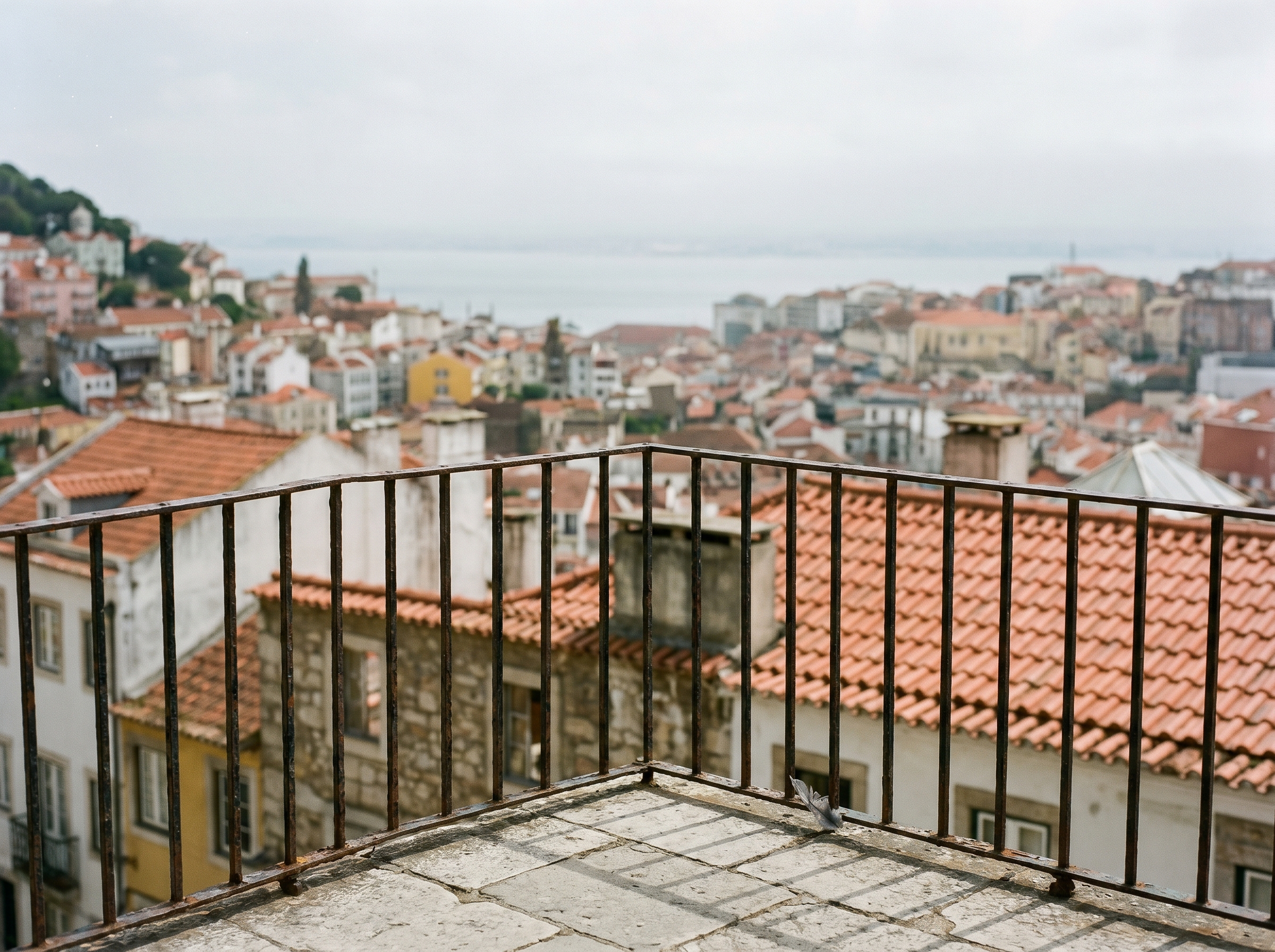
Both cities have been over-explained. Lisbon is cast as the soulful underdog: worn tiles, Atlantic light, cheap enough to feel like a discovery. Madrid is the confident capital: museums, late nights, restaurants that do not open until ten. Neither framing is wrong. Neither framing is useful.
The question is not which city is better. It is which city is right for a specific traveler, at a specific budget, with a specific window of time. That is the only question this piece answers.
What Each City Actually Is
Lisbon is a walkable Atlantic capital of roughly 500,000 built on seven hills above the Tagus estuary, organized around neighborhoods that function as distinct villages. Chiado is polished, literary, and expensive by Lisbon standards. Alfama is steep, tourist-dense at its center, and genuinely residential at its edges. Príncipe Real is the city’s quietest, most gallery-dense quarter — the neighborhood closest to a slow European ideal. Intendente is still raw, immigrant-community-anchored, and home to the best cheap lunch in the city. The scale is human. You can cover most of it on foot and by tram if you have patience for the hills and the polished cobblestones underfoot.
Madrid is a flat inland capital of 3.3 million that operates at a categorically different register. The Museo del Prado, the Museo Reina Sofía, and the Thyssen-Bornemisza form one of the three or four strongest museum clusters in the world — that is not a superlative, it is a factual differentiator grounded in collection depth and scholarly consensus. The food culture runs deeper than the international shorthand of tapas suggests: Malasaña and Lavapiés carry serious restaurant depth at mid-range prices, while Salamanca functions as a full luxury dining district. The city stays open later than anywhere else in Western Europe. If rhythm matters to how you experience a city, Madrid’s rhythm is unlike anything comparable on the continent.
These cities do not compete. They offer different things at different scales.
Getting There from North America
Both cities are increasingly well-served from North American gateways, but Madrid has the connectivity advantage in 2026.
Madrid (MAD): Iberia is executing a significant North American expansion anchored at the Madrid hub. The airline launched daily Madrid-Newark service on March 29, 2026 using the Airbus A321XLR, adding to existing Madrid-JFK operations and growing overall transatlantic capacity significantly in summer 2026 with multiple new routes. Toronto joins the network in June 2026. The joint business agreement with American Airlines further extends the reach of one-stop Madrid itineraries across the US.
Lisbon (LIS): TAP Air Portugal maintains a wide but narrower North American footprint from Lisbon, serving Boston, New York, Newark, Washington, Chicago, San Francisco, Los Angeles, and Miami. A new Lisbon-Orlando service launches October 29, 2026, operating three times weekly and adding a leisure market gateway. TAP’s Lisbon hub produces competitive connections into Portugal and onward to Porto, but the raw number of US gateways served is smaller than Madrid’s.
For travelers originating outside the major northeastern US hubs, Madrid is typically easier to connect to in 2026. For East Coast travelers, both cities are well-served by nonstop options.
The Budget Comparison
As of early 2026, Lisbon holds a meaningful cost advantage at the mid-range tier. The gap at the luxury tier is narrower.
| Category | Lisbon (mid-range) | Lisbon (luxury) | Madrid (mid-range) | Madrid (luxury) |
|---|---|---|---|---|
| Hotel / night | €130-€200 | €350-€500+ | €160-€220 | €400-€700+ |
| Dinner for two | €55-€85 | €150-€240 | €65-€95 | €180-€300 |
| Day transit pass | €6.45 (Carris/Metro) | — | €8.40 (metro day pass) | — |
| Museum entry (per person) | €0-€15 | €15-€25 | €0-€18 | €18-€35 |
| Daily total, 2 people (mid-range) | €260-€400 | — | €330-€480 | — |
Pricing reflects reported 2026 ranges. Rates vary by season, neighborhood, and booking window. The luxury tier upper end has no reliable ceiling in either city.
A well-reviewed boutique property in Príncipe Real or Chiado — the Memmo Alfama, As Janelas Verdes, or the Bairro Alto Hotel at its lower tier — will run €150-€220 per night. The equivalent positioning in central Madrid starts at €160 and rises faster. At the luxury end, the Verride Palácio Santa Catarina or the Bairro Alto Hotel at its upper tier runs €350-€500; Madrid’s entry points at the same standard — the Rosewood Villa Magna, Mandarin Oriental Ritz, or the Santo Mauro — begin at €400 and have a higher ceiling.
Food costs track similarly. A proper dinner in Chiado costs €60-€85 for two with wine. The same quality level in Malasaña or Chueca runs €70-€95. The differential is real but not decisive for most travelers. Where Lisbon’s cost advantage is most pronounced is in the everyday layer: market lunches, café stops, transit, and museum entry. Madrid’s higher floor is a function of scale, not inflation.
Museums and Cultural Infrastructure
This is where the comparison is least close.
Madrid has one of the most concentrated museum corridors in the world. The Prado holds more than 7,600 works on display, with Velázquez, Goya, and El Greco at a depth that cannot be assembled elsewhere. The Reina Sofía anchors the 20th century — Guernica in situ, the Spanish surrealists, a serious contemporary collection. The Thyssen-Bornemisza covers the gap between the two: Impressionism, German Expressionism, American abstraction. A serious visitor could spend three to four days in this corridor alone without redundancy. Note that the Prado drew an estimated 3.5 million visitors in its most recent peak year, and its director has publicly flagged overcrowding concerns as of January 2026. Pre-booked timed entry is now effectively required for peak periods.
Lisbon has the Gulbenkian Collection — genuinely one of the broadest private collections assembled in the 20th century, covering Egyptian antiquities through Impressionism with unusual coherence — and the MAAT (Museum of Art, Architecture and Technology) on the Tagus waterfront. The Museu Nacional do Azulejo is the most underattended decorative-arts institution in Western Europe: five centuries of Portuguese tile tradition in a 16th-century convent, with almost no queues. One critical 2026 update: the Gulbenkian’s main collection gallery is closed for renovation through July 2026. Visitors this year access the Centro de Arte Moderna (CAM) and the Foundation gardens, which are high quality but not the full experience. Verify current reopening status before planning.
For any traveler whose primary agenda is fine art, Madrid is the correct choice. It is not close.
Food Scene Depth
Madrid has the stronger restaurant infrastructure across every price tier. Michelin’s Spain 2026 edition recognizes approximately 120 restaurants in the Madrid region, including multiple three-star venues in the city. The mid-range depth in Malasaña and Lavapiés is what actually differentiates Madrid for day-to-day eating: serious restaurants at €30-€45 per person, operating without the tourist-facing softening that affects Chiado and Alfama in Lisbon. The mercados — Mercado de Vallehermoso over San Miguel for a working market rather than a tourist attraction — add another layer of quality at low cost.
Lisbon has three two-star Michelin restaurants in 2026 (Fifty Seconds, Alma, Belcanto), which anchor a respectable upper tier. The broader one-star ecosystem is solid. The everyday food culture — pão de centeio, bacalhau preparations, pastéis de nata at the source, the petiscos tradition — is its own distinct argument and is not replicated in Madrid. Seafood quality in Lisbon is structurally better than in an inland city: the Setúbal coast is 45 minutes away, and the fish market supply chain reflects it.
For travelers whose primary activity is eating well across a range of price points and contexts, Madrid has the structural advantage. For travelers who care specifically about seafood, pastry, and the textures of Portuguese food culture, Lisbon earns its place.
Walkability and Transit
Lisbon is walkable in the way that a terraced hillside city is walkable: rewarding, slow, and hard on the ankles. The Alfama requires either Tram 28 (€3 paid on board; a Carris/Metro day pass at €6.45 covers unlimited tram and metro rides) or a deliberate approach to elevation. Baixa and Chiado are flat, well-connected by two metro lines, and function as the most practical base for visitors who want to move efficiently. The city is small enough that most major sights fall within a 30-minute walk or a 10-minute tram ride from a central base.
Madrid is flat, which changes the experience entirely. The metro is one of the most legible and well-maintained systems in Europe — 13 lines, 302 stations, a day pass at approximately €8.40. The central neighborhoods (Malasaña, Chueca, La Latina, Salamanca) are walkable between each other without transit, and the Paseo del Prado corridor from the Reina Sofía to the Prado to the Thyssen is a 15-minute walk that does not require a map. Madrid’s scale is larger than Lisbon’s, but the absence of hills and the quality of the metro means that physical fatigue is a lesser factor.
Nightlife
Madrid’s nightlife operates in a different category. Restaurants in Malasaña and Chueca do not fill until 10pm. Clubs in La Latina and the electronic venues in Lavapiés run until 6am on weekends. The street-level bar culture across the central neighborhoods has a duration and density that no other major Western European city matches. This is not a matter of preference — it is a structural feature of the city’s social calendar, driven by deeply embedded dining and leisure rhythms that predate tourism.
Lisbon’s nightlife is strong. Bairro Alto functions as a concentrated bar district in the evening, and Cais do Sodré — anchored by the Pink Street and the cluster of venues around Mercado da Ribeira — has genuine energy until the early hours. LX Factory on Sundays is a different kind of cultural infrastructure. But the scale, duration, and city-wide reach of Lisbon’s night scene does not compete with Madrid’s. A traveler whose primary goal is nightlife should choose Madrid without deliberation.
Day-Trip Radius
Lisbon’s day-trip radius is underrated and significantly less crowded than Madrid’s equivalents.
- Sintra: 40 minutes from Rossio station by suburban rail, departing every 20 minutes, at approximately €2.50 each way. The Pena Palace is the obvious draw and is very crowded. A more considered visit skips the palace queue and goes instead to the Capuchos Convent or the Peninha Sanctuary — same geological drama, almost no other visitors.
- Arrábida Natural Park: A 40-minute drive south (or organized day trip), offering Atlantic coast scenery that ranks among the least-visited dramatic coastlines in Western Europe. No rail service; a car or organized transfer is required.
- Porto: The Alfa Pendular covers the Lisbon-Porto route in approximately 2 hours 40 minutes, departing from Oriente or Santa Apolónia. Second-class fares start at approximately €28-€35; first class runs €45-€50. Porto is too substantial for a single day trip — a one-night minimum produces a genuinely different experience. CP has added Alfa Pendular services on peak days in 2026.
- Setúbal and Azeitão wine country: Less than an hour from central Lisbon by road. Working quintas, small co-ops, and a regional food tradition that gives Lisbon restaurants their best ingredients.
Madrid’s day-trip infrastructure is defined by high-speed rail and canonical destinations.
- Toledo: 33 minutes from Atocha by high-speed train. A fully intact medieval city with a Gothic cathedral, Alcázar, and El Greco’s The Burial of the Count of Orgaz in situ in the Iglesia de Santo Tomé. One of the strongest day-trip returns in Europe relative to the transit time invested.
- Segovia: 27 minutes from Chamartín. Roman aqueduct, a 15th-century Alcázar, and a roast lamb tradition (cochinillo and cordero at Mesón de Cándido) that rewards the trip independently of the monuments.
- El Escorial: 55 minutes by regional rail from Atocha. The monastery-palace complex is architecturally singular — severe, vast, and unlike anything else built in the 16th century. Not a full-day destination for most visitors, but pairable with the Valley of the Fallen.
- Barcelona: 2 hours 30 minutes by nonstop AVE from Atocha. Feasible as a long day trip; more practical as a two-night extension.
Both cities have strong day-trip ecosystems. Lisbon’s are less crowded. Madrid’s are faster to access by rail and carry higher name recognition.
By Traveler Type
The museum and art traveler belongs in Madrid. The Prado-Reina Sofía-Thyssen corridor alone represents access to cultural depth that is not replicated anywhere else in Southern Europe. Plan around the Prado’s crowding: pre-book timed entry, arrive at opening, and allow at least three hours for the permanent collection before considering temporary exhibitions.
The architecture and craft traveler belongs in Lisbon. The azulejo tradition covers entire building facades, public interiors, and the Museu Nacional do Azulejo in a 16th-century convent. The Manueline stonework at Jerónimos Monastery in Belém is the only surviving concentration of its style. Neither of these categories has a meaningful equivalent in Madrid.
The food-forward traveler is better served by Madrid across all price tiers. The range and depth of mid-range restaurants in Malasaña and Lavapiés, the operational density of the food scene, and the mercado infrastructure give Madrid a structural advantage. Lisbon is the right choice if the food agenda is specifically Portuguese — seafood, bacalhau, regional pastry, Alentejo wine — rather than European restaurant depth.
The solo or slow traveler prioritizing livability is better served by Lisbon. The city is human-scaled, the café culture is functional rather than performative, and the pace of daily life is slower by the standards of any European capital. Co-working infrastructure is strong. The expat and digital nomad community is present without being suffocating. Madrid is a major European capital that runs fast; it is not a slow city.
The couple on a four-to-six day city break faces the only genuinely close call in this comparison. Both cities perform well at this trip length. The tiebreaker is rhythm: late nights and restaurant energy point to Madrid. A quieter pace with outdoor escapes — Sintra, Cascais, Arrábida — points to Lisbon.
The nightlife-focused traveler should choose Madrid with no ambiguity.
What the Second Week Looks Like
Most travel coverage stops before this question. It is the most useful one.
Second week in Lisbon broadens outward. The city’s day-trip radius expands the longer you stay: the Arrábida coast, the Azeitão wine route, Sesimbra (a working fishing village with a functioning Moorish castle above the beach, largely ignored by international visitors), and the Alentejo interior within two hours. The city itself rewards slower exploration — the Museu Nacional do Azulejo alone justifies a full afternoon. Príncipe Real’s gallery scene, small but coherent, is best absorbed over multiple visits rather than a single afternoon. The pace of Lisbon’s second week is materially calmer than the first.
Second week in Madrid deepens inward. The city does not run out. Skip the tourist markets — eat where locals queue. Lavapiés over Malasaña as the neighborhood with more genuine daily life and less tourist-facing optimization. The Sorolla Museum: two hours, arrive before 11, leave with a different understanding of how Spanish light was handled before the 20th century turned elsewhere. A Real Madrid or Atletico match at the Bernabéu or Metropolitano, which functions as a genuine cultural event rather than a tourist itinerary item. The Retiro park at 8am before the weekend crowds arrive. Madrid’s second week is denser than the first.
The Tradeoffs, Stated Plainly
| Axis | Lisbon | Madrid |
|---|---|---|
| Museum depth | Narrower — Gulbenkian (closed through July 2026), MAAT, Azulejo Museum | Exceptional — Prado, Reina Sofía, Thyssen |
| Food scene depth | Strong for Portuguese specifically; limited restaurant density overall | Deep across all price points and cuisines |
| Cost advantage | Clear at mid-range, especially accommodation | Higher floor, comparable ceiling at luxury |
| Walkability | Human-scaled; hills require planning | Flat, metro-efficient, larger footprint |
| Day-trip quality | Underrated, less crowded, more varied in type | Canonical, faster by rail, stronger name recognition |
| Nightlife | Strong but bounded — Bairro Alto, Cais do Sodré | Categorically different scale and duration |
| North American flights | Solid TAP network, expanding (Orlando Oct 2026) | Broader — Iberia’s aggressive 2026 expansion |
| Second week | Broadens outward: coast, wine country, nature | Deepens inward: more culture, more neighborhoods |
| Architectural distinction | Manueline stonework, azulejo tile tradition — singular | Significant heritage but less formally distinct |
| Pace and energy | Slow, livable, deliberately human | High-energy, operationally dense, late-night-oriented |
Verdict
Choose Madrid if your trip is anchored in fine art, you travel primarily to eat well across a range of restaurant types, you want the highest-energy major city in Western Europe, or you are the type of traveler who measures a city by whether it can exhaust you. The Prado alone represents cultural access that cannot be replicated elsewhere. The food scene at every price tier is among the strongest on the continent. The nightlife requires no qualification. Madrid is the correct choice for any trip built around cultural density or culinary range.
Choose Lisbon if you are traveling for two weeks or more, your pace is deliberately slow, the ability to leave the city and avoid crowds matters to your planning, or architectural specificity is the trip’s primary frame. Lisbon also wins when the cost differential at mid-range accommodation is a real planning variable — the gap is meaningful over a week. One 2026-specific note: the Gulbenkian’s main collection is closed through July 2026. Travelers for whom the Gulbenkian is a primary draw should time accordingly or build their museum itinerary around the MAAT and the Azulejo Museum instead.
The piece of travel writing that describes Lisbon as “underrated” is describing a city that has not been underrated since approximately 2016. The piece that calls Madrid “intimidating” is describing the most navigable major European capital on earth. Both framings are false. Both cities are good. The question is what the trip is built around — and on that question, the answer is not close.